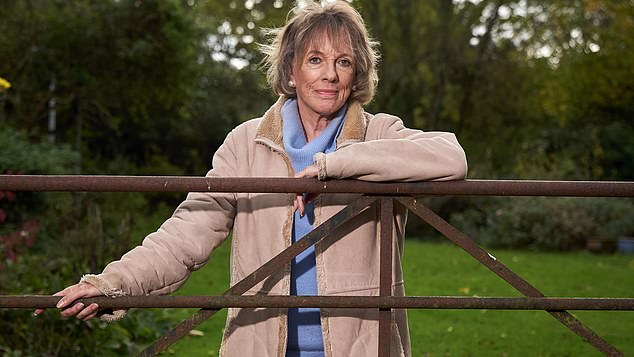

Dame Esther Rantzen has been criticised by MPs for claiming that they oppose plans to legalise assisted dying because they have ‘undeclared religious beliefs’.
The terminally ill television presenter and campaigner made the comments in a letter to politicians ahead of a debate on the legislation in Parliament today.
She said that because of these believes ‘no precautions would satisfy them’ enough to support allowing people to seek help to end their own lives.
However, her suggestion sparked a furious response from MPs opposed to the Terminally Ill Adults (End of Life) Bill.
Labour’s Jess Asato asked the bill sponsor Kim Leadbeater to distance herself from the remarks, adding: ‘Many colleagues found this distasteful and disrespectful.’
And her Labour colleague Florence Eshalomi added: ‘As politicians we have to be clear that members with valid concerns about this bill are not raising it because of some ideology or religious belief.
‘It is because we recognise that if this bill passes it may impact everyone, not that those who may choose to die…
‘It is frankly insulting to disabled people, hardworking professionals up and down the country who have raised many valid concerns about this Bill, to have it dismissed as religious beliefs.’
Protesters for and against the law change gathered in Westminster this morning ahead of a five-hour session in the Commons during which various amendments to the law will be debated and voted on by MPs.

The terminally ill television presenter and campaigner made the comments in a letter to politicians ahead of a debate on the legislation in Parliament today.

Protesters for and against the law change gathered in Westminster today ahead of a five-hour session in the Commons during which various amendments to the law will be debated and voted on by MPs.

Florence Eshalomi said: ‘It is frankly insulting to disabled people, hardworking professionals up and down the country who have raised many valid concerns about this Bill, to have it dismissed as religious beliefs.’
But the final vote on whether to bring it into law has been delayed until late next month due to the amount of amendments and debate.
Writing to MPs who must decide whether to allow people to seek help to end their own lives, Dame Esther, who has cancer, wrote: ‘There are some who oppose this crucial reform. Many of them have undeclared personal religious beliefs which mean no precautions would satisfy them.’
Speaking outside Parliament her daughter Rebecca Wilcox said : ‘I’m just hoping that the MPs today see common sense that we should have choice at the end of our lives.
‘We should be able to have a pain-free, caring, compassionate death.
‘I only wish I could get that for my mother, and I know that the peace of mind that would come with that would be huge, because that’s what’s missing from her life at the moment, she has no idea what’s coming around the corner.
‘She has no idea how her body is going to respond to the cancer.’
Doctors have become the latest professionals to voice their concern about plans to legalise assisted dying, as the legislation returns to the Commons.
The Royal College of Physicians (RCP) has said it believes there are ‘concerning deficiencies’ with the proposed Terminally Ill Adults (End of Life) Bill.
Its intervention came after the Royal College of Psychiatrists (RCPsych) said it has ‘serious concerns’ and cannot support it.
Concerns have been raised over the speed at which the law is being taken through and fears over safeguards for vulnerable people.
Several MPs who backed it in an initial vote in November have now said they will oppose it.
But PM Sir Keir Starmer, who will miss the votes on a trip to Albania, has indicated he remains supportive of the proposed legislation.
New Reform MP Sarah Pochin has also confirmed she will support it, while Nigel Farage is opposed.
Opening the report stage debate today, bill sponsor Kim Leadbeater said many have ‘lost loved ones in deeply difficult and traumatic circumstances’.
The Labour MP for Spen Valley told the Commons: ‘Put simply, if we do not vote to change the law, we are essentially saying that the status quo is acceptable.
‘Over recent months, I have heard hundreds of stories from people who have lost loved ones in deeply difficult and traumatic circumstances, which show that that is clearly not the case.
Last night the Mail revealed the Government had quietly admitted it had got key figures related to the legislation wrong.
On the eve of the controversial legislation returning to Parliament, the official forecast of how many people are likely to seek to end their own lives was corrected – but MPs were not alerted.
The final page of the Impact Assessment carried out by the Department of Health and Ministry of Justice, which was controversially published late on the day of the local election results, was updated to state: ‘Since publication on 02 May 2025, two errors have been identified and corrected.’

The legislation is being led by backbench Labour MP Kim Leadbeater in a Private Members’ Bill rather than by the Government
It explained that the wrong period of time was used to collate figures of recent assisted deaths in Oregon and so the prediction for England and Wales was incorrect.
Under the revised figures, up to 647 deaths are expected in the first half-year of the scheme rather than 787 and 1,078 applicants are expected instead of 1,311.
Campaigners told the Mail the that error highlighted the ‘chaotic’ nature of the legislation, which is being led by backbench Labour MP Ms Leadbeater in a Private Members’ Bill rather than by the Government.
She has repeatedly made major changes to the plan, such as removing the role of High Court judges to approve applications, and has continued to table amendments to it until this week.
In their position statement on Thursday, the RCP said despite changes to the Bill in recent months which supporters argue have strengthened it, the college believes ‘there currently remain deficiencies that would need addressing to achieve adequate protection of patients and professionals’.
It said there are ‘key factors’ which must be in place should assisted dying be legalised.
But MPs with a medical background have urged a law change.A statement, signed by supportive MPs including doctors Neil Shastri-Hurst, Simon Opher and Peter Prinsley, insisted ‘most healthcare professionals understand that the current law is not working’, that it ‘criminalises compassion’, places clinicians ‘in an impossible position’ and cannot be tolerated or defended.
Expressing continued hope that her Bill can keep making progress through Parliament, Labour MP Ms Leadbeater said proceedings in the Commons will be watched by terminally ill people and bereaved family members ‘who are counting on us to make our law better, safer and kinder – not just for them but for all of us, whatever we might choose’.
In a comment piece in the Mirror newspaper, she said: ‘We are closer than ever to achieving the change the British public have long been calling for.’
She insisted the Bill is ‘even stronger’ than it was back in November, and ‘goes further than any other around the world in its safeguards, oversight and regulation’.