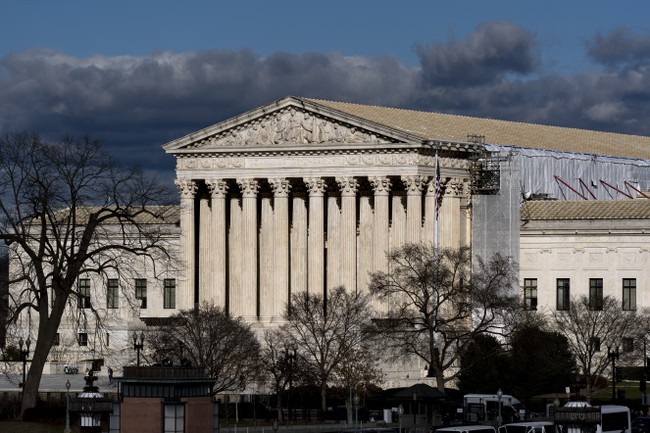

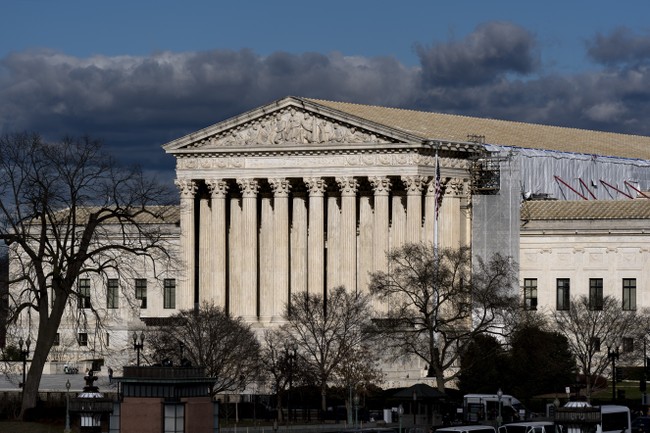
Until today, the presumption from earlier Supreme Court rulings had been that the Humphrey’s Executor precedent had reached the “go through its pockets and look for loose change” stage. Beginning in May, a series of rulings and temporary actions certainly made it seem as though the 1935 decision had one foot in the grave and the other on a banana peel.
Today, however, oral arguments gave the distinct impression that the court may see Humphrey’s Executor as only mostly dead. And at least one justice – Brett Kavanaugh – raised the question as to whether it applies to the FTC in the first place.
At issue in today’s argument was Donald Trump’s firing of Federal Trade Commissioner Rebecca Slaughter, a Democrat appointee and one of several members of supposedly “independent” agencies that Trump has removed from office. The administration argued that the exercise of executive authority by such agencies makes their officers directly accountable to the president, in whose office all Article II powers reside. Slaughter’s attorney Amit Agarwal – a former clerk for Justices Alito and Kavanaugh – argued that there was no limiting principle to this argument, and ninety years of precedent under Humphrey’s Executor produced regulatory stability and cooperation:
The case involves Mr. Trump’s firing of a commissioner on the Federal Trade Commission and a landmark decision from 1935, which said that Congress could put limits on the president’s authority to remove some executive branch officials.
Since returning to the White House, Mr. Trump has fired government watchdogs, leaders of independent agencies and rank-and-file federal workers, drawing multiple legal challenges. A case involving the Federal Reserve will be heard by the court in January. The justices have previously said they believe the Federal Reserve’s unique history distinguishes it from the F.T.C. and other agencies under consideration on Monday, an issue they’ve discussed during the arguments.
The Supreme Court has generally allowed the firings to take effect through temporary emergency orders. This case is the first opportunity for the court to issue a conclusive ruling on the underlying legal questions of Mr. Trump’s firings.
I’ve been following this argument more on live-blogs at SCOTUSBlog and the NY Times (link above), rather than listen to the livestream audio, so some of the impression will be filtered by those perspectives. It’s also a fool’s errand to read too much into the Socratic approach traditionally taken by Supreme Court justices. However, it seems clear that the court was looking for ways around a full-blown reversal of Humphrey’s Executor, mainly for the potential impact on the Federal Reserve. Solicitor General D. John Sauer attempted to differentiate between the Fed and the FTC, but even the conservative justices appeared skeptical, according to the questions posed.
Instead of striking down the precedent, some justices questioned whether the FTC qualifies for its protection at all. Chief Justice John Roberts signaled the potential off-ramp:
Roberts says the F.T.C. shielded 90 years ago by the key precedent looked nothing like the F.T.C. today, which he says exercises enormous executive power.
The analysts at SCOTUSBlog are betting on a Roberts-led majority upholding the firing with a Kagan-led dissent. Kagan did follow up on Roberts’ argument by saying that the FTC is set up much like other agencies, saying, “They’re all set up basically the same way.” If that’s the case, then perhaps the off-ramp will be significant enough to leave Humphrey’s Executor in place for the Fed (and Article I courts, which came up in the discussion), but severely limited to the exceptions rather than the rule. If a Roberts-led majority imposes those kinds of serious restrictions on the precedent, that may be enough to get a 6-3 ruling that upholds the firing of Slaughter while leaving protection for the Fed.
The overall thrust of questioning by the conservative justices leaned in the direction of executive authority in this case, NYT legal reporter Abbie Van Sickle noted:
We’ve been listening to the justices questioning the lawyer for the fired commissioner. Many of the court’s conservatives appear quite skeptical of arguments by Slaughter’s lawyer that Congress should be able to limit the ability of presidents to fire leaders of independent agencies.
Who knows? Perhaps the court will dispense with Humphrey’s Executor altogether, and then rely on other precedents to protect the Fed if the issue arises. Sauer insisted that the White House understands the distinction between the Fed and agencies like the FTC, but at least a couple of conservative justices worried enough about it to ask. Given that the court by its nature likes to avoid bold steps where off-ramps exist, I’d guess that they will instead limit this precedent to agencies and functions with limited executive authority and let presidents deal with all other agencies directly.
In other words, Humphrey’s Executor seems more like “mostly dead” at the moment. Unless Chief Justice John Roberts spent the morning blaving.
Editor’s Note: Unelected federal judges are hijacking President Trump’s agenda and insulting the will of the people.
Help us expose out-of-control judges dead set on halting President Trump’s mandate for change. Join Hot Air VIP and use promo code FIGHT to get 60% off your membership!