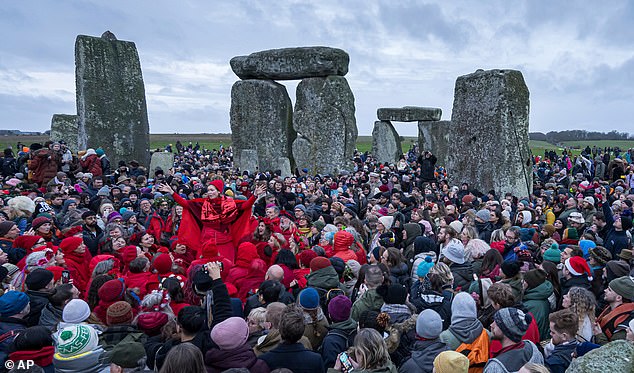

Thousands of revellers have gathered at Stonehenge to mark winter solstice.
On average, Brits will experience seven and a half hours of daylight today, making it the shortest day for the northern hemisphere.
For many it is a moment to look forward to, with days getting longer and nights shorter from this point forward.
People braved the 8C weather to flock to the historic monument in Wiltshire and watch the sunrise at 8.03am.
Large crowds had gathered at the UNESCO World Heritage Site for when the gates opened at 5.15am – with long queues for the cafe.
As the sun rose over the prehistoric stone circle, celebrations broke out including folk dancers and pagan rituals.
Some sang and beat drums, while others took time to reflect among the huge stone pillars.
One family woke up at 2am to drive three hours from Nottingham to join in the ‘spiritual’ event.
Emma, Tom, and Bella Ridley-Thompson said they were ‘very excited’ to be at Stonehenge.
‘It’s just nice to get involved. This is a ceremony after all, so it’s nice to dress up and have a bit of respect,’ they said.

Thousands of people have gathered at Stonehenge to mark the winter solstice – as huge crowds formed to watch the sunrise on the shortest day of the year

Folk dancers were also pictured performing this morning in traditional outfits

Folk dancers were also seen performing in traditional outfits with some sporting flower crowns – and on occasions, a full face of paint

Photos from this morning show revelers dressed in bright red outfits as well as Brits who have come with the chilly weather in mind – donning thick hats and scarves

Onlookers also reported a long queue to the cafe in the early hours of this morning

A couple of attendees also brought along some instruments for the occasion – with one woman even donning a Santa hat

Photos show the extent of the crowds – and a sea of warm jackets and wooly hats surrounding the stones
Another couple said they return to Stonehenge every equinox to ‘recharge.’
‘We’re coming out of the darkness and then into the light again, so for me, it’s about rebirth,” Kim Tester told the BBC.
‘We just love the atmosphere, it’s beautiful.’
Will Scutt, of English Heritage, described it as a ‘revered cultural moment in ancient history’.
Visitors were allowed to get closer to the ancient stones, which date back to 2,500 BC, than ever before.
He said: ‘We’ve got really rare lichens on them and incredible carvings on them, so I’m hoping that people will respect the stones.’
Morris dancers performed in traditional attire to celebrate the Earth being ‘reborn’ and the promise of longer days.
The folk dance is a symbolic ritual to mark the turning of the year and connect with ancient traditions of fertility and nature.
Many make the pilgrimage to the stone circle every summer and winter and consider it a spiritual experience.
The ancient monument, erected between 5,000 and 3,500 years ago, was built to align with the movement of the sun on the solstices – key dates in the calendar for ancient farmers.
As well as marking the shortest day of the year, when the sun is at its lowest arc, today is also the first day of winter in the astronomical calendar.
This calendar is based on the tilt of the Earth, and sees winter begin on December 21, 2025 before ending on March 20, 2026.
In contrast, the meteorological calendar always has the first day of winter as December 1, ending on February 28 (or 29 during a Leap Year).
The solstice occurs because the earth is tilted on its axis, by about 23.5 degrees relative to its orbit around the sun.
This tilt provides different parts of Earth with varying amounts of sunlight throughout the year.
It is the opposite in the Southern Hemisphere, where it is the longest day of the year and summer will start.