Public protests, marches and rallies have been banned across large parts of Sydney for the next two weeks under sweeping new laws introduced in the wake of the Bondi Beach terror attack.
NSW Police Commissioner Mal Lanyon announced the temporary restrictions late on Wednesday, declaring the South West Metropolitan, North West Metropolitan and Central Metropolitan policing areas ‘restricted’ for public assemblies.
Under the 14-day order, any protest or rally will be treated as unauthorised. Participants will lose protections under the Summary Offences Act, exposing them to potential charges for obstructing traffic or pedestrians.
No new Form 1 applications for protests will be accepted, and previously approved gatherings have been revoked.
‘This is a time for community to come together and to show respect and courtesy, it’s not a time for large public assemblies and division. The community deserves to be safe and feel safe,’ Lanyon said.
The changes follow emergency legislation passed by Parliament granting the Commissioner powers to impose bans after a declared terrorist incident.
‘This declaration is designed to give police the powers to ensure community safety,’ Commissioner Lanyon said.
‘The tragic events at Bondi Beach have left a profound impact on our community and reaffirmed the urgent need for stronger safeguards to reduce fear and increase safety.’

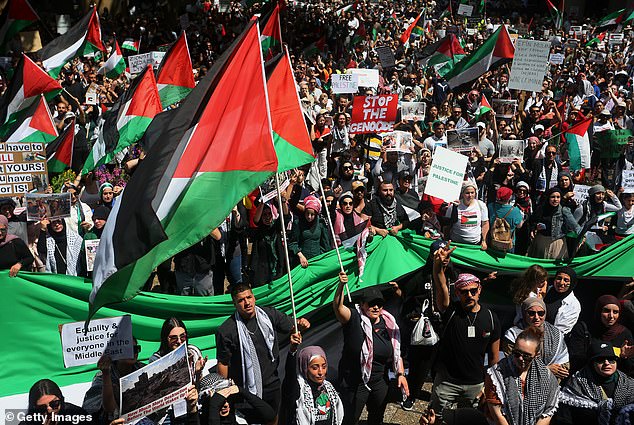
All protests have been banned across Sydney for 14 days (pictured pro-Palestine march in 2023)

Demonstrators at an anti-immigration rally at Prince Alfred Park in Sydney on December 21
Informal gatherings are still allowed, but police can now issue move-on directions to anyone causing obstructions, behaving in an intimidating or harassing manner, or likely to cause fear.
Officers have also been given new powers to require people suspected of offences to remove face coverings for identification.
‘In the immediate aftermath of the attack at Bondi last week, further protest activity would aggravate fear and divisiveness in the community at a time when we need to build safety and confidence,’ Lanyon added.
‘We will continue working closely with the government and community leaders to ensure these laws are implemented in a way that strengthens safety and cohesion across our state.’
The restrictions will be reviewed after 14 days, and may be renewed fortnightly for up to three months.
The crackdown has sparked backlash from advocacy groups, including the Palestine Action Group, Jews Against the Occupation, and the Blak Caucus, a First Nations organisation.
These groups are preparing to mount a constitutional challenge to the new laws.
‘It unnecessarily infringes on the implied freedom of political communication, which is essentially the freedom of speech we have in this country,’ lawyer Nick Hanna said on Tuesday.

Police officers watching over demonstrators at the anti-immigration rally on December 21

NSW Police Commissioner Mal Lanyon (pictured) said it was ‘not a time’ for large protests
In Parliament, the NSW Greens opposed the legislation and are supporting the constitutional challenge over concerns about the protest ban.
‘The Palestine justice movement and anti-genocide protests, made up of hundreds of thousands of people and including many Jewish community members, have consistently and loudly opposed antisemitism and all forms of racism,’ Greens Senator Mehreen Faruqi said, criticising the ban.
‘This is a time when unity, solidarity and meaningful leadership are needed, not authoritarianism nor the undermining of democracy, which depends on our right to assemble, to speak out, and to protest.’
Critics have also highlighted confusion about the scope of the bans, questioning whether they apply only to marching protests or also to static gatherings such as vigils and sit-ins.