Prime Minister Anthony Albanese has refused calls to launch a royal commission into the Bondi Beach terror attack, arguing it is the ‘national interest’ to hold a review into the security agencies instead.
During a press conference on Monday afternoon, Albanese staunchly defended his decision despite demands from the victims’ families he launch a national inquiry.
‘My heart goes out to them at what is an incredibly traumatic time. My job, as the Australian Prime Minister, is to act in the national interest,’ Albanese said.
‘It is in the national interest for us to do the Richardson review on national security, on any gaps which are there in the conduct of our agencies, including the AFP, ASIO and the interactions between the Commonwealth and state jurisdictions, and to then make sure we act on the recommendations which are there.’
He said that while royal commissions ‘can be good at deciding facts’, they are ‘not as good at considering things that are not agreed, where people have differences of views.’
The review, which will be led by Dennis Richardson – former head of ASIO and of the departments of defence and foreign affairs – will assess Australia’s federal law enforcement and intelligence agencies.
It is expected to be finalised by April.
The review was called in the aftermath of the December 14 attack in which Islamic State-inspired gunman Sajid Akram, 50, and his 24-year-old son Naveed Akram allegedly killed 15 people on Bondi Beach.
‘The government is committed to making sure that we can’t wait years for answers. We need to get on with any changes that are required,’ Albanese said.
‘This ISIS-inspired atrocity in Bondi is a stark reminder of the rapidly changing security environment that we face and the need to make sure our agencies have what they need and we’re determined to make sure they have exactly that.’

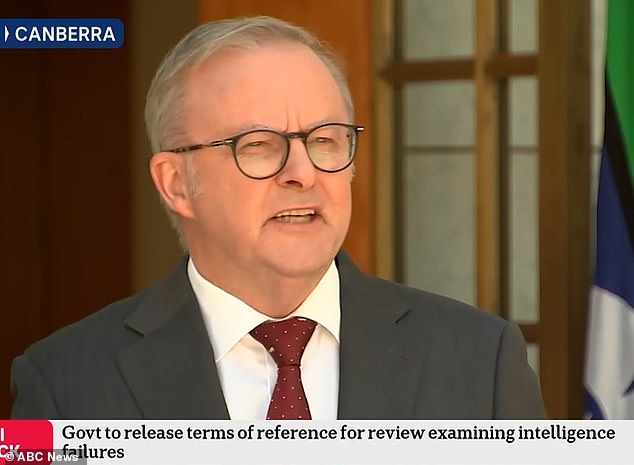
Prime Minister Anthony Albanese has refused widespread calls to launch a Royal Commission into the Bondi Beach terrorist attack, despite pleas from the victims’ families
The PM, who was flanked by Home Affairs Minister Tony Burke, was repeatedly grilled by reporters on Monday over why a royal commission couldn’t also run parallel to the inquiry.
‘You will have the NSW royal commission, you will have the Burgess review, you will have court cases against the perpetrator of this atrocity, who survived, all running at once. And at the same time, you will have legislation proposed before the parliament,’ he said.
‘[If we had a royal commission], the full sweep of issues that have been asked to be examined would delay, by a number of years, any outcome.’
Burke agreed, adding that ‘there has never been a royal commission which has been capable of acting with the speed of this inquiry will deal with.’
‘With national security information, by definition, it doesn’t lend itself to public inquiry,’ he said.
‘But in the issue of unity versus division, if you were to make those issues subject to a royal commission, it is not simply the people who feel they have been harmed by things that have been said or slogans that have been used, that will be called.
‘It will also be those who have made those statements, who will make submissions, who will be platformed. And all of that happens again and gets relived.
‘And no one can tell me that that is in the interest of unity to re-platform some of the worst voices.’

Home Affairs Minister Tony Burke said a royal commission would help platform ‘some of the worst voices’
The snap press conference came just one day after the families of victims of the attack penned a powerful open letter to the PM.
‘You owe us answers. You owe us accountability. And you owe Australians the truth,’ it read.
‘We demand answers and solutions. We need to know why clear warning signs were ignored, how anti-Semitic hatred and Islamic extremism were allowed to grow dangerously unchecked and what changes must be made to protect all Australians going forward.’
The letter was signed by the families of the youngest and oldest victims – 10-year-old Matilda and Holocaust survivor Alex Kleytman, 87, and the relatives of hero couple Sofia and Boris Gurman, Rabbi Eli Schlanger, Reuven Morrison, Edith Brutman, Tibor Weitzen, Yaakov Levitan, Tania Tretiak, and Boris Tetleroyd.
‘Our children feel unsafe at school and university. Our homes, workplaces, sporting fields, and public spaces no longer feel secure. It is an intolerable situation that no Australian should have to endure,’ the letter reads.
‘The rise of anti-Semitism in Australia goes far beyond one state jurisdiction. It is a national crisis that demands a powerful national response.
‘The dangerous rise of anti-Semitism and radicalism in Australia is not going away. This threat is real and it is escalating.’


The letter was signed by the families of the youngest and oldest victims – 10-year-old Matilda and Holocaust survivor Alex Kleytman, 87
Along with the Coalition, Independent MP Allegra Spender, whose electorate covers Bondi, has also called for a Commonwealth royal commission.
‘The PM’s own department leading a federal review is the government investigating itself – it won’t cut it,’ Spender said.
‘We need a joint Commonwealth-State inquiry that is genuinely independent and with real powers if we are to ensure lessons are learned and meaningful change is delivered.’
Spender also called for the inquiry to be able to accept public submissions.
In a statement on X, former Liberal treasurer and prominent Jewish Australian Josh Frydenberg said the intervention from families should have been ‘too loud to ignore.’
‘With recent polls showing the Australian people agree with the long list of legal, national security and political leaders who have called for a Royal Commission, it’s now time for the Prime Minister to listen and act,’ Frydenberg said.
‘The voices are too loud and too important to ignore. It’s clearly in Australia’s national interest, for the Prime Minister to call a Royal Commission now.’