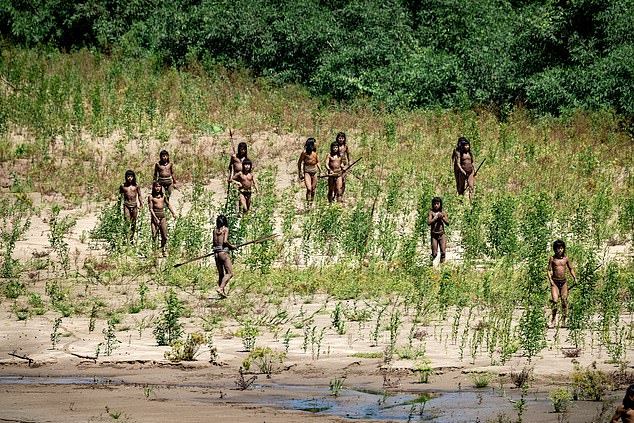

Incredible, never-before-seen footage and images of the world’s biggest uncontacted tribe have surfaced, with spear-wielding Amazonian hunters shown interacting with Western explorers.
The astonishing scenes were captured by American conservationist Paul Rosalie, who claims to be the first to capture high-definition images of the remote tribe.
Rosalie’s footage shows tribesmen cautiously descending on a beach, bows and arrows in hand, as they wade through a cloud of butterflies.
As they move closer along the beach, with wariness and curiosity, they scan the group of Western explorers and point, with some seeming ready to attack.
In a surprising twist, their initial vigilance dissipates, and the hunters are shown laying down their weapons and approaching the group of strangers.
A few of the tribesmen are even shown cracking a smile.
The footage was captured more than a year ago by Rosalie, but the conservationist decided not to disclose the exact location of the tribe sighting to protect them from further contact with the outside world.
Rosalie, who went on the Lex Friedman Podcast to talk about the footage, explained that the tribe has no immunity to common diseases, so contact with them could be fatal.

Never-seen-before footage of the world’s biggest isolated tribe has surfaced

The spear-wielding hunters are seen scanning the strangers as they try to analyse potential threats

The tribesmen are shown scanning the group of Western explorers
Speaking on the podcast, the conservationist said: ‘This has not been shown ever before. This is a world first.’
Up until now, footage of uncontacted tribes has been grainy, as it is usually taken from long distances and with phone cameras.
There are currently 196 remaining uncontacted Indigenous groups living in forests across the globe who have their own languages, cultures and territories.
The emergence of Rosalie’s footage comes after a new report by a London-based Indigenous rights organisation warned that influencers trying to reach uncontacted tribes were becoming a growing threat to their survival.
According to a report by Survival International, uncontacted groups are seeing ‘surging numbers’ of influencers who enter their territories and ‘deliberately seek interaction’ with tribes.
It explained how ‘adventure-seeking tourists’, influencers, and ‘aggressive missionaries’ are becoming a growing threat to these groups as they introduce diseases to which isolated tribes have no immunity to.
‘These efforts are far from benign. All contact kills. All countries must have no-contact policies in place.’

The footage was captured by American conservationist Paul Rosalie

Rosalie decided not to disclose the exact location of the tribe sighting to protect them from further contact with the outside world

A London-based Indigenous rights organisation recently warned that influencers trying to reach uncontacted tribes were becoming a growing threat to their survival
The charity also explained how India’s North Sentinel island, which is home to the ‘the most isolated indigenous people in the world’, was becoming increasingly targeted by adventure influencers and illegal fishermen ‘who steal [their] food’ and boast about making contact with the tribe.
It mentioned the case of Mykhailo Viktorovych Polyakov, an American influencer who was on the island and tried to contact the Sentinelese after allegedly offering them ‘a can of ‘Diet Coke and a coconut’ earlier this year.
He was arrested by Indian authorities after he breached a law designed to protect the tribe.
He remains on bail and could face a lengthy prison sentence.
The group also condemned anthropologists and filmmakers for deliberately seeking uncontacted people ‘as an object of study…without thought for the potentially devastating consequences’.
It gave the example of David Attenborough, who in 1971 joined an Australian colonial government patrol in Papua New Guinea in an attempt to contact and film an uncontacted tribe, calling the moment ‘a reckless encounter which could easily have passed on deadly pathogens to which the[tribe] had no immunity’.
Survival’s research concludes that half of these groups could be wiped out within 10 years if governments and companies do not act.’

The tribe has no immunity to common diseases, so contact with them could be fatal

There are currently 196 remaining uncontacted Indigenous groups living in forests across the globe who have their own languages, cultures and territories
The report identified at least 196 uncontacted Indigenous groups in 10 countries, primarily in the South American nations sharing the Amazon rainforest, and estimated that nearly 65 per cent face threats from logging, about 40 per cent from mining and around 20 per cent from agribusiness.
The issue often receives little priority from governments, which critics say see uncontacted peoples as politically marginal because they don’t vote and their territories are often coveted for logging, mining and oil extraction.
Public debate is also shaped by stereotypes — some romanticise them as ‘lost tribes,’ while others view them as barriers to development.
Survival’s research concludes that half of these groups could be wiped out within 10 years if governments and companies do not act.’