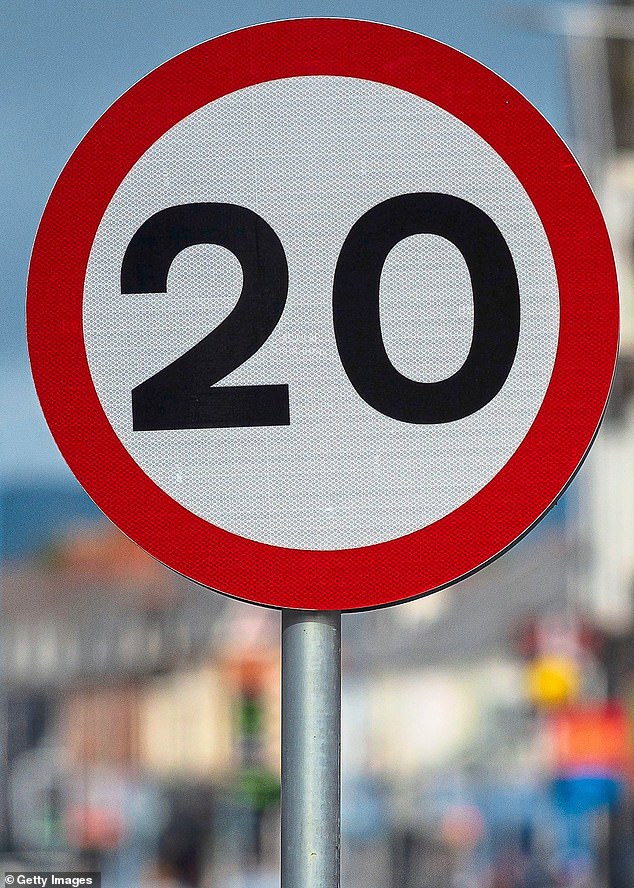

I was driving at 24 miles an hour on Park Lane – a major, three-lane road in the centre of London – when the camera got me. Twenty-four. Not 40, not 50 – 24. The kind of speed you associate with a hearse.
I’m now on nine points, all of which were for breaching the 20mph limit, which means I now must drive like a man carrying a tray of boiling soup. One more lapse and I’m condemned to six months of travelling by tube.
That was the moment I realised London isn’t managing its roads any more. It’s stalking its motorists. If you drive in this country’s capital – especially with 20mph limits spreading like Japanese knotweed – you begin to understand that motorists have become a source of revenue to be tapped.
Everywhere you look, stretches of road that have borne decades of safe, sensible 30mph traffic have been downgraded to 20. It’s a speed limit that makes sense in areas around schools, parks and hospitals, but when 20mph creeps on to the major arteries built specifically to move traffic through the capital, it begins to feel less like policy and more like a money-making scheme.
In 2021, 2.8 million speeding points were issued in Britain. By 2024 the number had risen to 9.6 million. All with an attached fine of £100. No other ‘safety’ measure in the country has produced a revenue windfall like this.
This isn’t a sign we have become a nation of lunatic drivers, it’s evidence of a system engineered to entrap. It’s speed slow enough to feel unnatural.

I scarcely know any driver in London who hasn’t been sent off on a speed awareness course, for which you pay £100. Or you can decline the course and accept the points, along with the hundred quid fine. Either way, the money ends up in the same pocket.
The strangest part is that the vast majority of these offences don’t involve reckless drivers. They’re down to people like me who have drifted a few miles per hour above 20.
Driving at 20mph is not instinctive on a major highway; you sit there hunched over the wheel, eyes pinging between windscreen and speedometer, hoping you haven’t crept up to 23mph.
What’s more, it’s not a speed most modern cars are designed to sit comfortably at. Ninety-six per cent of vehicles on British roads are petrol or diesel. Some argue that at 20mph, cars will be sitting in a lower gear at higher revs – ie inefficiently. Vehicles burn more fuel and emit more pollution at this speed than they do at 30mph.
‘But it’s all about road safety’ comes the inevitable response from those in favour of speed restrictions. However, there are vanishingly few pedestrians on the roads I’m talking about, some of which don’t even have pavements.
Also, ordinary motorists going at 30mph are not the biggest killers on London’s streets. It’s drunk drivers, angry drivers, distracted drivers, street racers – and 20mph zones solve none of that.
In fact, the obsession with 20mph has had a perverse effect: it has made drivers pay less attention to the road. London has turned its motorists into anxious speed accountants instead of present, attentive road users.
Defenders of the policy love to say, ‘Well, in Europe…’ But nowhere else applies limits like this. Paris and Barcelona have 30km/h zones – roughly 19mph – but mostly on residential, single-lane streets. They do not slap these speed restrictions on six-lane thoroughfares. They do not impose it without redesigning the roads around it.
One other oft-repeated objection is that slower speeds make the roads safer for cyclists. But as a cyclist myself, I can say that 20mph is awful for us. When a car is trying to overtake you, 30mph creates a clean, safe window. At 20mph, cyclists end up boxed in by parked cars on one side and a frustrated motorist who can’t accelerate past you on the other.
So yes, I am on nine points, through nobody’s fault but my own. I now must drive as if I’m escorting explosives. I check my speedometer more often than my mirrors. It’s hard to escape the feeling that this isn’t about safety – it’s about slowing you down enough to pay up.