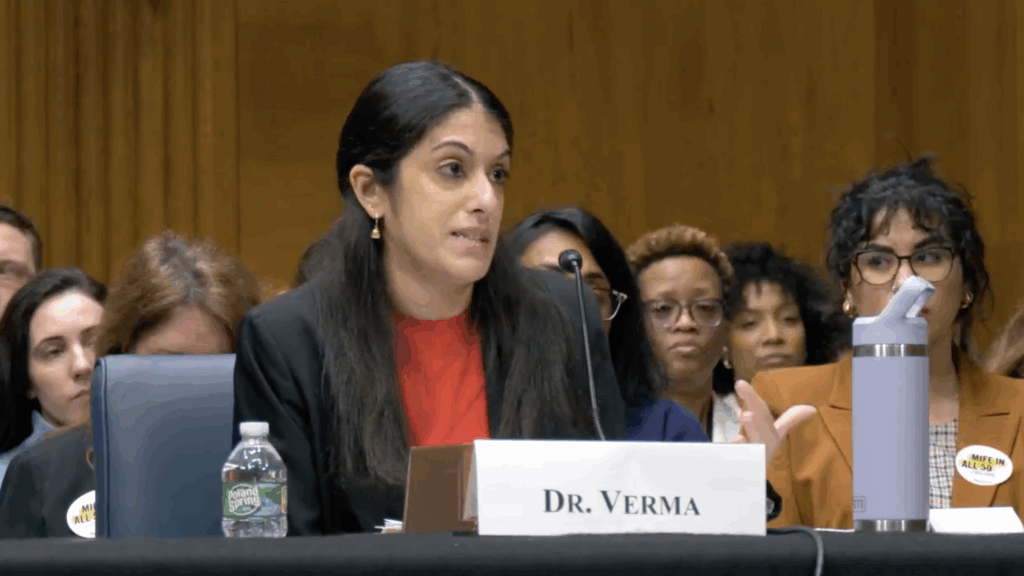

On Jan. 14, 2026, the U.S. Senate Health, Education, Labor, and Pensions (HELP) Committee kicked off the new year with a hearing titled “Protecting Women: Exposing the Dangers of Chemical Abortion Drugs.” The Democrats’ witness, abortionist Nisha Verma, revealed her commitment to protecting her own livelihood — even at the cost of women’s lives — so it is no surprise that the truth was also a casualty of her testimony.
Verma told Congress she considers it “deeply disturbing” that the Trump administration relies on the Ethics and Public Policy Center’s study of mifepristone safety, which we authored, to justify directing the FDA to conduct its own study.
The FDA’s mission is literally “protecting the public health by ensuring the safety, efficacy, and security of human and veterinary drugs …” In light of our study’s finding that one in ten women experiences a serious adverse event following an abortion prescription, we — along with a majority of the U.S. Senate and nearly half of the U.S. House of Representatives — recommended that they conduct their own study, and the leadership of HHS and the FDA agreed to do so.
How could anyone reasonably oppose this? If not the FDA, then who is possibly qualified to conduct such a study in a rigorous and unbiased manner?
The Democrats’ witness accused us of committing “substantial errors” and lacking “transparency” in our study when, in fact, The Washington Post’s “fact checker” went back and forth with us for multiple rounds of questions and ultimately published a review of our study that awarded us no “Pinocchios.”
We have been utterly transparent that we are contractually unable to identify our data broker, but that we rely on a standard all-payer health care claims database that is commercially available and used by academic researchers on a regular basis. Anyone can purchase and analyze the data. EPPC encourages the FDA to do precisely this.
Verma then argued that “the EPPC study makes egregious errors in its count of serious adverse events related to medication abortion.” We followed NIH and FDA protocol for identifying serious adverse events.
She accused us of misrepresenting “routine evaluation of expected symptoms of a medication abortion like bleeding and cramping as adverse events.” No, our study did not. Routine evaluation of expected symptoms were not included.
She then alleged that we do not follow FDA guidance, which states, “Emergency room visits that do not result in admission to the hospital should be evaluated for one of the other serious outcomes (e.g., life-threatening; required intervention to prevent permanent impairment or damage; other serious medically important event).”
In fact, we followed FDA’s guidance, which is why we do not include standalone ER visits as such. As our FAQ states, “The emergency room visits included in the report are only those related to the chemical abortion, based on the diagnosis and procedure codes in the insurance records, and are counted only if treatment for a serious complication related to the chemical abortion took place.”
Indeed, as we explicitly stated, we excluded 72 percent of ER visits from counting as serious adverse events, because they were either not serious, or not related to the abortion, or both. Only 28 percent of ER visits were counted as serious and related to the abortion.
The Democrat witness then alleged that our study made other errors, including “counting subsequent treatment to complete an abortion as an adverse event, conflating abortion care with miscarriage care and other uses of mifepristone, and counting longstanding health conditions such as chronic pulmonary issues as adverse events even if they are not related to the abortion.”
We did not classify routine follow-up care as an adverse event. However, when additional medical or surgical intervention was required due to complications such as hemorrhage, infection, or retained tissue beyond expected management, those events were classified consistent with FDA definitions. This distinction is standard in pharmacoepidemiology and does not represent an error.
We did not conflate abortion care with miscarriage care, but rather we carefully distinguished the codes for abortion from the codes for miscarriage, even when the same drug was used. As explained in our FAQ document: “We were very careful to exclude miscarriage care in our report by requiring any mifepristone-only prescription was accompanied by a Z332 code (encounter for elective termination of pregnancy) or Z640 (problems related to unwanted pregnancy).” Likewise, EPPC did not count longstanding health conditions as adverse events of abortion.
Finally, Verma alleged, “The paper makes sweeping policy recommendations that are not at all supported by its findings.”
EPPC’s “sweeping policy recommendations” are to return to the original FDA safety protocols. Or, short of that, to return at least to requiring an in-person doctor visit for prescribing and dispensing the abortion pill, as was the case for the first two decades of mifepristone’s use in the United States, until the Covid pandemic.
Whether such requirements are warranted is a reasonable policy question — but acknowledging uncertainty and recommending additional safeguards in light of new safety signals is not inconsistent with the study’s findings. These are all lies abortion activists have told about the EPPC study with no basis in reality.
The FDA has a duty to ensure the safety, efficacy, and security of drugs. The FDA does not have a duty to ensure access to abortion. The more this abortionist speaks, the more it becomes clear that she places a greater priority on promoting abortion than on protecting women.
Ryan T. Anderson is the president of the Ethics and Public Policy Center and Jamie Bryan Hall is the director of data analysis of the EPPC.