The US administration has told its allies including the UK to take control of their own security as part of its new defence strategy.
The 34-page National Defence Strategy document, the first since 2022, criticised partners from Europe and Asia for relying on previous US administrations to subsidise their defence.
It called for ‘a sharp shift – in approach, focus, and tone’. That translates to a blunt assessment that allies should take on more of the burden of countering nations from Russia to North Korea.
‘For too long, the US government neglected – even rejected – putting Americans and their concrete interests first,’ reads the opening sentence.
It comes after Trump threatened to impose tariffs on some European partners to press a bid to acquire Greenland before announcing a deal that lowered the temperature.
Trump also blasted the UK in recent days for ‘an act of great stupidity’ in signing the strategically important Chagos Islands away.
The new policy document views China, which the Joe Biden administration saw as a top adversary, as a settled force in the Indo-Pacific region that only needs to be deterred from dominating the US or its allies. The goal ‘is not to dominate China; nor is it to strangle or humiliate them’, the document says.
It later added: ‘This does not require regime change or some other existential struggle.’

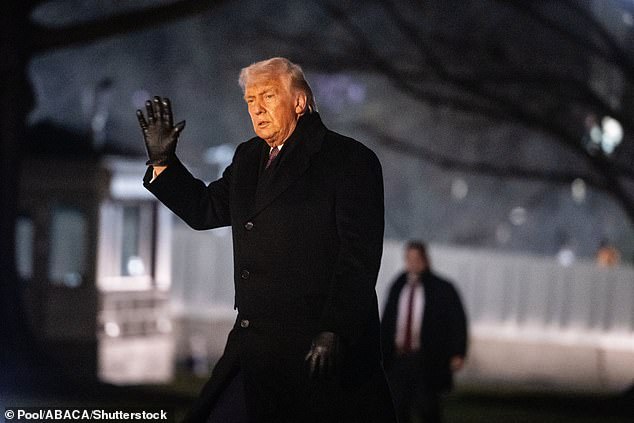
The 34-page National Defence Strategy document, the first since 2022, criticised partners from Europe and Asiafor relying on previous US administrations to subsidise their defence. Pictured: Donald Trump walks on the South Lawn of the White House

The move by the Pentagonreasserts the Trump administration’s focus on dominance in the Western Hemisphere above a long-time goal of countering China. Pictured: Chinese President Xi Jinping

The move by the Pentagon(pictured) reasserts the Trump administration’s focus on dominance in the Western Hemisphere above a long-time goal of countering China .
The move by the Pentagon reasserts the Trump administration’s focus on dominance in the Western Hemisphere above a long-time goal of countering China.
The strategy adds that American defence secretary Pete Hegseth’s department will provide ‘credible options to guarantee US military and commercial access to key terrain’ – especially Greenland and the Panama Canal.
And while the strategy at urges cooperation with Canada and other neighbours, it issues a stark warning that they must ‘do their part to defend our shared interests’.
This week, a back-and-forth between Trump and Canadian Prime Minister Mark Carney at the World Economic Forum meeting in Davos, Switzerland, ended with Carney publicly repudiating Trump for saying that ‘Canada lives because of the United States.’
The document states: ‘We will engage in good faith with our neighbours, from Canada to our partners in Central and South America, but we will ensure that they respect and do their part to defend our shared interests.
‘And where they do not, we will stand ready to take focused, decisive action that concretely advances US interests.’
Much like the White House’s National Security Strategy that preceded it, the defence blueprint reinforces Mr Trump’s ‘America First’ philosophy, which favours non-intervention overseas, questions decades of strategic relationships and prioritises US interests.
The US National Defence Strategy was last published in 2022 under then-president Joe Biden and focused on China as America’s ‘pacing challenge’.
The strategy warns that the US will ‘actively and fearlessly defend America’s interests throughout the Western Hemisphere’.
It specifically points to access to the Panama Canal and Greenland. It comes just days after Mr Trump said he reached a ‘framework of a future deal’ on Arctic security with Nato leader Mark Rutte that would offer the US ‘total access’ to Greenland, a territory of Nato ally Denmark.
Danish officials said that formal negotiations have yet to begin.
Mr Trump previously suggested that the US should potentially consider retaking control of the Panama Canal and accused Panama of ceding influence to China.
Asked this week if America reclaiming the canal was still on the table, Mr Trump said: ‘I don’t want to tell you that.
‘Sort of, I must say, sort of. That’s sort of on the table.’
The Pentagon also touted the operation that ousted Venezuelan president Nicolas Maduro earlier this month, saying ‘all narco-terrorists should take note’.
The document also said: ‘President Trump seeks a stable peace, fair trade, and respectful relations with China,’ following efforts to climb down from a trade war sparked by the administration’s sky-high tariffs.
It says it will ‘open a wider range of military-to-military communications’ with China’s army.
The strategy, meanwhile, makes no mention of or guarantee to Taiwan, the self-governing island that Beijing claims as its own and says it will take by force if necessary.
The US is obligated by its own laws to give military support to Taiwan.
By contrast, the Biden administration’s 2022 strategy said the US would ‘support Taiwan’s asymmetric self-defence’.
In another example of offloading regional security to allies, the document said: ‘South Korea is capable of taking primary responsibility for deterring North Korea with critical but more limited US support.’
For Europe, while saying that ‘Russia will remain a persistent but manageable threat to Nato’s eastern members for the foreseeable future’, the defence strategy asserts that Nato allies are much more powerful and so are ‘strongly positioned to take primary responsibility for Europe’s conventional defence’.
The document said the Pentagon will play a key role in Nato ‘even as we calibrate US force posture and activities in the European theatre’ to focus on priorities closer to home.
The US has already confirmed that it will reduce its troop presence on Nato’s borders with Ukraine, with allies expressing concern that the Trump administration might drastically cut their numbers and leave a security vacuum as European countries confront an increasingly aggressive Russia.