Republican Senator Rand Paul attacked Donald Trump’s foreign policy as he grilled Secretary of State Marco Rubio over the capture of Venezuelan dictator Nicolas Maduro on Wednesday.
The Kentucky lawmaker asked Rubio whether similar action taken against the US would be considered an act of war at a Senate Foreign Relations Committee hearing.
Paul asked: ‘[If] a foreign country bombed our air defense missiles, captured and removed our president, and blockaded our country, would that be considered an act of war?’
The question referred to Operation Absolute Resolve, the capture of Venezuelan dictator Maduro and his wife on January 3, which was billed as a law enforcement operation by the Department of Justice, not an act of war.
Rubio pushed back against his claims, arguing that he was presenting a hypothetical situation the US is unlikely to face.
‘It’s hard for us to conceive that an operation that lasted about four and a half hours and was a law enforcement operation to capture someone we don’t recognize as a head of state indicted in the United States,’ the Secretary of State said.
Paul argued that the ‘drug bust’ performed by the US ‘leads to chaos,’ asking: ‘My question would be if it only took four hours to take our President. It’s very short. Nobody dies on the other side. Nobody dies on our side. It’s perfect. Would it be an act of war?’
Rubio held the line on the Trump administration’s rhetoric, insisting: ‘We just don’t believe that this operation comes anywhere close to the constitutional definition of war.’

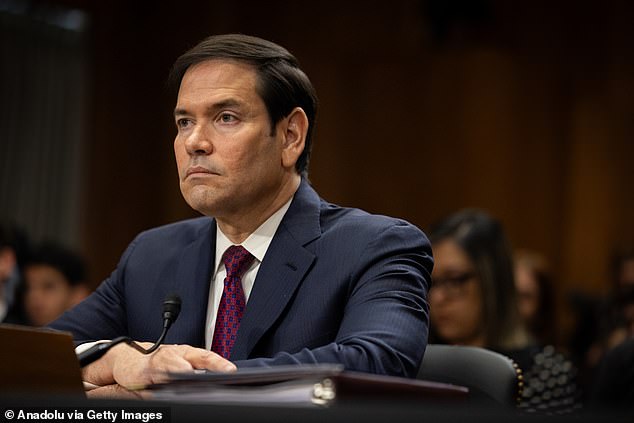
Secretary of State Marco Rubio is seen before testifying in front of a Senate Foreign Relations Committee hearing on Venezuela, in Washington, DC, United States on January 28, 2026

Senator Rand Paul, a Kentucky Republican listens as Secretary of State Marco Rubio appears before the Senate Foreign Relations Committee, at the Capitol in Washington, Wednesday, January 28, 2026
Paul has also repeatedly co-led efforts to rein in presidential powers, sponsoring a War Powers resolution with Democratic Senator Tim Kaine of Virginia that led to a full Senate vote earlier this month that tied, meaning it did not move forward.
Trump described the Senate’s move to restrain his military authority as one that ‘greatly hampers American Self Defense and National Security, impeding the President’s Authority as Commander in Chief.’
Rubio expressed hope for cooperation with Venezuela and said he expected the US embassy there to reopen soon.
‘I can tell you right now with full certainty we are not postured to, nor do we intend or expect to, have to take any military action in Venezuela,’ Rubio told the Senate Foreign Relations Committee.
‘The only military presence you’ll see in Venezuela is our Marine guards at an embassy,’ he said.
Trump has demanded that Venezuela, which has the world’s largest proven oil reserves, cooperate with US oil companies.
The State Department last week named a senior diplomat, Laura Dogu, as top diplomat for Venezuela, and earlier sent a mission to assess the embassy in Caracas.
‘We think very quickly we’ll be able to open a US diplomatic presence on the ground,’ Rubio told the Senate Foreign Relations Committee.
The restored US mission ‘will allow us to have real-time information’ and improve interaction with Venezuelan authorities as well as ‘members of civil society, the opposition,’ Rubio said.
The United States shuttered its embassy in 2019 shortly after Washington and other major powers declared Maduro to be illegitimate following an election marred by reports of irregularities.
US commandoes raided Caracas on January 3 and seized Maduro, a longtime leftist nemesis of Washington, and his wife, Cilia Flores.

Nicolas Maduro is seen in handcuffs after landing at a Manhattan helipad, escorted by heavily armed Federal agents as they make their way into an armored car en route to a Federal courthouse in Manhattan on January 5, 2026 in New York City

Fire at Fuerte Tiuna, Venezuela’s largest military complex, is seen from a distance after a series of explosions in Caracas on January 3, 2026

Venezuela’s interim president Delcy Rodriguez delivers her first annual address to the nation at the National Assembly, following the U.S. strike in Caracas that resulted in the capture of President Nicolas Maduro and his wife, Cilia Flores, in Caracas, Venezuela, January 15, 2026
The couple were flown to New York to stand trial on US-issued charges of drug trafficking, which they deny.
Senator Jeanne Shaheen, the top Democrat on the Senate Foreign Relations Committee, said that the operation has cost at least hundreds of millions of dollars ‘and yet the Maduro regime is essentially still in power.’
‘Her cooperation appears tactical and temporary, and not a real shift in Venezuela’s alignment. In the process, we’ve traded one dictator for another,’ Shaheen said.
Senator Chris Van Hollen, another Democrat, pointed to Trump’s meetings with oil executives and questioned if he ordered the attack for personal benefit.
‘By any measure, this is the most corrupt administration in American history,’ he said.
Venezuelan officials say more than 100 people died, both Venezuelans and Cubans, who unsuccessfully tried to protect Maduro.
Rubio called the tactical operation a success as no Americans died.
Trump indicated hours after deposing Maduro that he favored working by pressuring Rodriguez rather than seeking to empower Venezuela’s democratic opposition, dismissing its leader, Maria Corina Machado, as a ‘very nice woman’ who did not command ‘respect.’
But Trump sounded more favorable to Machado after she visited him at the White House and presented him with her Nobel Peace Prize, which she won last year despite Trump loudly coveting the prestigious honor.
Following his testimony on Wednesday, Rubio is scheduled to meet with Machado again in a closed-door session.
Rubio, a Cuban-American and fervent critic of Latin American leftists, had, as a senator, championed the opposition forces of Machado.
Rodriguez insisted Sunday that she has had enough of orders from Washington. But she has also worked to encourage US oil investment and said Tuesday that the United States was unblocking sanctioned Venezuela funds.