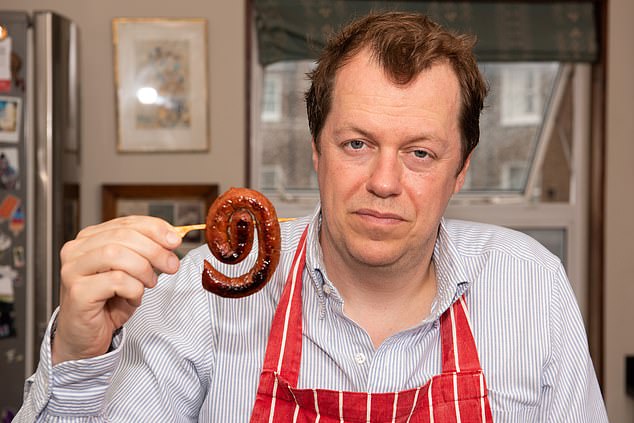
When it comes to unmentionable cuisine, I’ve pretty much eaten it all. Insects and eyeballs, snake wine and blood soup, maggot cheese, cod sperm, rotten shark and pig’s bum. But nothing could prepare me for the horror that sits before me – a plate of food so vile, so unremittingly joyless, so downright depressing that just describing it brings on a culinary PTSD from which I may never recover.
There’s the ‘bacon’ that looks like a dog chew and tastes of charred plastic, with a slight whiff of old Frazzles. Alongside a ‘burger’ flavoured with salty despair, a ‘sausage’ more suited to insulation than eating. And ‘cheese,’ so claggingly, cloyingly, goppingly debased that even the bin spat it back out. Welcome, dear reader, to the infernal world of the ‘vegan plant-based meat alternative’.
With names like This Isn’t Bacon Rashers (you’re not wrong there), Beyond Burgers (beyond the pale, more like), La Vie (best place for it) and I Am Nut OK (nor me), these ‘100 per cent plant-based’ horrors not only promise healthier eating (‘less saturated fat!’), but claim to save the Earth, too.
To quote the nauseatingly twee blurb on the back of La Vie’s Smoked Plant-Based Ham (I ate it, so you don’t have to): ‘Our plant-based recipe naturally recreates everything about ham, without the pig. Better for you, for the planet and, of course, for our Buddy (the pig).’ Urgh.
At their peak in 2022, sales of these ‘vegan plant-based alternative meats’ reached a staggering £1 billion. Supermarkets cleared the shelves for ever-more slickly marketed fake meat, investors piled in millions of pounds and suddenly, the future looked entirely meat-free. The figures, though, tell a rather different story.
Between 2022 and 2024, there was a 10.4 per cent drop in plant-based meat sales. And by January 2025, they had fallen a further 4.5 per cent. Hardly catastrophic, but the decline shows no sign of abating. It’s not just the supermarkets that are suffering, the companies behind these gruesome products are too.

There’s the ‘sausage’ more suited to insulation than eating, writes Tom Parker Bowles, the ‘burger’ flavoured with salty despair…

… and the ‘bacon’ that looks like a dog chew and tastes of charred plastic, with a slight whiff of old Frazzles
Meatless Farm collapsed into administration in 2023 (though later revived) as did VBites, the vegan business started by Heather Mills, ex-wife of Sir Paul McCartney, while Unilever flogged its plant-based brand The Vegetarian Butcher in 2024.
Neat Burger, the vegan burger chain backed by Leonardo DiCaprio and Lewis Hamilton, entered liquidation in July last year, while Beyond Meat, a market leader in plant-based burgers, spiralled to a loss of more than £76 million in the third quarter of last year.
So, is this the beginning of the end, not just of those vile, barely edible plant imposters, but of veganism itself?
Of course not. While there’s more chance of me being anointed Pope Tommaso I than turning vegan, I have nothing but respect for those who eschew meat, fish, dairy, eggs and honey for reasons moral, religious or medical. They should be applauded, not vilified. No, my disdain is reserved for those witless part-timers, the angry, eternally offended virtue signallers who cling on to each and every new trend in the hope of specious ‘Likes’ and empty ‘Follows’. They’re the shrill, finger-wagging minority who give the eminently civilised majority a bad name. If they’re true vegans, then I’m Peppa Pig.
Things have changed, too, in the upper echelons of gastronomy. Where once you’d run a mile from a vegan restaurant (‘Would Sir like some self-flagellation with his lentil stew?’), at the best places, it’s now near impossible to bag a seat.
Alexis Gauthier is a classically trained French chef who held a Michelin star for 12 years. But in 2016, he turned vegan, and in 2021, totally removed animal products from his menu at Gauthier Soho in London. ‘I became vegan the day I realised that I did not want to profit from killing animals any more,’ he tells me. The change was ‘challenging’, but he used his classical training to start discovering a ‘new world of ingredients that I didn’t know about, and a combination of flavours that I wasn’t aware of’.
Of course, French cuisine is famous for its lavish amounts of cream and butter. ‘But it’s so much more than that, so much more intricate and precise.’
He makes a Marseille sauce that tastes ‘more like bouillabaisse than if I had added fishbones, because I use seaweeds you can only find in the Mediterranean Sea. It’s beautiful, flavourful and very French. You can do classical French cuisine without the animals. And that’s the beauty of it.’ The man is a master.
As is Kirk Haworth, the young chef proprietor behind Plates, one of the country’s most lauded restaurants. Which happens to be vegan. The son of acclaimed chef Nigel Haworth, he trained under the likes of Thomas Keller, Sat Bains and Phil Howard. But when he contracted Lyme’s disease, he had to rethink the way he cooked and ate, to avoid processed foods that would inflame his condition.
‘I was forced to look at food in a different way and take out things like butter and cream,’ he says. ‘It was scary, because you’re almost starting again, from 16 years of training to cook a perfect piece of fish or meat to saying, I’m going to start playing with the carrot and try and make this cool and exciting and delicious.’ Which he did. He was astounded by the ‘purity of flavour’, and wants ‘to make fruit and vegetables exciting, and get people excited about them’. Like everyone else, he has little time for fake meat. ‘Normal junk food still makes me ill, so I can’t really eat those either.’

Tom Parker Bowles with the selection of meat alternatives. I ate them, so you don’t have to, he says of many of the examples

This Isn’t Bacon Rashers. You’re not wrong there, writes Tom Parker Bowles… and yes, I know, the grammar is awful
He doesn’t go around claiming that going vegan cured him of the disease, but ‘food plays a huge part if you’re suffering with anything, mental or physical’.
Both Haworth and Gauthier are exceptional chefs who create some truly incredible dishes and are inspired, rather than hindered, by being vegan.
The point is, however, that so many products are not produced by great chefs. Despite all their claims of bunny hugging and saving the Earth, the vast majority of these vegan meat substitutes are every bit as ultra-processed as any Pot Noodle, hot dog or packet of Coco Pops.
The issue is not with anyone’s chosen way of eating, but rather what these counterfeit meat products actually contain.
On the front of a bag of This Isn’t Pork Sausages (yes, I know, the grammar is awful), you’re bombarded with the positives – ‘high in protein’, a ‘source of fibre’ and ‘83 per cent less saturated fat compared to a standard pork sausage of the same weight’.
But a quick glance through the ingredients list on the back tells a very different story. There’s the ‘textured pea protein’ and ‘pea protein isolate,’ the ‘thickeners’ that include methylcellulose, konjac, carrageenan, and Xanthan gum, the ‘natural flavouring’, ‘dextrose’, ‘colour (beetroot red)’ and casings made from ‘sodium alginate’.
Now compare that veritable chemistry lab to the ingredients of my favourite pork chipolata from HG Walter butcher – 90 per cent free-range British pork, breadcrumbs, salt, herbs and spices. No prizes for guessing which is the more natural.
‘There’s an interesting irony here,’ says nutrition therapist and author Ian Marber, ‘in that a decade ago, food brands highlighted their “plant-based” credentials and it seemed that everyone would be “plant-based” in time.’
But as people began to realise the dangers of Ultra Processed Foods (UPFs), ‘hindsight allows us to see the meat alternatives pretty much as ultra as one can get. They are by nature very processed.’
Graham Soult, managing director of retail consultancy Canny Insights, agrees. ‘People are realising that just because a product is vegan, it doesn’t make it healthy. I think customers are more informed and savvy about what they want to eat as part of an overall healthy lifestyle.’
In short, far from being the ‘natural’ choice, these vegan meat substitutes have turned out to be UPF wolves in sheep’s clothing.
David Sables is CEO of Sentinel Management Consultants and advises food suppliers about getting into supermarkets. ‘A few years back, all those plant-based and vegan solutions got past a lot of business development on the basis of what wasn’t in the product, but didn’t really address what was in them. What is in these products is a bigger compromise than the meat that isn’t.’
They’re also premium and relatively expensive. ‘Healthy eating goes out of the window when you can no longer afford anything.’
Soult couldn’t agree more. ‘These days, more people wanting a vegan or a flexitarian diet are cooking using basic, affordable ingredients. Prices have become a much bigger factor for many households so shoppers are also being more selective about what they buy.’
There are some decent vegan products out there – Symplicity burgers for one. Made from fermented vegetables with a little miso and tamari for extra umami, I’d actually eat them without a gun pressed hard against my head. Mimicking meat was never the point, and I’m not alone in my admiration.
Both Gordon Ramsay and Tom Kerridge stock them in their restaurants while Professor Tim Spector, no fan of UPFs, declares them ‘the future of food’.
Soult, who is a vegetarian, would also far rather eat a burger where ‘you can see the beans and carrot, because part of the point of not eating meat, at least for me, is that I don’t really like meat. I don’t want to buy things that look and taste like meat’.
And that’s the thing. These meat substitutes will never ape a plump chipolata, a fat, charred steak or a crisp rasher of smoked streaky bacon.
So why bother with a second-rate imitator when there are so many other delectable vegan options out there? A lustily spiced chickpea curry, say. Give me crisp salad with a sharp shallot dressing, and a fiery Thai vegetable stir fry over filthy fake chicken nuggets. Embrace what you have, rather than trying to replicate what you don’t.
Even seemingly innocuous ingredients like jackfruit, often used to mimic shredded meat, come with their own particular set of issues.
Asma Khan, the cook, writer and restaurateur behind Darjeeling Express, admits they’re superior to ‘lab-created proteins’.
But, she argues: ‘The excessive cultivation of jackfruit is only possible through huge amounts of fertilisers, and incredible debt being taken by farmers to grow for the West. For Westerners who think they’re being very moral, taking the high ground, and going for the plant-based alternative’ – she pauses – ‘I just think it’s more important to be meaningful in what you’re doing, instead of just trying to follow the trend or crowd.’
Sales of vegan meat fakes may be in a gradual decline. But consumers’ appetite for a more balanced, healthy and plant-centred diet most certainly is not.
Waitrose points out that their customers are ‘increasingly prioritising wholefoods such as fresh fruit, veg, nuts and grains, as well as non-UPFs and simpler ingredients as part of a broader interest in health and nutrition’. Quite right, too.
As Michael Pollan writes in The Omnivore’s Dilemma: ‘Eat food. Not too much. Mostly plants.’ That’s not to say we should give up meat. Perish the thought! But we should certainly eat less meat, and better quality. Meaning we shun those cheap, intensively farmed chickens and pigs. And instead, buy British, free-range meat, with proper provenance. Preferably from our local butcher, who will be only too happy to tell us where his meat is from. Yes, it’s more expensive, but it should be a treat rather than a staple.
Anyway, unhappy beasts make unhappy eating, and it’s our responsibility to ensure the animals we consume are brought up and killed in the most humane way possible. Regenerative, sustainable farming practice is the way forward, and we should aim to live in harmony with nature, not against her.
All good food starts with a healthy, fertile soil. And there should be no place for these horrible, third-rate, ultra-processed fake meat monstrosities. Vegetarian or vegan, pescatarian or omnivore, that’s one thing upon which we can all agree.