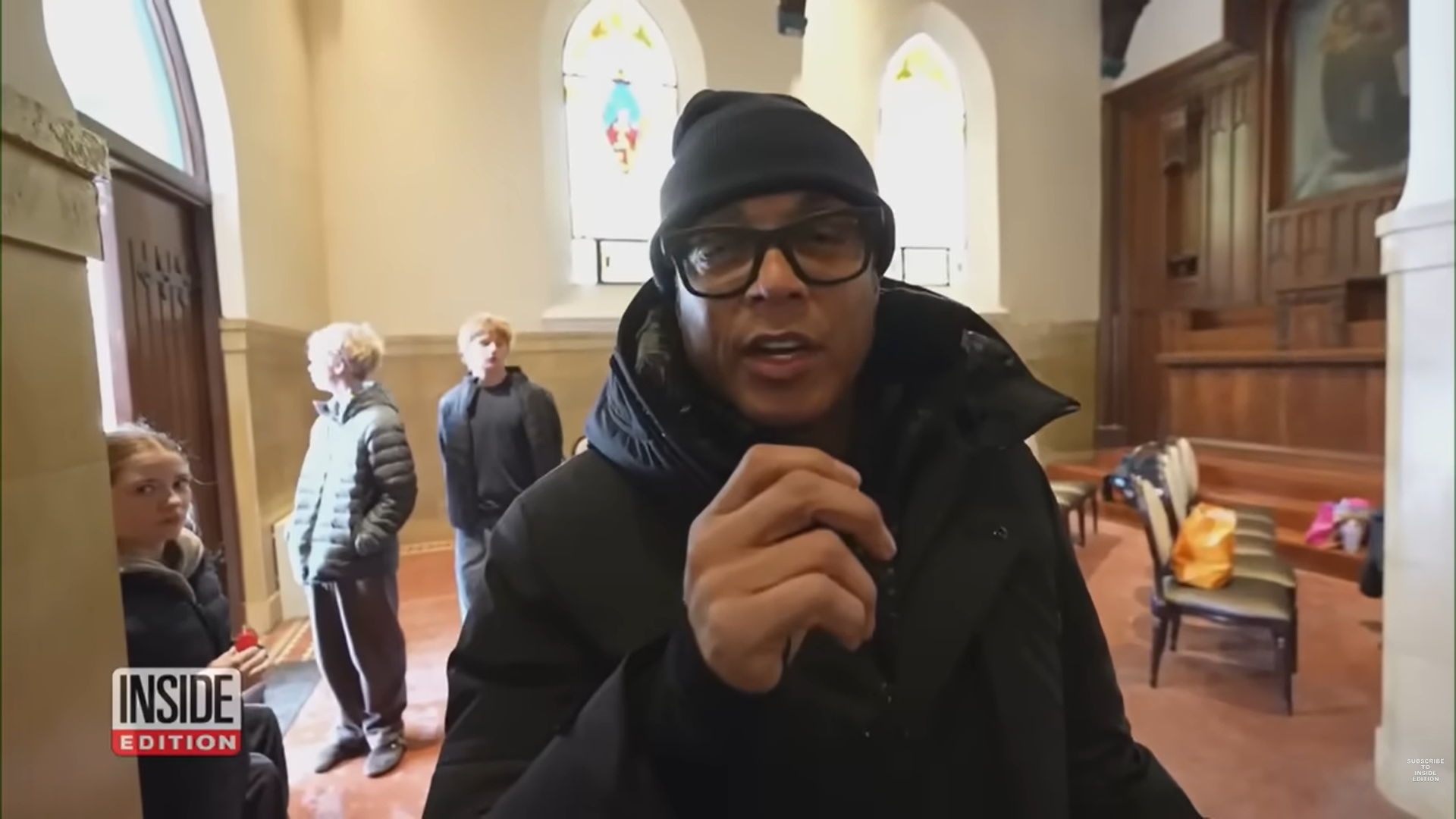

Soon after the unsealing of the grand jury indictment returned against Don Lemon, the left launched a two-track media blitz to defend the former CNN pundit. A cacophony of “journalists” falsely claimed the Trump Administration charged Lemon for exercising his First Amendment right to freedom of the press. Simultaneously, some big names, such as Jake Tapper and George Stephanopoulos, framed the grand jury indictment as somehow suspect because several judges had earlier refused to issue an arrest warrant for Lemon. Neither narrative holds merit.
The Federalist’s editor-in-chief, Mollie Hemingway, has already destroyed the First Amendment spin, explaining on Fox News’ Special Report:
“Being a journalist or saying that you’re a journalist does not give you the right to interfere with people’s First Amendment rights to worship. [Lemon] is on camera harassing the worshippers, being part of the effort to keep them terrified …”
Efforts to denigrate the grand jury’s indictment of Lemon are equally flawed — to the extent you even learned of the fact that a grand jury indicted the former CNN host.
For instance, yesterday on This Week with George Stephanopoulos, the ABC host began his questioning of Deputy Attorney General Todd Blanche by noting: “Just this week, Don Lemon was arrested, the journalist Don Lemon was arrested, along with another independent journalist. And this was despite the fact that a magistrate judge and an appeals court refused to approve the request. And the Chief Federal District Judge Patrick Schiltz wrote that there was no evidence that Mr. Lemon engaged in any criminal behavior or conspired to do so.”
Missing from Stephanopoulos’ spin was the fact that a (grand) jury of Lemon’s peers, after hearing and seeing the evidence of Lemon’s involvement in the disruption of church services, chose to indict the YouTube podcaster. Instead, Stephanopoulos suggested that there was no basis to arrest Lemon because a magistrate judge had refused to issue an arrest warrant.
This narrative ignores the basics of criminal procedure, which allows the federal government to obtain an arrest warrant either by swearing out a complaint before a magistrate judge or by presenting evidence to a grand jury and obtaining an indictment. The Trump Administration initially went the former route, seeking to quickly arrest Lemon and his alleged co-conspirators to forewarn potential copycats of the criminal jeopardy they would place themselves in if they interrupted the upcoming weekend services of January 24 and 25, 2026.
Thus, on January 20, 2026, two days after Lemon and his fellow alleged co-conspirators disrupted church services in Minnesota, federal prosecutors filed a criminal complaint against eight individuals, alleging “charged individuals conspired to disrupt religious services and intimidated, harassed, terrorized, and physically obstructed the parishioners at Cities Church on the morning of Sunday, January 18, 2026.”
The magistrate judge concluded the complaint supported a finding of probable cause only against three of the eight defendants, and therefore refused to issue arrest warrants for Lemon and several of the other alleged co-conspirators. According to the government, prosecutors on January 21, “offered to submit additional evidence to support the complaint,” but “the duty magistrate judge indicated that he was unwilling to review additional evidence on an expedited basis and directed the Government to instead seek a grand jury indictment.”
The grand jury, however, would not be available until January 27, according to federal prosecutors. Accordingly, the Department of Justice promptly sought review by the district court — something allowed under criminal procedural law because magistrate judges are not Article III judges appointed by the president and confirmed by Congress. The district court judge, Judge Schiltz, initially indicated he would review the matter but then stated he would not be able to evaluate the question of probable cause until at the earliest, January 27. Judge Schiltz, prosecutors explained, then “invited the government to seek relief from the Court of Appeals.”
The Trump Administration did just that, asking the Eighth Circuit to grant mandamus, either ordering the lower court to issue the arrest warrants or to do so itself. The Eighth Circuit denied the extraordinary relief of mandamus, with one judge stressing that “the Complaint and Affidavit clearly establish probable cause for all five arrest warrants.” That judge noted, though, that mandamus was not appropriate because “the government has failed to establish that it has no other adequate means of obtaining the requested relief.”
And what was that other adequate means of obtaining the requested relief? Obtaining a grand jury indictment against Lemon and his alleged co-conspirators. Thus, there was nothing nefarious behind federal prosecutors bringing their case to the grand jury. That was the “other adequate means of obtaining the requested relief.”
In fact, in his response to the Trump Administration’s mandamus petition to the Eighth Circuit, Judge Schiltz stressed that if a magistrate judge denies an arrest warrant, the normal course is for prosecutors to “either improve the affidavit and present it again to the same magistrate judge or [to] present its case to a grand jury and seek an indictment.” Judge Schiltz reiterated that point later in his letter to the Eighth Circuit, writing: “The government can still take its case to a grand jury any time it wishes.”
Judge Schiltz would later file a second response to the mandamus petition in which he asserted: “The government lumps all eight protestors together and says things that are true of some but not all of them. Two of the five protestors were not protestors at all; instead, they were a journalist and his producer. There is no evidence that those two engaged in any criminal behavior or conspired to do so.”
In that same email response, Judge Schiltz noted that he had not “refused” to make a decision about whether to issue the warrants, but instead needed to decide whether he would review the magistrate’s denial after meeting with his colleagues on Tuesday. But how could Judge Schiltz conclude that “[t[here is no evidence that those two engaged in any criminal behavior or conspired to do so,” if he did not review the magistrate’s decision?
Worse still, Judge Schiltz excused the behavior of two of the individuals the government sought to charge because they were “not protestors at all” but were “a journalist and his producer,” as if that mattered. It doesn’t. And to the extent Lemon and his producer sought to present a defense based on the First Amendment, that defense comes later: It does not justify denying the issuance of an arrest warrant.
Jake Tapper would glom on to Judge Schiltz’s email, posting on Saturday that the judge, “a Scalia clerk and Bush appointee,” had found that “Don and his producer ‘were not protestors at all; instead, they were a journalist and his producer.’” “There is no evidence that those two engaged in any criminal behavior or conspired to do so,” Tapper quoted the federal judge as saying.
Again, how would Judge Schiltz know since he didn’t review the magistrate’s decision? On the other hand, the Eighth Circuit appellate judge who reviewed the lower court’s decision on mandamus, concluded “[t]he Complaint and Affidavit clearly establish probable cause for all five arrest warrants.” Both Tapper and Stephanopoulos ignored the fact that a federal appellate judge found the government had already clearly established probable cause — and that was before prosecutors went to the grand jury, which was now available, where the jurors presumably saw for themselves what Lemon and his producer did.
And that grand jury concluded probable cause supported the indictment of Lemon and his alleged co-conspirators. That a magistrate judge previously rejected the government’s request for the arrest warrants is irrelevant, as even Judge Schiltz admitted in his communications to the Eighth Circuit. It’s time for the leftist media to admit the same.
Margot Cleveland is an investigative journalist and legal analyst and serves as The Federalist’s senior legal correspondent. Margot’s work has been published at The Wall Street Journal, The American Spectator, the New Criterion, National Review Online, Townhall.com, the Daily Signal, USA Today, and the Detroit Free Press.
She is also a regular guest on nationally syndicated radio programs and on Fox News, Fox Business, and Newsmax. Cleveland is a lawyer and a graduate of the Notre Dame Law School, where she earned the Hoynes Prize—the law school’s highest honor. She later served for nearly 25 years as a permanent law clerk for a federal appellate judge on the Seventh Circuit Court of Appeals.
Cleveland is a former full-time university faculty member and now teaches as an adjunct from time to time. Cleveland is also of counsel for the New Civil Liberties Alliance.
Cleveland is on Twitter at @ProfMJCleveland where you can read more about her greatest accomplishments—her dear husband and dear son. The views expressed here are those of Cleveland in her private capacity.