
The snug bar chat on football can revolve around two questions. Who is the best manager of all time? And who is the worst?
Helenio Herrera would certainly figure in the top ten of the category of the first question. He may also be the top contender in the second.
‘He was a bad, bad man,’ says his latest biographer, Richard Fitzpatrick.
He has spent the last six years researching Herrera’s role in the death of a player, his fondness for dispensing amphetamines as if they were sweets, his link to a ‘fixer’ who was an assistant to Josef Mengele in a Nazi death camp, and his serial philandering.
However, Fitzpatrick adds: ‘It may be a judgment on my moral fibre, but I still find him entertaining.’ The proof of this is HH: Helenio Herrera, Football’s Original Master of the Dark Arts (Bloomsbury £20).
Herrera is best known in Scottish circles as being the coach in the opposite dugout when Jock Stein led Celtic to the European Cup triumph in Lisbon in 1967. His impact on the sport is significant and still endures.
His CV sparkles with trophies. He won four La Liga titles, three Serie A titles and consecutive European Cups. There were others, too. A Coppa D’Italia with Roma, a Copa Del Rey and a Fair Cities Cup with Barca. He won the World Club Championship with Inter Milan.

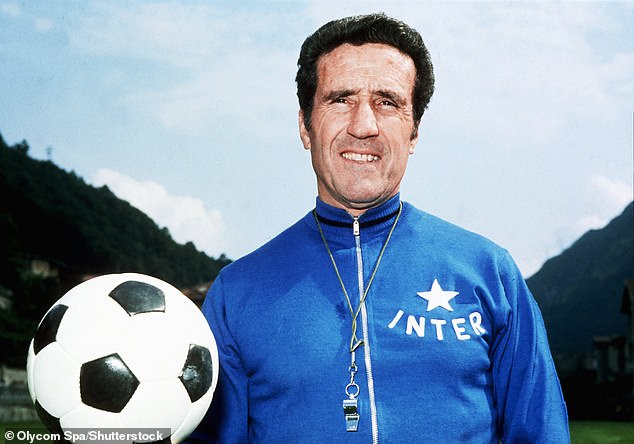
Helenio Herrera spent 37 years managing a variety of clubs including Barcelona and Inter Milan

Herrrera is approached by an angry Jock Stein ahead of the 1967 European Cup final

Celtic took the Italian giants by surprise by winning 2-1, Stevie Chalmers scoring the clincher
‘His best achievement probably was winning back-to-back titles with Atletico Madrid,’ says Fitzpatrick. ‘That is unlikely to ever happen again. My choice for best manager ever would be Alex Ferguson for what he did at Aberdeen and Manchester United and for his longevity, but HH would be in the top five for me.’
It was his presence at Barca and Inter that has made him a lingering, historic presence in both cities.
Fitzpatrick, an Irish journalist, moved to the Catalan city in 2010 and his interest in the coach was piqued by regular mentions of him in the press and on television.
‘He loomed large,’ he says. ‘In many ways the modern culture of Barca begins with him. Johan Cruyff and Pep Guardiola followed. But it is interesting to note that Barca reveres its coaches, Real Madrid doesn’t.
‘People don’t remember the coaches who won five consecutive European Cups for Real Madrid from 1955. But HH is still in the mainstream of Barcelona, with his sayings and his achievements still quoted.
‘He was also part of the start of the El Clasico rivalry. Before he came, Barcelona’s main rivals were the Basque teams or Espanyol while Real had the derby with Atletico.’

Herrera won the Spanish league twice with Barcelona and is still revered to this day
Herrera, who was born in 1910 — though he routinely lied about that — may be seen by modern fans as an intriguing curio. He was much more than that, though.
‘Yes, football nerds would know of him and Celtic fans of any age would recognise him, but he is a colossus of the game,’ says Fitzpatrick. This is no exaggeration.
Herrera’s attention to detail, his focus on fitness, and his tactical genius influenced coaches and thus dictated the direction of the game throughout the world.
Stein and Willie Waddell, who took Rangers to victory in the European Cup Winner’s Cup in 1972, both visited the coach to study his methods. HH is known, too, for his defensive system — catenaccio — that seemed insuperable before it was blown away on a sunny day in Lisbon.
However, he had an impact on the modern culture of coaches in another way.
‘He was the first celebrity manager,’ adds Fitzpatrick. ‘He lived the celebrity lifestyle. He raised the profile of coaches.

Regarded as one of football’s first ‘celebrity managers’, Herrera was also a hit with the ladies
‘He was the first to be really well paid and to attract a prestige greater than his peers. Stein, Matt Busby and Bill Shankly were not well-paid. He was.’
This was gained through an iron will and a fierce determination. ‘At Inter, for example, the president, Angelo Moratti, was an oil tycoon with a huge fortune,’ says Fitzpatrick. ‘Yet HH was ordering him around. Moratti had to bribe HH’s wife with a stipend so she could float ideas with her husband.’
Much of his style can be recognised in the career of Jose Mourinho. ‘HH had a special persona, he created devilment, deflected attention from his team on to himself, and had a massive ego,’ says Fitzpatrick.
‘But I also see similarities to Guardiola. Both are those pain-in-the-a*** managers who are on to you all the time, don’t let up, have that unrelenting intensity. Both Manchester City and HH keep going to the end of the season.’
However, there was darkness to HH that was his alone. He was an advocate of drug-taking by players. There is evidence that he brought the amphetamine culture from Spain to Italy.
He was also a close confidant of Dezso Solti, a survivor of Auschwitz and a kapo under the regime of Mengele. Solti was found to have fixed matches, most spectacularly in favour of Inter.

Herrera chats with Rangers manager Scot Symon and Kilmarnock boss Willie Waddell
However, it is the death of Giuliano Taccola that remains the biggest indictment on the charge sheet against HH. The Roma forward collapsed and died in a dressing room in Sardinia in 1969. Herrera was later charged with manslaughter but was not convicted.
Taccola had a heart condition and his death was put down to ‘bad luck’. Herrera forced him to train on the day of the match even though the forward was unwell. Did the coach’s policy of forcing drugs on his players contribute to the tragedy?
It’s a question that hangs in the air. Fitzpatrick’s dazzling and gripping book, though, reveals much of the truth of an extraordinary character.
Poverty had been a constant companion for Herrera’s family when he was young. Born in Buenos Aires, he was largely brought up in a shanty town in Casablanca. He lost three brothers as a child.
‘His fierce natural intelligence, confidence and ambition pulled himself out of that trap,’ says Fitzpatrick. It led him into others, however.
His greatness was thus marked by scandal and tragedy. It was wounded fatally by Celtic and Stein.

Celtic’s triumph in 1967 took its toll on Herrera and signalled the death knell of his Inter side
‘It was his Waterloo, absolutely,’ says Fitzpatrick of Lisbon 1967. ‘It is highly likely that the Inter players were still on a doping regime but nothing could resist the power and verve of Celtic.
‘HH had won back-to-back European Cups before losing narrowly to Real the previous year. They were runaway favourites. Nobody gave Celtic a chance. He expected to win and they were played off the park. It killed that team.’
Days later Inter lost the Scudetto. They then lost in the final of the Coppa D’Italia. La Grande Inter lay in ruins.
‘He looked for scapegoats and shipped out players. He tried to reinvigorate the side but ultimately failed. Lisbon was the death knell of that great team.’
Herrera died in 1997. He lives on in this remarkable biography. Fitzpatrick has interviewed great names from Jim Craig, Fabio Capello, Ian St John to Sandro Mazzola.
But it is his trip to visit Herrera’s widow in a palace in Venice that evokes much of the life of Il Mago, good and bad. ‘She keeps his flame alive,’ says Fitzpatrick. It burns bright still.