
A British ambassador warned the Government more than two decades ago that Andrew Mountbatten-Windsor’s behaviour as a roving trade ambassador was damaging his country and the Royal Family.
Diplomatic papers leaked to The Mail on Sunday reveal that Andrew, who was recommended for the role by his friend Peter Mandelson, caused deep concern among officials within weeks of starting work.
Patrick Nixon, then ambassador to the United Arab Emirates, said of the then Duke of York’s visit to the region in November 2001: ‘I was particularly alarmed by some crass and offensive remarks about Saudi Arabia and its oil which he made to distinguished Emiratis.’
But it was Andrew’s behaviour at a reception during a return visit the following year that prompted Mr Nixon to complain to the Government.
His concerns reached the head of the diplomatic service at the Foreign Office in London, but it would be nearly ten years before Andrew was forced to quit as UK trade envoy over his links to Jeffrey Epstein.
During this time, he is said to have passed potentially confidential and sensitive documents to the convicted paedophile.
In a letter dated October 15, 2002, and marked RESTRICTED – PERSONAL,
Mr Nixon tells Sir Stephen Brown, the UK Trade and Industry chief executive, that by rudely disregarding a number of dignitaries, including an Emirati royal, ‘the Duke has damaged rather than enhanced our standing and that of the Royal Family’.

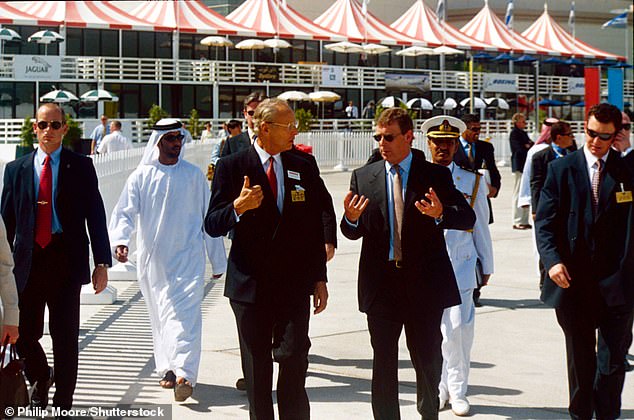
Patrick Nixon, former British ambassador to the United Arab Emirates, said of the then Duke of York’s visit to the region in November 2001: ‘I was particularly alarmed by some crass and offensive remarks about Saudi Arabia and its oil’. Pictured: Andrew Mountbatten-Windsor (centre right) with Sir Charles Masefield in 2001

Andrew with Dubai’s Crown prince Sheikh Mohammed Bin Rashid Al Maktoum in November 2001
The embassy reception on October 9, which was attended by 400 guests, was held to celebrate British engineering firm Halcrow’s 50 years of trading in the Gulf.
One guest, Shaikh Saif, nephew of the ruler of Fujairah on the UAE’s east coast, travelled for four hours to meet Andrew, only to be snubbed after waiting another hour at the reception to greet him.
‘I was obliged to telephone the director of the Ruler’s Court to apologise,’ said Simon Collis, then Consul-General in Dubai. ‘Dr Al Kindi was characteristically courteous but it was clear he felt the gesture was appropriate.’
On receiving Mr Nixon’s letter detailing Andrew’s offensive behaviour, Sir Stephen raised the matter with the Foreign Office.
Writing to Michael Jay, head of the diplomatic service, he said: ‘I find it inexplicable that someone whose own life is governed by royal protocol does not appear to appreciate the harm he is doing.’
Having ‘experienced two similar, though potentially less damaging incidents’ when Andrew visited Singapore, Sir Stephen said he sympathised ‘deeply’ with British diplomats stationed in the UAE.
He concluded that Andrew ‘does our interests no good and himself no service by such ill-considered action’, adding despairingly that the then prince ‘told me he intends to visit the Gulf annually. Does this, or visits to the UK by those offended, provide any opportunity to repair the damage? Or is it best to let the matter drop?’
The embassy imbroglio was detailed in full in an October 15 report by Mr Collis, who noted that Halcrow changed the date of the event to accommodate Andrew as ‘guest of honour’.

Diplomatic papers leaked to The Mail on Sunday reveal that Andrew, who was recommended for the role by his friend Peter Mandelson, caused deep concern among officials within weeks of starting work

On receiving Mr Nixon’s letter detailing Andrew’s offensive behaviour, Sir Stephen Brown raised the matter with the Foreign Office, writing to Michael Jay, head of the diplomatic service
He wrote: ‘We were mindful of the Duke’s behaviour at a reception during his last visit when he arrived late and avoided until the last minute the “majlis” area [sitting places] where senior Emirati dignitaries habitually sit on these occasions.
‘We agreed the Duke should enter the majlis area directly on arrival, greet the assembled dignitaries, be presented with a specially produced commemorative copy of Halcrow’s book from the Chairman (the only photo op of the event) and remain in the majlis while the Chairman made a four-minute speech.
‘The whole process would take no more than ten minutes. HRH would then be free to follow his instincts and mingle freely with the other guests… All this was agreed with Halcrow, and with the Duke’s Private Secretary.’
But ignoring the carefully laid plans, Andrew ‘deliberately instructed his driver to drop him at the public entrance to the garden and plunged into the crowd of guests’.
To the dismay of diplomats, he then rejected their repeated entreaties to ‘attend the majlis’.
Mr Collis said: ‘He brushed off attempts to introduce him to the dignitaries there, preferring to work them himself, with the result that he was not able to greet properly the most senior guest, Shaikh Saif… a young man being groomed for major decision-making.’
Mr Collis, who later became UK ambassador to Saudi Arabia, added: ‘The net effect of this behaviour on both the British exporter and on their most senior Emirati sponsors and clients was negative.’

Andrew in the UAE in November 2001. It was on this visit the former prince allegedly snubbed Shaikh Saif, nephew of the ruler of Fujairah on the UAE’s east coast, who waited hours for a meeting with Andrew
Afterwards Halcrow chairman Tony Allum complained to the Consul-General about the Duke’s behaviour, though ‘more in sorrow than anger’.
‘He noted that he had behaved in similar fashion at an event with Halcrow in the UK earlier in the year,’ wrote Mr Collis.
Mr Collis encouraged Mr Allum to speak with candour when meeting Sir Stephen because he ‘needed to know what experience British businesspeople had of our Special Representative’.
And he concluded witheringly that inviting Andrew to another reception would be ‘counterproductive in terms of relations with Sheikhs and other senior Emiratis (the target audience the duke is most uniquely suited to influencing here) unless we could be confident he is ready to stick to an agreed programme for ten minutes’.
Andrew was forced to give up his trade role in 2011 over his links with Epstein.
From the outset, Charles had expressed concerns about his younger brother’s suitability for the role, but his mother, the Queen, overruled him with the backing from the former trade secretary Mandelson, who, like Andrew, is now under investigation over allegations of misconduct in public office.
At the time, Mandelson said: ‘As a former trade secretary I know of the great importance of trade missions. With a royal association they can achieve a reach into overseas foreign markets which is of immense value to the economy of the country.
‘In that context the Duke of York will have a very important role for which he is well qualified.
‘This activity on behalf of the nation should not be confused with the commercial activities for personal gain which is associated with certain other members of the Royal Family.’