
A turtle with a missing flipper was rescued and successfully rehabilitated in California before being released back into the ocean.
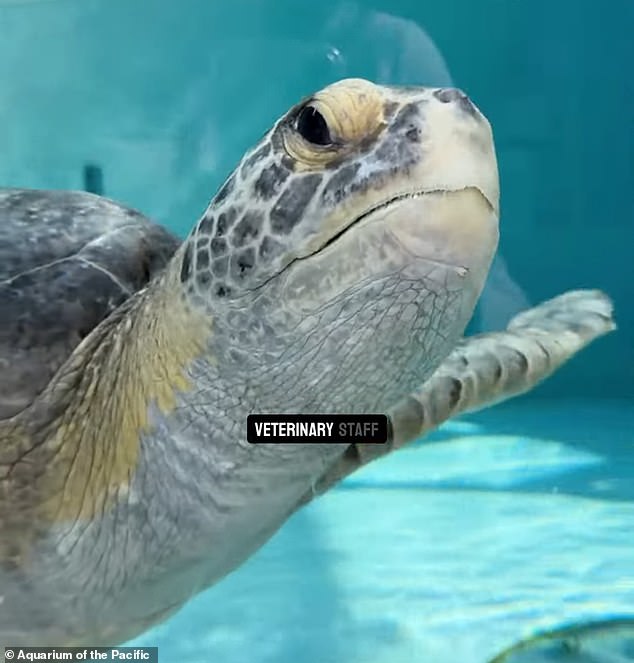
Porkchop, a green sea turtle, spent nearly a year recovering at the Aquarium of the Pacific in Long Beach – about 25 miles south of Los Angeles – before returning to the water.
In a moment that resembled a scene from Finding Nemo, the turtle was released along the San Gabriel River.
The aquarium chose that location ‘because of the proximity to a resident green sea turtle population,’ it said.
Porkchop was rescued in March 2025 with 90 percent of its front flipper dead as a result of no blood circulation.
The severe injury was caused by a fishing line, and further X-rays revealed that the turtle also had a fishing hook stuck in the back of its mouth.
‘When this turtle first arrived, we did not know what the outcome would be because of its critical condition,’ Dr. Brittany Stevens, an aquarium veterinarian, said.
She added: ‘We are thrilled that this turtle was able to heal and gain its strength, so much so that it was able to return home.’

Porkchop, a green sea turtle, was rescued in March 2025 and required a full amputation of one of its flippers

The turtle was nursed back to health at the Aquarium of the Pacific in Long Beach, California, before being released into the San Gabriel River
Veterinarians removed the hook and amputated the dead part of Porkchop’s flipper.
Porkchop was first spotted by volunteers who were monitoring the river as part of a community science program.
They noticed the turtle had been stuck in the same spot and was unable to swim away.
A fishing line tangled in debris had become tightly wrapped around its flipper, fully preventing the reptile from moving.
Rescuing Porkchop took about four hours – and the turtle’s subsequent full rehab took about a year.
‘She was very, very seriously injured,’ Jeff Flocken, the Aquarium of the Pacific’s regional vice president of the Aquarium of the Pacific, told PEOPLE.
He described the surgical procedures that may have saved Flipper’s future as a ‘full amputation.’

Porkchop also had a fishing hook stuck in the back of its mouth, which demanded an hour-long surgery
Two different surgeries were required to begin nursing the turtle back to full health.
The first procedure, which removed Porkchop’s necrotic flipper, lasted about five and a half hours.
A second operation removed the hook wedged in the turtle’s mouth in about an hour.
The aquarium said that Porkchop had adapted seamlessly to living with three flippers.
Green sea turtles can survive in the wild with only three flippers and learn to compensate for a missing limb like human beings, according to the Olive Ridley Project.
Functions that a front flipper usually carries out can be accomplished using the back flipper instead, for instance.
‘She thrived very quickly,’ Flocken told the outlet.

The San Gabriel River, where Porkchop was returned to, has the largest group of green sea turtles in North America

The Aquarium of the Pacific said that Porkchop had already been sighted again by volunteers since being returned to the wild
In fact, Porkchop even became well known to visitors of the Southern California aquarium.
‘She was a bit of a ham,’ Flocken said.
But still, the turtle was excited to be released back into the wild.
‘The minute we pulled the stretcher out from under her, she just swam right away,’ he said.
Porkchop has already been sighted in the San Gabriel River again by volunteers since going back into the water.
We thought it was more important that she had an opportunity to go back out in the wild and live the rest of her lifetime in a natural environment,’ Flocken said.
Green sea turtles do not breed or nest in California, but they migrate to the west coast state’s waters for foraging.
The largest group of green sea turtles in North America is near the mouth of the San Gabriel River, where Porkchop was dropped off.