
Saudi Arabia’s state oil company has warned of ‘catastrophic consequences’ for the world’s oil markets if the Middle East war continues to choke exports, as three commercial shops were attacked in the Strait of Hormuz.
The waterway is a chokepoint in the global oil trade, where roughly 20% of the world’s oil would ordinarily pass through daily.
But as a result of the roiling war, oil shipments have been largely blocked from using the shipping artery. And Iran said on Tuesday would not allow ‘one litre of oil’ to be shipped from the Middle East if US and Israeli attacks continue.
Amin Nasser, the CEO of Aramco, said: ‘While we have faced disruptions in the past, this one by far is the biggest crisis the region’s oil and gas industry has faced.’
He admitted that while his firm, the world’s single biggest exporter of oil, was meeting most of its customers’ needs for now, this was only possible by tapping into storage facilities outside the Gulf.
Nasser said that these stores cannot be used for ‘an extended period of time, but for the time being, we are capitalising on it.’
The CEO said: ‘There would be catastrophic consequences for the world’s oil markets, and the longer the disruption goes on … the more drastic the consequences for the global economy.’
The stark warning comes after three commercial ships were attacked in the Strait of Hormuz.
An attack on the Thailand-flagged bulk carrier Mayuree Naree from an ‘unknown projectile’, which was reported at 4.35am GMT, happened 11 nautical miles north of Oman and resulted in a fire onboard the ship.
The UKMTO, a maritime monitor, said crew are evacuating the vessel.
It added: ‘Vessels are advised to transit with caution and report any suspicious activity to UKMTO while authorities continue to investigate.’
No group or military has yet claimed responsibility.
It comes as:
- Ukrainian president Volodymyr Zelensky warned Russia may send troops to Iran to fight against US and Israeli attacks
- Four people were injured after two Iranian drones struck near Dubai International Airport
- The UN Security Council is set to vote today on a resolution demanding Iran stops attacking its Arab neighbours

American forces destroyed 16 Iranian minelaying vessels near the Strait of Hormuz
Earlier, the Japan-flagged container ship One Majesty had sustained minor damage from an unknown projectile 25 nautical miles northwest of Ras Al Khaimah in the United Arab Emirates, two maritime security sources said.
Its crew members are safe and the vessel is sailing towards a safe anchorage, the sources added.
A third vessel, a bulk carrier, was also hit by an unknown projectile approximately 50 miles northwest of Dubai, maritime security firms said.
The projectile had damaged the hull of the Marshall Islands-flagged Star Gwyneth, maritime risk management company Vanguard said, adding that the vessel’s crew were safe.
The attacks came shortly after American forces destroyed 16 Iranian minelaying vessels near the Strait of Hormuz.
The White House had earlier warned Iran will be hit ‘at a level never seen before’ if they place mines on the Strait of Hormuz amid concerns the regime could target the key oil waterway.
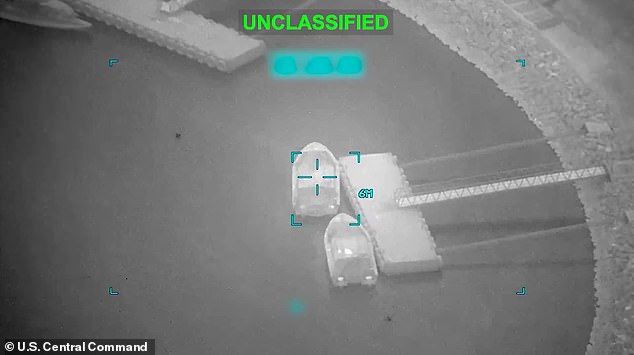
‘US forces eliminated multiple Iranian naval vessels, March 10, including 16 minelayers near the Strait of Hormuz,’ the US Central Command announced on X, with an accompanying video showing some of the strikes.
The Strait of Hormuz is the only sea passage between the Persian Gulf and the Gulf of Oman.
The minelayers near the Strait of Hormuz were among multiple Iranian vessels taken out by US forces on Tuesday.
The military published the figure and unclassified footage of some of the vessels after Donald Trump warned Iran against laying mines in the critical waterway.
As the world continues to reel from skyrocketing fuel prices, the European Commission president Ursula von der Leyen today said that the EU is considering subsidising or cutting gas prices to ‘deliver relief now.’
Gas prices in Europe have doubled since war broke out, and von der Leyen today said in Strasbourg that subsidies or caps could be used to lower the impact when gas sets the price of electricity, which happens when intermittent renewables do not supply power to the grid.
Overnight, the US and Israel traded air strikes with Iran across the Middle East on Wednesday as the besieged Tehran government warned its state security forces were ready with ‘fingers on the trigger’ to confront any anti-government protests.
Following an exchange of some of the heaviest bombardments in the region yet on Tuesday, the combatants renewed their attacks on opposing targets in Israel, Lebanon and the Gulf as the war stretched into its 12th day.
The conflict has effectively blocked vital shipping lanes through the Strait of Hormuz, halting the flow of one-fifth of the world’s fossil energy supplies from the petroleum-rich Gulf.

A map showing the latest attacks in the Strait of Hormuz reported to the UKMTO. The latest attack is marked with an ‘X’

A fireball rises from the site of an Israeli airstrike that targeted an area in Beirut’s southern suburbs overnight March 10 to 11, 2026

An Iranian missile flies toward Israel, amid the US-Israel conflict with Iran, as seen from Jerusalem, March 11, 2026
Further complicating matter, Ukraine’s President Volodymyr Zelensky claimed Russia could become the first country to send troops to Iran to fight against the US and Israel amid reports Moscow is sharing intelligence with Iran.
Vladimir Putin has denied providing information to Iran to help target American forces in the Middle East during a phone call with Donald Trump earlier this week.
It comes after the Washington Post reported the Kremlin has passed Iran the locations of American military assests including warships and aircraft.
Overnight, millions of Israelis were repeatedly driven into bomb shelters as the military warned Iran had launched missiles toward Israel, a sign that Tehran retains the capacity to strike Israel after nearly two weeks of hostilities.
The sound of explosions from air defences intercepting the rockets punctuated the pre-dawn darkness as air raid sirens blared and Israelis scrambled to safe rooms and shelters.
There was no immediate word of whether any of the missiles reached the ground.
Iran’s armed forces spokesman Abolfazl Shekarchi on Wednesday urged regional countries and fellow Muslims to indicate ‘US-Zionist [Israeli] hiding places’ to maximise the precision and impact of Iranian strikes, while minimising harm to civilians, who he said are ‘used as human shields’, according to Defapress, a news outlet affiliated with the military.
Shekarchi also said that Iran will respond to recent U.S.-Israeli strikes in residential areas.
The latest attacks from Iran roughly coincided with a new Israeli barrage on Beirut aimed at rooting out the Iran-backed group Hezbollah, which has fired into Israel from Lebanon in solidarity with the Tehran government.
Explosions were also heard in Beirut and in southern Lebanon after Israel said it had started a new assault on targets related to the Iranian-linked militia Hezbollah.
The attacks set a building ablaze in central Beirut in the densely populated Aicha Bakkar area, engulfing the top two floors of the multi-storey structure. There were no immediate reports of casualties from the strike, which came without warning.
An earlier Israeli strike killed five people in the Nabatieh district in southern Lebanon, while two more were killed in strikes in the Tyre and Bint Jbeil districts, Lebanon’s health ministry said.
A Red Cross worker also died as a result of wounds sustained on Monday, when his team was hit by an Israeli strike while they were rescuing people from an earlier attack.
Nearly 500 people have been killed so far in Lebanon since Hezbollah triggered the latest round of fighting with Israel when it fired rockets into the country’s north after the American and Israeli attacks on Iran started.
In response, France today said it will send 60 tonnes of aid to Lebanon.
French foreign minister Jean-Noël Barrot said the aid would arrive by Thursday, and would include ‘sanitation kits, hygiene kits, mattresses, lamps and a mobile medical post’ amid strikes on Lebanon.
Israel warned of three Iranian attacks early on Wednesday, with sirens heard in Tel Aviv and elsewhere but no immediate reports of casualties.
In addition to Iranian attacks targeting Saudi Arabia’s oil fields, the kingdom’s defence ministry said it had destroyed six ballistic missiles launched toward Prince Sultan Air Base, a major US and Saudi-operated air facility in eastern Saudi Arabia.
The ministry also said it intercepted and destroyed two drones over the eastern city of Hafar al-Batin.

Emergency personnel work at the site of an Israeli airstrike that targeted a building in Beirut’s Aisha Bakkar neighbourhood on March 11, 2026

Lebanon was drawn into the Middle East war last week when Hezbollah attacked Israel in response to the killing of the Iranian supreme leader in US-Israeli strikes
Two Iranian drones have struck near Dubai International Airport, wounding four people though flights continue, authorities said.
The Dubai Media Office, which issues statement on behalf of the city-state’s government, said the attack caused ‘minor injuries to two Ghanaian nationals and one Bangladeshi national, and moderate injuries to one Indian national.’
It said flights are continuing.
Dubai International Airport, home to the long-haul carrier Emirates, is the world’s busiest for international travel. Authorities have been trying build up its flight schedule though the airport has been targeted in the war.