
Regardless of how things pan out in the title race over these next couple of months, Rangers are already well under way with their plans for next season.
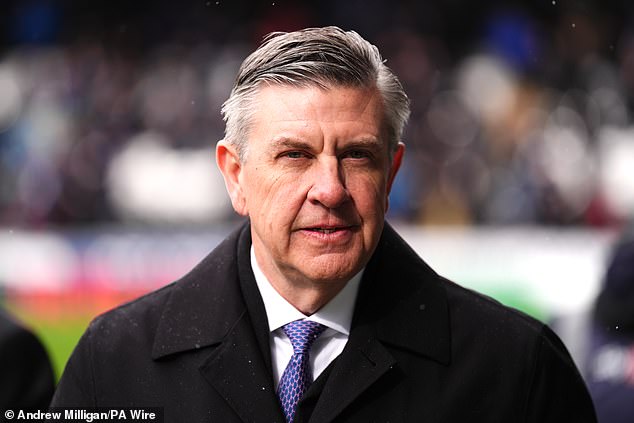
It was announced on Wednesday by chairman Andrew Cavenagh that a fresh investment of £16million will be generated through a new share issue.
That effectively sets a rough initial budget for Danny Rohl, with the potential for more funds to be added to the transfer kitty through any player sales.
Rohl spoke last week about the fact discussions had already started with regards to squad planning and recruitment for the summer.
All of this is sound practice. The fact that Rangers are making early inroads in these areas undoubtedly gives them an edge over their rivals across the city.
For a start, Celtic still don’t know who their manager will be next season. There is no recruitment structure to speak of, heading into a summer when the squad will need the football equivalent of open-heart surgery.

Rangers chairman Andrew Cavenagh has got fans excited with the new £16million share issue
When Martin O’Neill laid bare the extent of the problem in January, he was blunt and honest. Celtic’s efforts to sign new players sounded like back-of-a-fag-packet stuff.
Looking at the three title contenders, you can bet your bottom dollar that Tony Bloom and Jamestown Analytics have, like Rangers, already started drawing up a list of transfer targets.
And, of all three clubs, it’s still Hearts, with their data-driven approach, whom you would trust to spend their money most wisely.
As was the case in January, this summer transfer window is shaping up to be massive for all three clubs, regardless of who ends up lifting the league trophy.
In his address to supporters earlier this week, Cavenagh pointed out that the cash raised by the Americans since their takeover last year now stands at £36m.
A total of close to £40m has already been spent on players across two transfer windows, albeit the net spend would be just shy of £20m once player sales are accounted for last summer.
Nobody can question the level of commitment being shown by Cavenagh and his fellow investors. They backed Rohl in January and will do so once again in the summer.

Celtic’s Michel-Ange Balikwisha, signed for £5m, failed to shine against Auchinleck Talbot
But money in itself does not guarantee success. Just look at Celtic. Their demise this season is rooted in their squandering of a dominant financial position over the rest of Scottish football.
In their latest interim accounts posted last month, Celtic had cash reserves just shy of £70m sitting in the bank. The rainy-day fund, largely untouched, at a time when the roof is in danger of caving in due to flooding.
It is simply not true to say that Celtic haven’t spent money over these past few years. The problem is that they have too often spent it on average players.
Given that Cavenagh and the Americans are still relatively new to the scene in Scottish football, this is perhaps one of the biggest lessons they can learn from.
Over these past few years, Celtic have delivered a masterclass in how not to run a football club behind the scenes.
With access to Champions League riches far more frequently than any of their domestic rivals, as well as a few big windfalls from player sales, they had a chance to really build something.
But, as this season has proven, Celtic’s house was built on sand. That is a mistake that Cavenagh must not repeat in his efforts to build an empire at Ibrox.
Pumping money into the playing squad will be a welcome and necessary course of action. But only if it aligns with the wider structure of the club.

January arrivals Tochi Chukwuani, Andreas Skov Olsen and Tuur Rommens are paraded at Ibrox
It was, and remains, utterly absurd that Celtic actually spent more money on legal costs to fight red cards and SFA charges in January than they did on transfer fees, arming O’Neill with only a few loan signings.
As far as Rangers are concerned, judgment should be reserved on the overall structure of the club behind the scenes.
Cavenagh explained earlier this week that there are no plans for the club to replace Kevin Thelwell and appoint a new sporting director. The main reason why Rangers have declined to make a new appointment in that role is because they are not a fan of the model.
It was felt that Thelwell had too many different areas to oversee and thus the quality of his input into each department became diluted.
Rangers want a tighter, more streamlined approach at executive level and it is on that basis that they intend to conduct their transfer business in the summer.
Recruitment will be led by Rohl, technical director Dan Purdy, and Stig Inge Bjornebye, the Norwegian who arrived on a consultancy basis in December and whom Rangers are keen to retain beyond the summer.
But it is worth nothing that Robbie Thelwell is still there as head of recruitment for the men’s first team. Likewise, Nathan Fisher as chief scout.
If Cavenagh is keen to streamline certain areas of the club, then the recruitment department does still look to be somewhat bloated with several guys doing similar jobs.

Hearts have had great success with their data-led model, particularly with Kyziridis and Braga
In announcing the new share issue, along with a 6.5 per cent increase in the price of adult season tickets, Cavenagh reaffirmed his belief that the playing squad still needs further investment.
It is not only player sales that will determine what sort of cash can be added to that initial figure of £16m. The possibility of Champions League qualification will also play a huge factor.
Even if Rangers go on and win the league, they would not have direct entry into the main competition. Instead, they would have to go through the qualifiers due to Scotland’s falling co-efficient.
The nation’s co-efficient, calculated over a five-year period, has taken a battering these past couple of seasons and this is something which has profound implications for all concerned.
The SPFL Premiership is now almost certain to have only one Champions League place after next season due to poor results over these past few years. Teams will also have to enter in the earlier rounds of the qualifying stages, thus making it more difficult to reach the main competition itself.
What sort of players would Rangers be able to attract if they were consigned to the Europa League?
Or, to flip that on its head, the level of finance available to Rohl and calibre of player would surely be so much greater if the club can get into the Champions League.
So whilst Cavenagh will be commended for helping to provide fresh investment and backing Rohl, none of it is a guarantee of success.
In the summer, the club have no desire to make radical changes to the squad or to have another overhaul as witnessed last year.

Honduran winger Luis Palma was essentially a £3.5million flop for Celtic
Instead, they intend to be more considered, making incremental improvements. Rangers feel like they did good business in January by bringing in Tochi Chukwuani, Tuur Rommens, Ryan Naderi and Andreas Skov Olsen.
Rommens has already proven himself to be an excellent addition at left-back. Chukwuani is a powerful figure in midfield and adds a good presence.
But the jury remains out on Naderi and Skov Olsen. Signed for just shy of £5m, Naderi has yet to score a league goal in seven appearances, whilst Skov Olsen just hasn’t got going at all following his loan move from Wolfsburg.
Rangers hold an option to buy the Danish international winger for £8m in the summer, but he has shown nothing so far to warrant that type of outlay.
There is no question that Rangers could afford him. But could they really justify spending half of Rohl’s initial budget of £16m on a player who has thus far flattered to deceive? Probably not.
These questions around recruitment still need to be answered. As Celtic fans would no doubt testify, being armed with a few quid in the bank does not offer any guarantee of success.