
President Donald Trump announced Wednesday that there are two or three weeks left in the war against Iran and that the regime is “really no longer a threat.” What exactly will be done during, and after, those remaining two to three weeks is unclear.
But, for now, the economically vital Strait of Hormuz remains shut, and over the past few weeks, the U.S. has transferred thousands of ground troops to the region. Given the administration’s shifting goalposts and unclear messaging over the last few weeks, escalation is still not outside the realm of possibility. And any further escalation of the conflict would probably mean boots on the ground.
But after decades of costly, ultimately futile wars in the same part of the globe, the prospect of another ground conflict in the region is deeply unpopular with most Americans. Such a move, if taken, would almost certainly tank President Donald Trump’s already wavering approval rating, sink Republican prospects for the midterms and even 2028, and mar his legacy with a long Middle East war he promised to avoid.
In light of that, our other options are to continue the air and naval war alone without a ground element, or, as some have suggested, to begin arming the Iranian people (or other groups like the Kurds and Azerbaijanis) so they can overthrow the regime themselves. Even if the U.S. stops its direct military actions against Iran in the coming weeks as Trump suggested, the administration could still arm and train Iranians to destabilize the regime from the inside.
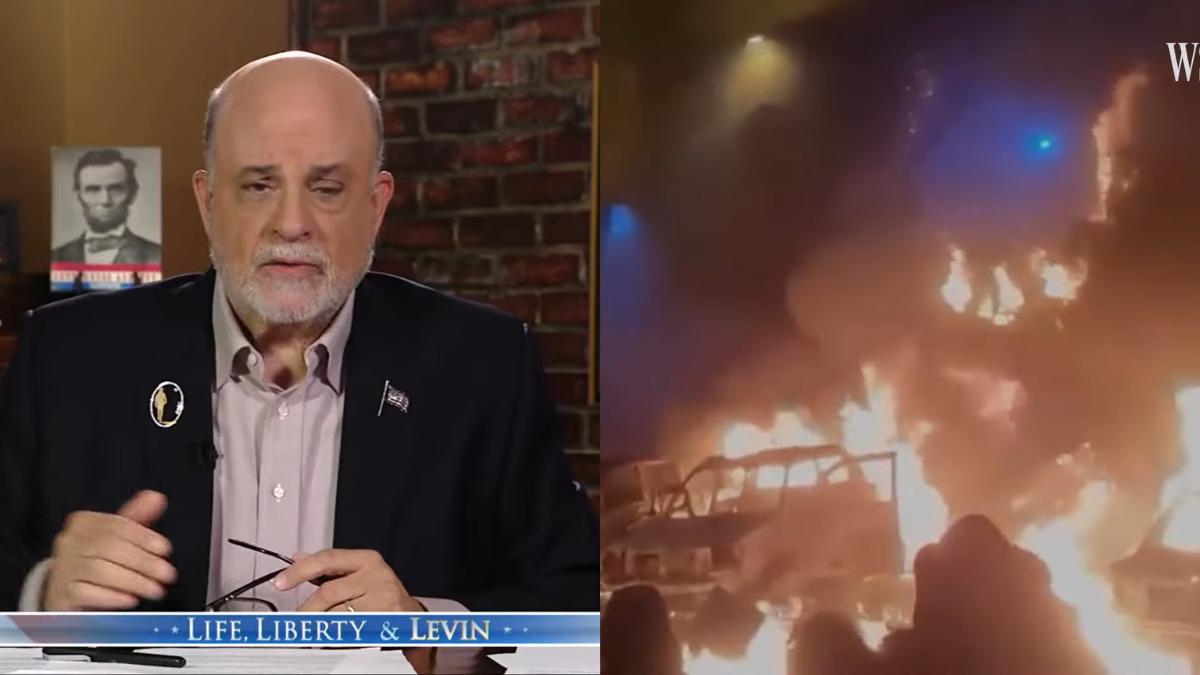
Reagan admin veteran (as if he’d ever let you forget it) and neocon political commentator Mark Levin emphatically endorsed the latter option Tuesday.
“ARM THE IRANIAN PEOPLE IMMEDIATELY!” he posted on X. “I’ve been calling for this for weeks on radio. One thing we can do, which Reagan did in Afghanistan, Angola, and Nicaragua, is ARM THE PEOPLE in Iran so they are no longer butchered by these monsters without the ability to fight back! They will rise up as a real fighting force, but they need weapons! And it must be done IMMEDIATELY, especially if we are talking about ending our military operation in a few weeks!”
I’m sure Levin typed that post while wearing his finest set of rose-colored glasses, but even the most diehard Reagan fan or the casual observer of recent U.S. foreign policy can see that arming rebel groups against an enemy regime hasn’t had the best track record for the U.S. In fact, it’s often ended in high-profile, embarrassing disasters for us. But neocons seem to like that sort of thing, so they’re going to keep peddling these garbage ideas, no matter the second- or third-order consequences for our nation.
First off, you can’t just throw guns at a bunch of civilians and expect them to be a “real fighting force.” They have to be trained if they’re going to even stand an inkling of a chance against an organized military force. So, someone would obviously have to train them. Something tells me that someone would be us. Not only would that entail our continued involvement, but it risks dragging us further into the war (remember that we initially went into Vietnam to merely train the South Vietnamese military, after all). Besides, we’ve seen how effective U.S.-trained soldiers have been when fighting on their own in Syria, Iraq, and Afghanistan.
In 2015, the Pentagon set out to train up to 15,000 rebels to help take on ISIS and topple Syrian President Bashar Al-Assad. Five hundred million dollars later, we had only managed to train a few dozen men, and those who actually made it to the battlefield were quickly killed, captured, or fled. Some of them even surrendered their equipment over to terrorists in return for safe passage out of the country. A separate CIA effort to train rebels also met a dismal end and was thankfully cancelled by Trump in his first term.
Meanwhile, the Iraqis and Afghans we spent untold resources and man-hours on training to defend their own homelands cut and ran at the first sight of major combat against ISIS and the Taliban, respectively. Their cowardice left mountains of U.S.-provided equipment in the hands of terrorists, who subsequently distributed them to other militant groups.
“But that was during the incompetent Bush 43 and Obama years. Reagan knew how to do it right!” Levin might respond. But, as it turns out, the exact three examples Levin cited also turned into fiascos for the United States.
The Reagan administration provided support to the anti-communist militant group UNITA against the communist MPLA during the Angolan Civil War. From the mid-80s to early-90s, the U.S. provided tens of millions of dollars in aid to UNITA, including state-of-the-art Stinger missiles, in an attempt to curtail Soviet and Cuban influence in Angola. This aid turned out to be for naught, as the MPLA eventually won the civil war. The MPLA, though it has shed some of its communist tenets, still rules Angola to this day. In recent years, Angola has cozied up to China, negotiating lucrative deals for its substantial oil and mineral reserves.
Levin, in an extremely puzzling move, cited Nicaragua as a positive example of the United States supporting rebels against a hostile regime. The Reagan administration helped fund the Contras, anti-communist guerrillas who opposed the Marxist Sandinista movement, which had just taken control of the government of Nicaragua. The catch came with how the U.S. was funding the Contras. In 1984, Congress had passed legislation cutting off aid to the Contras, but the Reagan administration was still determined to prop up the rebels.
So, the Reagan administration raised funds to funnel to the Contras by selling weapons to … Iran. The U.S. government sold tens of millions of dollars worth of weapons to the same Iranian regime we’re currently at war with and then used proceeds from those sales to fund rebel bands in Nicaragua.
The resulting Iran-Contra affair was a massive scandal during the Reagan era. And, much like in Angola, it didn’t change much. The Sandinistas negotiated peace with the Contras in 1990, and free elections saw the ousting of the Sandinistas from power. However, the party returned to power in 2006 and has ruled the country ever since.
After the Soviet Union invaded Afghanistan in 1979, the United States began to provide support for the mujahideen, guerilla fighters that flocked to Afghanistan from all over the Muslim world to engage in a holy war against the Russians. Under Operation Cyclone, the CIA hoped to bog the Soviet Union down in a quagmire similar to how the U.S. had been in Vietnam. We trained mujahideen fighters and provided them with hundreds of millions of dollars in weapons, including Stinger missiles, and equipment during the decade-long war, which eventually saw the Soviets withdraw in humiliating fashion. This time, we actually achieved our aims by arming and organizing Third World religious zealots.
And how did that work out?
Oh.
Um, it didn’t work out very well at all.
One of those mujahideen fighters was Osama bin Laden, though there is debate on whether he ever received direct U.S. aid. Our attempt to hobble our Cold War nemesis resulted in a domino effect that led to the rise of the Taliban, the emergence of al-Qaeda, 9/11, the war in Afghanistan, and the disastrous withdrawal orchestrated by the Biden administration in 2021. Our aid to Afghanistan in the 1980s is now probably the most well-known instance of blowback — the unintended negative consequences of a political act — in the history of U.S. foreign policy.
As we’ve seen, the strategy of arming the locals can be simply ineffective or can spiral into era-defining disaster. Providing guns and training to the Iranian people so that they can take on the regime themselves *might* work, but the best you’re going to get out of that is a long civil war and an uncertain future. But the potential second-and third-order consequences, especially involving a state with over 90 million people and access to the building blocks of a nuclear weapon, are too great to risk it.
Levin and others like him may live in the realm of “true neoconservatism has never been tried,” but the American people see it for the fantasy that it is, and they want to keep it that way.
Hayden Daniel is a staff editor at The Federalist. He previously worked as an editor at The Daily Wire and as deputy editor/opinion editor at The Daily Caller. He received his B.A. in European History from Washington and Lee University with minors in Philosophy and Classics. Follow him on Twitter at @HaydenWDaniel