
As the smoke clears from the explosion of the Blue Origin New Glenn rocket, people are realizing that more than a rocket and the launchpad went up in a blazing ball of fire last night.
It wasn’t a setback; it was a near-fatal blow to Jeff Bezos’ spaceflight company, and an almost certain fatal blow to Amazon’s Starlink competitor Amazon LEO.
This angle is even crazier pic.twitter.com/LuLG3frNw2
— Sawyer Merritt (@SawyerMerritt) May 29, 2026
The New Glenn rocket was designed not just to compete with SpaceX; it was a necessary component of Amazon’s plans to get into the space-based internet market.
Blue Origin has had a fundamentally different development model from SpaceX, which plans for and expects new rockets to spectacularly fail as part of its rapid-iteration philosophy of rocket development. They even invented a name for the phenomenon that has almost become a joke: RUD, for Rapid Unscheduled Disassembly. That’s why you often see SpaceX folks laughing and cheering even after failures; they know the next try will be soon, and that the resulting product will be better and safer.
Zoomed in and upscaled the audio synchronized video of the New Glenn explosion from NSF 😱 pic.twitter.com/VbDKbz8dYV
— Gator Gar (@gatorgar) May 29, 2026
Blue Origin has followed the Boeing/NASA/ULA model: design the rocket to within an inch of its life before ever lighting the candle. It’s hardly a perfect system, but it’s also how NASA built the amazing Apollo system that flew us reliably to the moon. It’s slow, very expensive, but potentially a brittle system because failures come at a much higher cost than SpaceX’s.
Blue Origin just vaporized a rocket, a launch pad, and Amazon’s entire satellite deployment timeline in nine seconds.
NG-4 was supposed to fly June 4 carrying 48 Amazon Leo satellites. That mission was the first of 24 contracted Blue Origin launches Amazon needs to build its… https://t.co/Pz2Su6925C
— Aakash Gupta (@aakashgupta) May 29, 2026
Blue Origin just vaporized a rocket, a launch pad, and Amazon’s entire satellite deployment timeline in nine seconds.
NG-4 was supposed to fly June 4 carrying 48 Amazon Leo satellites. That mission was the first of 24 contracted Blue Origin launches Amazon needs to build its Starlink competitor. Amazon has roughly 240 satellites in orbit against an FCC requirement of 1,618 by July 2026. They already filed for a two-year extension because they were falling short. Losing your primary heavy-lift rocket on the pad doesn’t help that math.
The pad damage is the part people aren’t thinking about. New Glenn carries roughly 2.4 million pounds of propellant. The explosion toppled one of LC-36’s lightning protection towers. That launch complex took years to build and billions to outfit. You can manufacture a new rocket in months. You cannot rebuild a launch pad in months.
The cascade gets worse. Blue Origin’s Blue Moon MK1 lunar lander is supposed to launch on New Glenn this fall for NASA’s CLPS program. That mission is the pathfinder for Artemis III, which needs Blue Moon MK2 to fly on New Glenn in mid-2027 to land astronauts at the lunar south pole. Every month LC-36 sits damaged pushes Artemis further into the late 2020s.
Jeff Bezos has two companies betting on the same rocket. Amazon Leo needs 24 New Glenn launches to close the gap with Starlink. NASA needs New Glenn for Artemis. Both timelines just broke simultaneously, and LC-36 is on fire.
It took SpaceX only 6 years from its founding to reach orbit with its Falcon 1 rocket, including time to get started and hire people. It has been delivering payloads to orbit ever since, and now has about 90% of the launch market.
The blast bent those steel beams on the tower inwards: pic.twitter.com/VAw1o3L8WW
— Scott Manley (@DJSnM) May 29, 2026
It has taken Blue Origin 25 years to get to orbital flight, and its payload delivery has been insignificant and spotty, delivering satellites that NASA considered expendable. Until last year, Blue Origin had only conducted sub-orbital tourist flights.
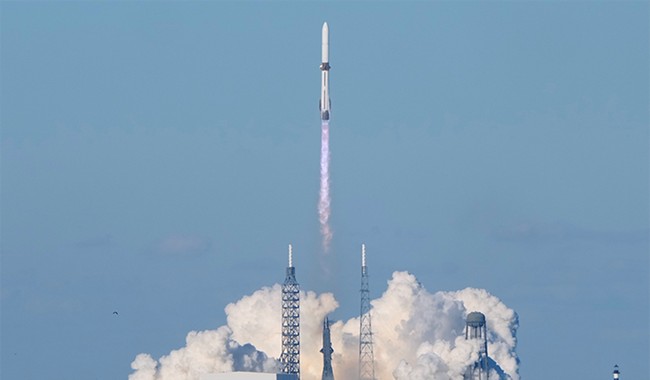
A powerful New Glenn rocket owned by Jeff Bezos’ Blue Origin exploded in a spectacular fireball Thursday, sending billowing clouds of fire, smoke and flaming debris into the night sky in a tremendous conflagration visible for miles around.
The explosion occurred around 9 p.m. EDT as engineers were counting down to a brief test firing of the New Glenn’s seven methane-fueled BE-4 first stage engines at the Cape Canaveral Space Force Station. Blue Origin was gearing up for a June launch to put a batch of Amazon “Leo” internet satellites into orbit.
As the engines appeared to begin firing, something clearly went wrong at the base of the rocket. The 188-foot-tall first stage became enveloped in a rapidly growing fire and moments later, the 86-foot-tall upper stage could be seen tilting and starting to fall as the first stage apparently began collapsing.
Then the vehicle suddenly exploded as its load of methane fuel and liquid oxygen ignited in a roiling fireball.
The rocket was destroyed, and as the smoke cleared, there was no sign of the erector-gantry used to move the New Glenn from its hangar to the pad and to raise it from horizontal to vertical. Likewise, one of two tall lightning towers was no longer visible.
The Amazon Leo satellites were not on board for the hot-fire test.
The cause of the explosion and what might be required to fix the problem will await a detailed analysis of telemetry and launch pad video. As for the pad, video from news helicopters well after the explosion showed multiple fires and apparently severe damage.
What makes Blue Origin’s failure yesterday so important isn’t just that its rocket exploded, but the only launch pad it has was destroyed as well, and launch pads take time to build, the rocket is apparently fundamentally flawed and not designed for rapid iteration, and Amazon LEO is on a very tight timeline to deliver satellites to orbit, lest they lose their launch licenses.
A New Glenn rocket has 5.5 GWh of energy (first and second stage).
The Little Boy bomb dropped on Hiroshima had 17.5 GWh of energy.
The largest non-nuclear blast was Operation Minor Scale (1985) with 4.65 GWh of energy.
The largest non-nuclear accidental blast was the Halifax… https://t.co/ODfrcyWdQh
— Robert Graham (@robertgraham) May 29, 2026
A New Glenn rocket has 5.5 GWh of energy (first and second stage).
The Little Boy bomb dropped on Hiroshima had 17.5 GWh of energy.
The largest non-nuclear blast was Operation Minor Scale (1985) with 4.65 GWh of energy.
The largest non-nuclear accidental blast was the Halifax explosion (1917) with 3.37 GWh of energy.
Amazon, according to its current license, must reach a milestone of 1,601 satellites in orbit to meet the federal government’s timeline.
It is currently 1,387 satellites short of that. It needed New Glenn’s massive payload capacity to get anywhere close, even if they get a two-year extension of the deadline as they have requested.
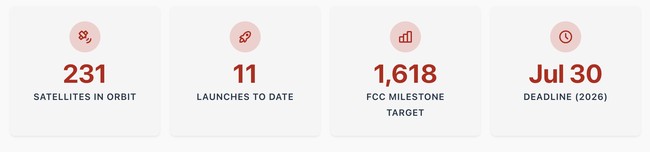 Any way you cut it, the math doesn’t math. If the feds give an extension, Amazon has no choice but to have SpaceX deliver the satellites. Only they have the launch cadence to get that many satellites to orbit. New Glenn was supposed to solve that problem. And be cheaper than most rockets, as it is partially reusable.
Blue Origin’s New Glenn rocket booster landing successfully on a drone ship pic.twitter.com/FGaYuZAGX5
— StarSnap 🌟 (@StarSnap_1) April 21, 2026
Amazon’s satellites are also more expensive and more complicated than SpaceX’s, likely meaning fewer delivered per launch. In fact, New Glenn was overkill for almost any launches other than for Amazon LEO. It’s not a competitor to the Falcon 9 rocket; its more akin to Falcon Heavy, which has only had to launch 12 times since it began operation.
The ratio of Falcon 9 to Falcon Heavy launches is 29 to 1.
🚨 🚨 BEZOS HAS 3 OPTIONS LEFT AFTER NEW GLENN’S LAUNCHPAD EXPLOSION. ALL 3 ARE CATASTROPHIC.
This is the moment nobody wants to talk about.
After years of development, a $1B+ heavy-lift rocket program, and a final ground test before Amazon’s Kuiper satellite mission → Blue… pic.twitter.com/Kdsd1k3vBb
— 🇨🇳 Liu Feng 刘锋 (@LiuInTheShadows) May 29, 2026
🚨 🚨 BEZOS HAS 3 OPTIONS LEFT AFTER NEW GLENN’S LAUNCHPAD EXPLOSION. ALL 3 ARE CATASTROPHIC.
This is the moment nobody wants to talk about.
After years of development, a $1B+ heavy-lift rocket program, and a final ground test before Amazon’s Kuiper satellite mission → Blue Origin is now boxed into THREE choices. And every single one is a nightmare:
⚠️ OPTION 1: REBUILD LC-36 FROM SCRATCH
– The only launchpad Blue Origin owns is now a debris field
– One 600-foot lightning tower toppled. Erector-gantry: gone. Ground equipment: destroyed.
– Pad rebuilds after a full vehicle explosion take 12–24 months minimum
– Amazon’s Kuiper constellation — already years behind SpaceX Starlink — falls further behind
– Every month of delay costs Amazon market share it cannot get back
⚠️ OPTION 2: BORROW OR BUY LAUNCH CAPACITY FROM A COMPETITOR
– The only competitor with available heavy-lift pads is SpaceX
– Asking your direct rival for a launchpad is not a business negotiation — it’s a surrender
– SpaceX has every incentive to slow-walk, overcharge, or simply say no
– Amazon would be funding the company that is actively destroying Kuiper’s market window
– Jeff Bezos built Blue Origin specifically to avoid this dependency
⚠️ OPTION 3: ABSORB THE DELAY AND KEEP INVESTING
– New Glenn’s first stage was enveloped in fire during a routine hotfire test — the final check before orbital flight
– The vehicle collapsed. The upper stage tilted and fell. Fires burned at multiple stories
– This wasn’t a launch failure. This was a ground test. The hardest problems haven’t even been attempted yet.
– Blue Origin has no second pad, no backup vehicle, and no timeline for the next attempt
– And Starlink already has 7,000+ satellites in orbit
Let that sink in.
There is no Option 4. There is no clean exit. There is no “we rebuild and catch up by Q4.”
The media is showing you “rocket science is hard” and “no injuries reported.”
They’re NOT showing you that Blue Origin just destroyed its only launchpad — the single piece of infrastructure that connects years of development to an actual orbital mission — three hours before midnight on May 28, 2026.
Adding to Blue Origin’s woes is the fact that Bezos is looking for other investors as it burns through cash. It’s been around 26 years without seeking outside investors, demonstrating that Bezos was willing to dip into his deep pockets to keep it going. Apparently, he wanted others to invest to ease the burden.
At the same time, SpaceX is going public, with an expected value of $2 trillion. The contrast is stark.
SpaceX didn’t need New Glenn to fail—the market barely overlaps—so there is no elation over there. But Bezos needed New Glenn to succeed, and quickly.
This doesn’t spell the end of New Glenn or Blue Origin, which has some great engineers, just as Boeing does. But it does call into question the business model, and the delays will be devastating.
It’s sad. Competition is good, and the more paths to orbit, the better.
Editor’s Note: Do you enjoy HotAir’s conservative reporting that takes on the radical left and woke media? Support our work so that we can continue to bring you the truth.
Join HotAir VIP and use promo code FIGHT to receive 60% off your membership.