An eyelash curler, a pizza oven and a bottle of “very good white wine” are among the luxuries selected by celebrity guests on the long-running BBC radio programme Desert Island Discs.
When comedian and author David Walliams appeared on the programme in 2009, he chose a gun. He said that if he were forced to endure extreme loneliness, he would want the means to end his life.
“I can’t stand being on my own,” he said. “I hate it. I have a pathological fear of being on my own. When I am with my own thoughts I start to unravel and I start to think self-destructive thoughts.”
Presenter Kirsty Young sounded taken aback. Walliams, however, was not joking.
As with many aspects of his life and troubled inner world, there was little humour in the admission.
That has never seemed more apparent than now, as Walliams faces allegations from several women who claim he groomed them when they were teenagers and subjected them to sexual assault or inappropriate sexual contact. Walliams denies all the allegations.
Raised in suburban Banstead, Surrey, Walliams rose to fame through the sketch show Little Britain, alongside Matt Lucas, before becoming a household name as a judge on Britain’s Got Talent, ITV’s biggest Saturday-night programme.
He also became one of the world’s most successful children’s authors, selling more than 60 million books. His publisher, HarperCollins, dropped him last December amid allegations of inappropriate behaviour towards some female employees.
After finding fame, Walliams was diagnosed as bipolar and has spoken candidly about the profound unhappiness that has affected him for much of his life. His emotional turmoil has apparently made it difficult for him to maintain a long-term relationship.
Instead, he has described a succession of intense infatuations with women who were, in some cases, unattainable friends. They have reportedly included television presenter Lisa Snowdon, actress Kate Beckinsale and singer Natalie Imbruglia.

David Walliams progressed from early fame on the sketch show Little Britain to mainstream success on Britain’s Got Talent, then ITV’s biggest Saturday-night programme
It is now alleged that he also pursued romantic relationships with young women who admired him, some of whom were still teenagers. According to the allegations, he invited them to watch him working on Britain’s Got Talent, attend comedy tours or visit him at home.
Walliams accepts some of the conduct described in the allegations. He disputes the claim that any of it was non-consensual.
So what can his history, public statements and relationships reveal about David Walliams’ sexuality and his attitude towards women?
David Williams was born in London on August 20, 1971, the youngest child of Kathleen and Peter Williams. He later changed the spelling of his surname for Equity registration purposes because another actor was already using the name David Williams.
His father, Peter, worked as an engineer for London Transport, while his mother, Kathleen, was a school laboratory assistant. She was also a Brown Owl, the adult leader of a local Brownie group, for many years.
Walliams has portrayed his father as distant. He said Peter did not listen when Little Britain was first broadcast on radio and did not praise the programme when it later became a television success.
“I never felt good enough to be his son,” Walliams wrote in his 2012 autobiography, Camp David.
When Peter died in 2007, the message on David’s wreath read: “All I ever wanted was to make you proud.”
Walliams has said his mother “overcompensated” for Peter’s emotional distance, surrounding him and his sister Julie with affection and attention.
He has described the period before he started school as the happiest time of his life. He and his mother would sit in the kitchen, eat mince and mash for lunch and listen to Jimmy Young’s programme on BBC Radio 2.
He enjoyed attending Cubs, part of the Scout movement, and has written that he had his first sexual experience at the age of ten, when another boy invited him into his tent.
He described further experimentation after joining the Sea Scouts. The group was led by a former merchant seaman. “Most of the games we played in the hall involved him chasing and spanking us,” Walliams recalled. “What happened at the Sea Scouts wasn’t sexual abuse as such, it all felt more innocent than that, but it was still very strange.”
He continued: “Of course we would fiddle with each other in the dark. One boy I developed a sustained attraction for, and we would often pair off.
“After we were intimate he would be so full of anger at what he had done he would become violent with me. My whole experience of sex at this time can be summed up in one word. Shame.”
At primary school, Walliams says he was called “gay” almost every day in the playground. Although he described the taunts as cruel, he said he understood why other children made them because he was “inescapably effeminate”.
“The way I ran, the way I threw a ball, the way I talked, the way I flicked my hair… was just like a girl. In my case, a big fat ugly girl.”

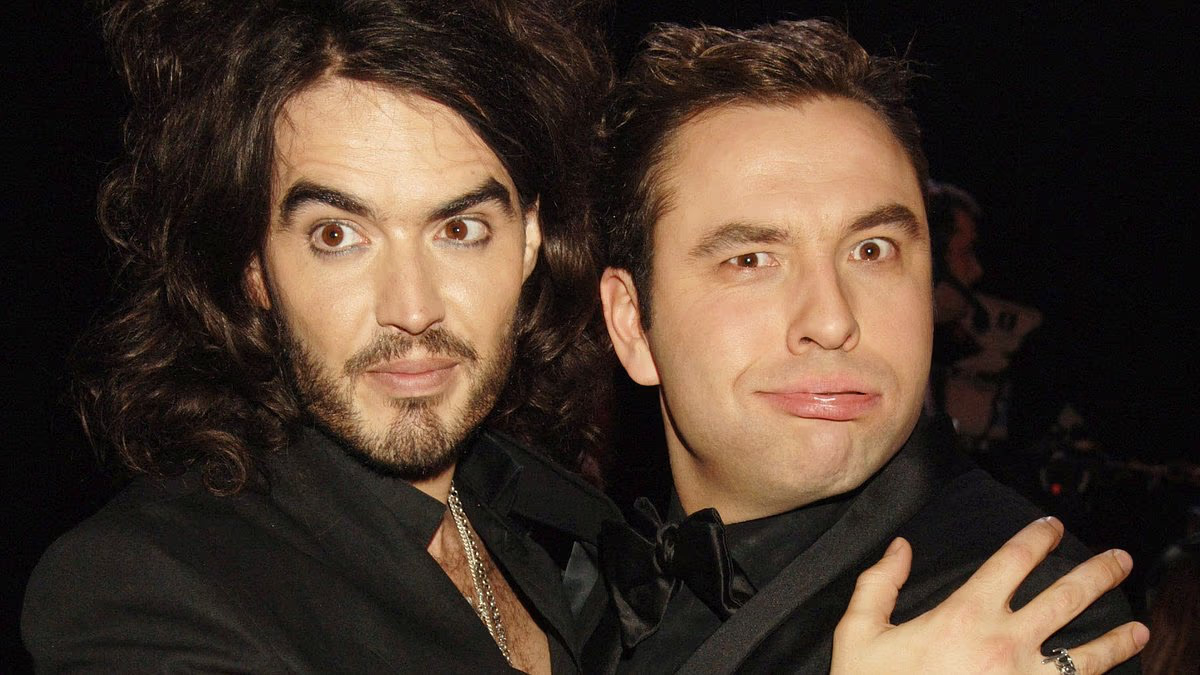
In 2008, Walliams said: “I meet up with Russell Brand, we have these chats about relationships and misery.” The pair are pictured at a British Comedy Awards after-party in 2006
Perhaps unsurprisingly, he was cast in a school production as Henrietta Maria, the 17th-century Queen of England, wearing a wig and dress.
The performance became a turning point. His exaggerated fanning brought the house down, and he later recalled: “It was as beautiful as moondust. I knew what I wanted to do with my life, I wanted to make people laugh.”
Despite his early experiences with boys, Walliams says he was attracted to girls but struggled with intense self-loathing. “Sometimes I think it would be simpler if I was [gay] because everyone thinks I am,” he said. “If I was gay, I would just get on with it. I love women. I love being around women. I find them incredible and intoxicating. I have never had that feeling I get with women with a man.”
He has said his first suicide attempt came when he was 12, during a Sea Scouts camp.
In his autobiography, he wrote that he went to a stream where he had previously played on a rope swing and made a noose, but that he was too tall for it to work.
It was not his only suicide attempt. After completing his first term studying drama at Bristol University, he returned home for Christmas and was overwhelmed by what he described as a “swell” of depression. One day in January, after his parents had left for work, he began considering ways to kill himself.
He thought about turning on the oven and gassing himself, but worried that his mother could be injured if an explosion occurred when she switched on the lights. He took an overdose, was discovered by his mother and taken to hospital.
Even so, his desire to live and his ambition to become famous did not disappear.
In 1999, years before he became widely known, he began a private relationship with Caroline Aherne, who was then at the height of her career following The Mrs Merton Show and The Royle Family.
They met at London’s Groucho Club and were together for about a year. Walliams said Aherne would sometimes call him while drunk and accuse him of having no love in his heart and being incapable of it. He said alcohol had “poisoned her mind” and believed she had been too deeply affected by her father, a violent alcoholic, to find happiness.
“The situation was making me unbearably sad. It broke my heart that we couldn’t be together,” he wrote.
NEXT UP: Veteran Flight Attendant Reveals How to Spot a ‘Mile-High Menace’ Before Takeoff
Walliams also wrote that he struggled with what he called a sex addiction. He said a girlfriend ended their relationship in 2002 after reading his diary, which recorded a series of “meaningless” sexual encounters dating back to around 1999, beginning with an affair involving an air hostess.
“I thought sex could take away the sadness. However, it just made it worse. And I sank lower and lower into despair. I had become a sex addict,” he wrote.
After the break-up, he spent a week at the Priory, where he received antidepressants, medication to help him sleep and therapy.
Once discharged, he returned to work on the final scripts for the first series of Little Britain.

Walliams and Matt Lucas appeared in Little Britain, which ran from 2003 to 2006
He worried about what would happen once production ended. “When I wasn’t busy, thoughts of suicide haunted me. I now had a cache of sleeping pills. Whether I had enough to kill myself I didn’t know, but I spent a long time obsessing about it.”
The success of Little Britain transformed Walliams into one of London’s most sought-after celebrities. He spent time with figures including Kate Moss, Elton John, David Furnish, Patrick Cox, Liz Hurley and Russell Brand.
Despite the self-loathing concealed beneath his camp humour and innuendo, Walliams has repeatedly described the powerful appeal of beautiful women. Like Brand, he also acknowledged that fame gave him access to them.
In a 2008 interview, Walliams said: “The thing about beauty is you do feel it is very compelling, because you hope that it rubs off on you in some way.”
In his book, he said he became attracted to Geri Halliwell because of her “beautifully flat stomach”.
He also wrote openly about a brief encounter with Patsy Kensit. “Patsy fancies you,” Matt Lucas reportedly told him. “I didn’t take much persuading to meet up with her,” Walliams wrote.
He added: “I became so well-known that when I walked down the street every second person recognised me. Women threw themselves at me. And sometimes I caught them.
“Then I became rich… My life became curiouser and curiouser. Like Alice in Lewis Carroll’s novel I entered Wonderland. A place of dreams and nightmares.”
Walliams met Dutch supermodel Lara Stone in 2009, only weeks after she had left rehabilitation for alcohol addiction. He was immediately captivated by her, describing her as warm and slightly bohemian.
They married less than a year later, in May 2010. At the wedding, Walliams had the band play the theme from Disney’s Beauty and the Beast—a joke about their perceived difference in attractiveness that reportedly made some guests uncomfortable.
The marriage lasted five years and produced a son, Alfred, who is now 13.
Speaking about his son on the Chris Evans Breakfast Show on Virgin Radio in 2024, Walliams said: “I think back to the day he was born. And I always say to him: ‘The day you were born was the happiest day of my life’.”
But his personal struggles continued.
“Every day I think I’m fat,” he once said. In 2011, he swam the length of the River Thames for Sport Relief, raising more than £1 million and receiving widespread praise. Walliams said he undertook the challenge partly to relieve his feelings of worthlessness.
After his marriage ended in March 2015, a friend told me: “He is just deeply unhappy, underneath it all. If you are that unhappy, I don’t know how you can sustain a marriage.”
Another source suggested that he had become impossible to live with, saying pointedly: “Lara had had enough.”
A few weeks before the couple announced their separation, Walliams reportedly mocked Stone’s accent harshly at a party. He was said to have been hurt by the apparent sexual chemistry between Stone and singer Justin Bieber, with whom she appeared in a jeans advertisement.
His professional standing continued to grow. By then an established judge on Britain’s Got Talent—where he often joked in an exaggerated camp style that he was Simon Cowell’s “number one girl”—Walliams remained popular among the celebrities he hoped to impress and had gained acceptance in influential circles.

Walliams, pictured with his novel Gangsta Granny in 2011, is one of the world’s most successful children’s authors, having sold more than 60 million books

His departure from the BGT judging panel in 2022 marked the beginning of his professional downfall
In October 2017, Walliams received an OBE at Buckingham Palace for services to charity and the arts.
“I remind myself every day how lucky I am to be working with incredible people,” he told reporters. “I don’t take any of it for granted, especially not today.”
That success did not last. His departure from the Britain’s Got Talent judging panel in 2022, after offensive comments about contestants that he believed were not being recorded, marked the beginning of his downfall.
Speaking about one female contestant, he reportedly said: “She’s like the slightly boring girl you meet in the pub that thinks you want to f*** them, but you don’t.”
Walliams sued production company Fremantle for damages. His lawyers said the incident had once again left him suicidal.
The timing of the current allegations has also drawn attention to Walliams’ past friendship with Russell Brand, who has received a ten-and-a-half-year sentence for rape and sexual assault. The two men met in 2002 and moved in the same social circles for many years.
Walliams was among the guests who travelled to India for Brand’s 2010 wedding to pop star Katy Perry.
Brand also described himself as a sex addict and spent time at a residential clinic in the United States for treatment.
In 2008, Walliams said: “I meet up with Russell Brand, we have these chats about relationships and misery. I think of him as a more extreme case than me, but he always says: ‘Ooh, don’t make me get into that bed on my own! You’re not going to make me get into that bed on my own, are you?’” Brand is now behind bars.
Walliams, meanwhile, is facing a severe personal and professional crisis. There will be debate over whether the allegations made against him amount to criminal offences.
Last week, Sara Mansoori KC told the High Court that Walliams had made two suicide attempts since learning of the allegations, including one after he absconded from a secure hospital in July.
At the height of his success, Walliams wrote in his diary: “If hell is in your mind, then I have been to hell.”
He appears to remain there.