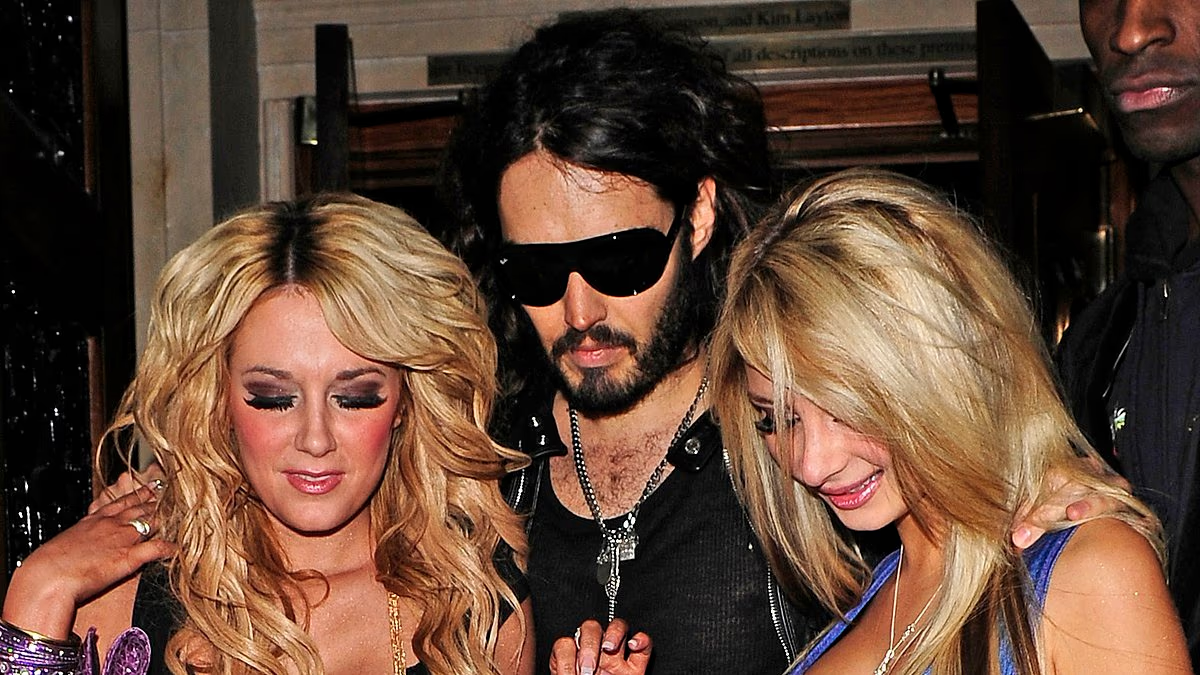

Even by Russell Brand’s standards, it was an audacious stunt. As he arrived at a comedy awards ceremony organised by the now-defunct lads’ magazine Loaded, the comedian posed for photographers while very publicly looking down the white, plunging neckline of nurse-turned-glamour model Abi Titmuss.
The cameras continued to flash as Brand entered Sketch, then one of London’s most fashionable celebrity venues, where he would be named the funniest man of 2006. Later, he reportedly told Abi, the former girlfriend of disgraced This Morning presenter John Leslie: “You like sex too. You are filthy, aren’t you?”
It was hardly an isolated episode. During the Noughties, Brand was a familiar presence on London’s party circuit, pursuing women in his trademark black clothing: an open shirt, spray-on jeans and cowboy boots. One former associate says he “leched at girls for fun” – and I was already aware of that reputation.
I saw it for myself during the Noughties, when Brand was among the most in-demand guests for parties in the media world.
He seemed to be everywhere. So was I. As a showbusiness gossip columnist for a tabloid newspaper, I often stayed out until the early hours, just as Brand and his friends did. The difference was that I was looking for a story, not a sexual conquest.
At the time, headlines often treated Brand’s behaviour as a joke, calling him “Randy Russ” or a “Lanky Lothario”. With hindsight, that light-hearted framing looks entirely misplaced. The conduct I witnessed appeared predatory.

Russell Brand, pictured in 2009, was frequently seen leaving London clubs with women during the Noughties

At a 2006 awards ceremony, the comedian was photographed looking down the low-cut white top of nurse-turned-glamour model Abi Titmuss
I remember seeing Brand at the 2006 NME music awards, which he hosted at London’s Hammersmith Palais. It was the event where Sir Bob Geldof called Brand a “c***” on stage amid reports that he had been romantically involved with Geldof’s daughter Peaches, who was not yet 17.
Despite Sir Bob’s public condemnation, I watched in disbelief as Brand continued flirting with Peaches after the ceremony. Her age appeared not to concern him.
At another alcohol-fuelled event, the annual National Comedy Awards, fellow journalists and I watched as Brand followed Charlotte Church around the former ITV headquarters on London’s South Bank.
Wherever Brand went, it seemed, a woman was never far away – whether she welcomed his attention or not.
One morning in the early hours, I headed to Mayfair’s Maddox Club after a Teenage Cancer Trust concert.
Brand was there, draped over a Vivienne Westwood model known as Jordan.

David Walliams reacts to Jonathan Ross’s recently resurfaced “joke” at the 2004 British Comedy Awards about the comedian “taking home” 15-year-olds

Ross described Brand and Great British Bake Off host Noel Fielding as “two of the best-known c***smen in the business”
The relationship was brief. Soon after Brand ended it, I was told he had treated Jordan “foully”. His associate added: “Girls’ feelings don’t matter to Russell.”
For the organisations that employed him – including Channel 4, where he presented Big Brother’s Big Mouth, and Radio 2, where he hosted a Saturday evening programme in the mid-2000s – such behaviour should have prompted criticism. Apparently, it did not. Instead, it seemed to enhance his appeal to employers. The Noughties were a boisterous and seedy period: money circulated freely, drinks flowed at parties and celebrities were paid generously to attend. Women were drawn in by famous names on guest lists, while cocaine was widespread.
Brand’s wider circle included television host Jonathan Ross and comedian Noel Fielding. A journalist friend was once invited by Fielding, then known for The Mighty Boosh, to a gloomy basement flat in Camden. I accompanied her. Brand was there, embracing a woman in the corner while other guests sat in a circle, taking turns snorting cocaine.
Fielding later acknowledged taking pills, magic mushrooms, cocaine, ecstasy and ketamine. That night, he was unkind to my friend. He was also a regular presence at Camden venues such as The Hawley Arms and developed an unusual friendship with Pixie Geldof, who was still at school at the time.
I once saw them shopping together at Urban Outfitters on Kensington High Street. Fielding had a devoted following among music and celebrity publicists, who would trail him to gigs at the Kentish Town Forum and drinks at the nearby Pineapple pub. Whenever I encountered him, he struck me as deeply arrogant.
Ross was not a partygoer in quite the same way, but Brand and Fielding appeared to regard him as the elder statesman of British comedy. A recently resurfaced “joke” he made at the 2004 British Comedy Awards, about disgraced comedian David Walliams “taking home” 15-year-olds, reflected the prevailing attitude towards women.

The television host, who was part of Brand’s circle, released a statement on Tuesday seeking to distance himself from the remark
NEXT UP: Secret Operation at Heart of Drone Invasion, Files Reveal
On Tuesday, Ross issued a statement attempting to explain his role. “This joke was submitted to me by the Comedy Awards scriptwriting team and I believed that the punchline was a reference to the fact he had publicly dated younger women, exaggerated for comic effect,” he said.
British comedy was harsher in that era than it had been during the 1990s. Women working in comedy had long felt uncomfortable on the circuit, while Brand’s hyper-sexualised persona and the crude humour of Little Britain also demeaned female viewers.
As Jo Brand once noted, the 2000s brought a rise in rape jokes, suggesting that some comedians were reviving the broad misogyny of the 1970s with an even more vicious edge. Jimmy Carr’s 2010 stage show, for instance, was titled Rapier Wit and included the line: “What do nine out of ten people enjoy? Gang rape.”
Another example came on Channel 4’s Big Fat Quiz of the Year in 2007. Ross, Brand and Fielding appeared alongside host Carr, comedians Rob Brydon and David Mitchell, and the only woman on the panel, singer Lily Allen, who was then 21.
At one point, Ross called Brand and Fielding “two of the best-known c***smen in the business” and suggested swapping seats with Allen so she could sit nearer Brydon and Mitchell and “might go home with her dress still on”.
“How dare you, we’re not rapists,” Fielding exclaimed, prompting loud laughter from the audience. Carr then questioned why Fielding was wearing a cape if he was not a rapist. Fielding replied that it was a Jack the Ripper cape, beginning, “He wasn’t a rapist, he was a…” Brand completed the sentence: “Serial murderer.”
Brand then added: “There is no direct corollary between rapes and capes; it’s just a rhyme.
“Leave him alone. What if, horror of horrors, he ain’t even done a rape? You could ruin his reputation.”
Women were expected to laugh at such “taboo-busting” jokes or risk being labelled prudish. In a culture that routinely shamed and judged them, it is little wonder many felt unable to challenge rogues, bullies and criminals. It is increasingly apparent that, within British comedy and television, those rogues often held the power.
A friend sent me the clip last week. After watching it, I replied: “Sadly, that was 2007 – stuff like that was happening everywhere.”
But why? What made the 2000s such a damaging decade for women?
The 1990s had brought an intense focus on British culture, and many young women drew inspiration from figures such as Tracey Emin, Zoe Ball and Kate Moss, who appeared to live by their own rules. The party scene was chaotic, but it looked exciting. By contrast, the 2000s felt harder and more unforgiving. The Spice Girls’ upbeat message of girl power gave way to images of Britney Spears in pigtails and Amy Winehouse battling addiction.
Big Brother produced a stream of aspiring celebrities who embraced the nightclub circuit and often sought relationships with famous men. London’s bars and clubs were thriving; on some nights I received six or seven invitations to celebrity events. Gossip magazines were thriving too. Getting photographed with a star inside a party and again by paparazzi outside was considered a major success.
Some men also came to believe that women were “up for it” in the hedonistic Noughties. Women were becoming more confident and visible in music and comedy, and certain men seemed to view that progress as an opportunity for retaliation. As Brand told Abi Titmuss, the young women who had grown up in the 1990s were “filthy too”.
There is no doubt that male celebrities were treated like heroes. Today, public figures are much more cautious about their behaviour. Back then, camera phones were not common, so there was often no immediate evidence. This kind of womanising was not confined to comedy; it was also widespread in television and among prominent footballers.
This week, my sister reminded me of an incident at Funky Buddha, a Mayfair club I visited every Tuesday in search of stories. We were chatting when a boyband member put his hand up her skirt. It happened in 2005, and if I could name him, many people would be shocked. My sister was deeply upset and still speaks about it today.
Footballers were no different. In 2005, a former England player approached me at London’s Embassy club, touched my leg and said: “Cor, I like a pair of nice, strong legs.” He then offered me a lift home. When I declined and said I could pay for my own taxi, he replied with a wink: “Your loss.”
This behaviour was widespread. Celebrities would ask friends whether a potential conquest was “safe” – meaning she could be trusted not to sell her story to the press. Many women did so anyway.
In the mid-Noughties, few footballers appeared more frequently in the red-top press for alleged infidelity than England player John Terry. On one occasion, he reportedly had sex with a woman with a broken leg at the Embassy, a favoured venue of his Chelsea teammates. After I met him there, he sent me a stream of sexually explicit messages, as he did to several other women.
I also saw footballers ask friends to identify women in nightclubs and entice them to Chinawhite, another venue frequented by people including Calum Best, son of George Best, and former EastEnders actor Dean Gaffney. I regularly saw both men talking to glamour models and Page 3 girls. They occupied the club’s “top table” with their manager, Dave Read, who maintained an extensive list of models he could introduce to them.
There were also reported incidents involving the vile sexual practice known as “roasting”. I narrowly avoided a situation myself in Marbella in 2005, when a then-prominent Premier League player invited me to his hotel room for a drink after a pool party. Two of his friends arrived afterwards.
I ran out, feeling extraordinarily fortunate to have escaped.
After Russell Brand’s fall from grace, we can only hope women are safer in the entertainment industries – and that more decent men are willing to challenge the behaviour they witness.