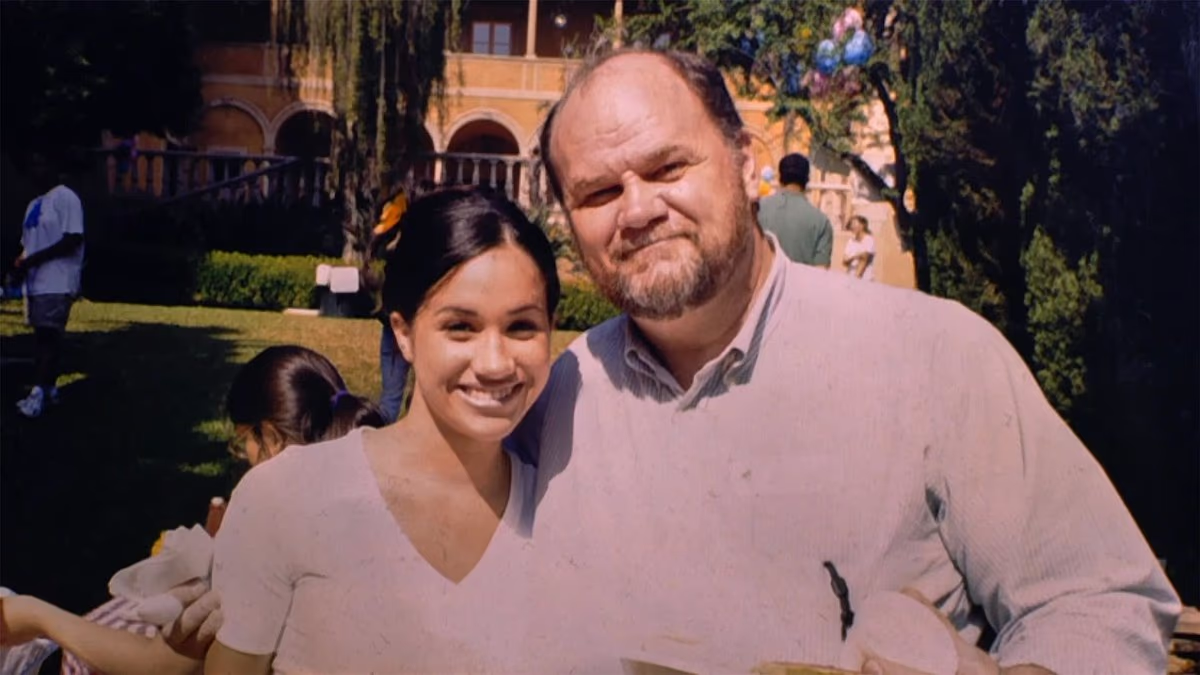

Why did the Metropolitan Police appear to take no further action over the letter? It is one of the most baffling questions in the disturbing saga surrounding Thomas Markle Snr and the allegations made against him.
The letter in question was written by Mr Markle’s late first wife, Roslyn Loveless. It was passed to the Met in 2019 and contained allegations that her former husband had repeatedly abused children.
Police disclosed the letter’s contents to Meghan Markle, presumably because she had become a member of the British Royal Family after marrying Prince Harry the previous year. Beyond that, however, there appears to have been no referral to overseas authorities that might have investigated the claims. Why?
As always, allegations must be distinguished from proven facts. Everyone is innocent unless and until guilt is established, and it remains impossible to know whether Mrs Markle’s claims were well-founded.
Mr Markle Snr denies the allegations and has described them as “sick lies”. Even so, if the Met considered the letter significant enough to share with the duchess, it is reasonable to ask why it was not also examined by an agency equipped to establish the truth.
That unanswered question has fuelled speculation, including suggestions that the matter may have been quietly set aside in 2019 by the police or, more controversially, by the Palace.
There may, of course, be an entirely innocent explanation.
Roslyn Loveless sent her handwritten letter to the Met’s Fixated Threat Assessment Centre, which deals with stalkers and people deemed to be “fixated” on public figures. Ms Loveless, who died two years ago, had struggled with alcoholism and was described in deeply unflattering terms by those who knew her.

Why did the Metropolitan Police appear to take no action over the letter? It remains one of the most perplexing questions in the troubling saga surrounding Thomas Markle Snr, writes A.N. Wilson
The letter was sent 44 years after Loveless’s marriage to Mr Markle Snr ended. Her daughter, Meghan’s half-sister Samantha, 61, later called her mother “not credible” and said she had been motivated by “hatred and bitterness”.
It is possible that the assessment centre reached a similar conclusion and decided no further action was warranted. But if so, why was Meghan told about the letter?
However unreliable Loveless may have appeared to be, the letter reportedly alleged that Mr Markle Snr—who continues to deny the claims—had travelled to Thailand and the Philippines to have sex with minors.
Any possibility that children were being abused would represent the most serious concern in this case. If such a risk existed, the police would surely have been expected to respond.
Jim Gamble, an international campaigner against child sexual abuse, told Radio 4’s Today programme yesterday that the Met’s failure to share the information with overseas agencies could have left children exposed to possible abuse for a further seven years after the letter was sent.
Mr Gamble, the former head of the Child Exploitation and Online Protection Centre, said the Met’s decision was “really difficult to understand”, particularly because the force had considered the letter important enough to show to the duchess and the royal protection team.
He said: “If information reaches you about someone in a foreign jurisdiction who may pose a threat to children, there is an established process. You would expect a UK police force to share it.
“I would have expected the Metropolitan Police to approach the FBI legal attaché at the US embassy and say: ‘This has not been proven—it is an allegation. You may wish to examine it because American authorities could have additional information and might be able to corroborate it.’”

Police disclosed the letter’s contents to Meghan, presumably because she had become a member of the Royal Family after marrying Prince Harry the previous year
Mr Gamble is not the only former official to question the Met’s handling of the case. Dai Davies, the former head of Scotland Yard’s Royal Protection Command, said he was “gobsmacked” that no other law-enforcement agencies appeared to have been contacted.
“I’m frankly astounded that, having received this material, they did not contact other relevant forces,” he said. “I believe they had a duty of care not only to Meghan but also to any alleged victims to investigate.”
The significance of the Met’s apparent inaction should not be overlooked. If the allegations were true, the alleged perpetrator may have had another seven years in
which to target children in different parts of the world, whether through physical meetings or online activity.
It has also been reported that hundreds or even thousands of items of evidence were removed from Thomas Markle Snr’s home in the Philippines after they were allegedly found by his son, Thomas Jnr.
There is no reliable basis yet for assessing what those items might be. But the claims have triggered bitter disputes within the deeply divided Markle family.
Meghan’s half-sister Samantha has accused Thomas Markle Jnr of fabricating the story for financial gain.
Ultimately, the facts should emerge. Whatever the outcome, however, the affair is unlikely to reflect well on the Royal Family.
The allegations present two stark possibilities: either Roslyn Loveless and Thomas Markle Jnr have made claims that are false on a vast scale, or they point to alleged criminal conduct said to have continued over decades. The claims concern the father-in-law of a man who is fifth in line to the throne, making Meghan’s response worthy of close examination as well.

In 2022, three years after the Met showed her the letter containing allegations about her father, Meghan said in her and Harry’s Netflix documentary that she had always been “a daddy’s girl”
In 2022, three years after the Met showed her the letter containing allegations about her father, Meghan said in her and Harry’s Netflix documentary that she had always been “a daddy’s girl”.
At the time, that remark may have seemed inconsequential. In light of what is now known about the letter, it carries far greater weight than ordinary family reminiscence.
If Meghan believed in 2019 that there was even a remote chance her father’s first wife was telling the truth, what action did she take? If she thought her father might pose a danger to children, why did she not publicise the allegations—or at least press police to investigate them?
It is possible that she raised concerns privately. Nevertheless, the questions remain. In time, they could become a serious issue for the police, the Royal Family and, by extension, the constitutional monarchy.
It is difficult to understand how allegations of this nature could simply have been forgotten or buried in an overworked junior officer’s in-tray. That uncertainty has inevitably prompted further speculation that the matter may have been deliberately suppressed.
At present, there is no evidence to establish who, if anyone, might have ordered such a suppression. Was it an official within the Met who feared the consequences? Or a member of the royal household who sought to prevent embarrassment less than a year after Prince Harry and Meghan’s wedding at St George’s Chapel, Windsor?
The police have said they are “reviewing the handling of this matter in 2019”. The Palace, meanwhile, told Our News Outlet that it was “not commenting on this matter which is personal to the Sussexes”.
Whatever the explanation, a full account of what happened would be in everyone’s interests.
The alleged crimes are of a different order from the accusations faced by Andrew Mountbatten-Windsor, and the potential damage to the monarchy could be considerably more serious.