Death-row inmate Christa Pike is being treated in a hospital under guard after surviving a botched execution that may leave her unable to make a full recovery, according to her lawyer.
Tennessee sentenced Pike to death in 1996, when she was 20, for the torture and murder of her classmate, Colleen Slemmer, the previous year.
Pike spent 30 years on death row as her execution was repeatedly postponed. It was eventually scheduled for September 30.
Pike, now 50, was injected with at least seven needles as medical staff tried to administer two lethal doses of pentobarbital over roughly two hours, according to witnesses and court filings.
However, she survived the procedure. Her lawyers said witnesses could hear her crying, whimpering and breathing heavily during the attempted execution.
At 8.53pm, shortly after media witnesses were escorted from the viewing chamber, Pike could reportedly be heard snoring behind closed curtains. The media had entered the chamber at 6.41pm.
Pike was taken unconscious to hospital with swollen, blistered arms after the drugs were administered. She was intubated and placed on a ventilator. As of Sunday, she remained alive but unconscious, her lawyers said.
One of her attorneys, Stephen Ferrell, told CNN’s Jake Tapper on Sunday that Pike’s hospital room “is guarded” and that she “may not fully recover.”

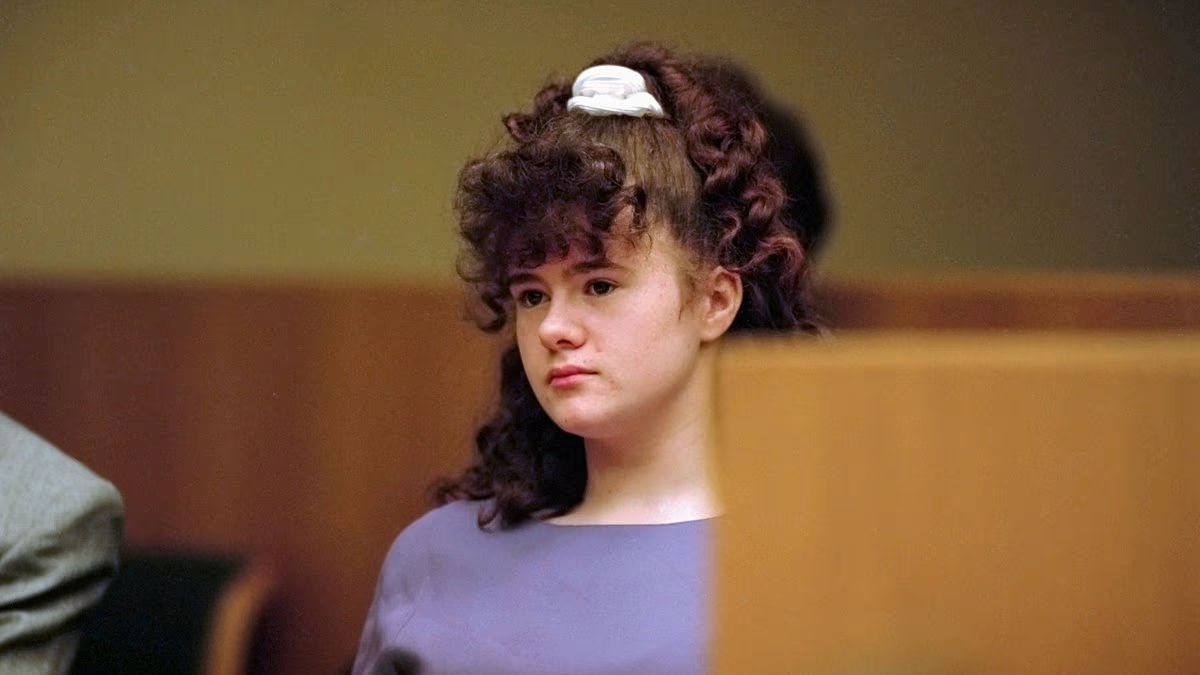
Pike was sentenced to death at the age of 20 in 1996. She is pictured crying during her sentencing hearing at the time.

Christa Pike survived two doses of pentobarbital during her execution on September 30 in Tennessee. She is now unconscious in a guarded hospital room and may never recover.
‘I think one of the main things that will leave this up in the air for a while is the fact that we don’t know what the prognosis is, as in the long-term prognosis. If she recovers, she may not fully recover,’ the lawyer said.
Ferrell added that Pike has not regained consciousness or been able to say anything since the failed execution, as far as he is aware.
The attorney also said that he has not been allowed inside the hospital room and that ‘we don’t really know the prognosis yet and may not know for several more days.’
The state of Tennessee has not yet announced whether it plans to attempt to execute Pike again, Ferrell added.
He said that he has asked the state’s governor to commute Pike’s sentence to life in prison, given the mental and physical torture she suffered throughout the leadup to her execution and the botched process itself.
‘We don’t know right now, and we may never know, what sort of torture she endured during that process,’ Ferrell said.
During Pike’s attempted execution, she said: ‘My arm feels like it’s about to burst open,’ and at another point, asked: ‘Does this happen like that?’
The botched execution has become a scandal that even drew reaction from President Donald Trump, who the next day said: ‘How does that happen? Should be easy to do. It shouldn’t be very difficult.’

Pike’s botched execution became a scandal that even drew criticism from President Trump, who said: ‘It shouldn’t be very difficult’.
It also led Tennessee Department of Correction Commissioner Frank Strada to announce he put in his resignation and will step down from the top role later this month.
Strada said it was a ‘great honor’ to serve in his position and that he still ‘believes the Department carried out its responsibilities in accordance with the established protocol.’
‘Even so, stepping aside is in the best interest of Tennesseans as the independent review moves forward,’ he said.
Pike’s attorneys have argued that the Department of Correction failed their client.
The lawyers said they believe problems with the IV lines caused the pentobarbital to flow into Pike’s body instead of her bloodstream.
‘Apparently at no point did any member of the execution team realize that the IV lines were not correctly placed or that the veins had blown and that the pentobarbital was, in whole or in part, entering Ms Pike’s body,’ the lawyers wrote in a court filing.
They wrote that instead of ‘remedying this failure,’ the execution team prepared and administered a backup set of pentobarbital syringes.
Pike’s lawyers are seeking to have all of the evidence from her botched execution preserved so they can ensure accountability and protect her legal rights.

Pike (pictured in 1996) carved a pentagram into Slemmer’s chest and took a piece of her caved-in skull after bludgeoning the young woman to death with a piece of asphalt.
The court filing emphasized that Pike previously filed an appeal claiming her execution would result in cruel and unusual punishment because of her individual physical characteristics, including thrombocytosis, post-traumatic stress disorder and small veins.
Tennessee’s execution protocol calls for a secondary set of drug syringes to be administered ‘if the inmate is not deceased’ after the first set. It does not spell out what happens if the subject is alive after the second set.
Governor Bill Lee has halted any additional executions for the year and ordered ‘a comprehensive, third-party review to determine exactly what occurred.’
At the age of 18, Pike lured Colleen Slemmer to an isolated area of the University of Tennessee’s campus in January 1995 and, alongside her boyfriend and a friend, tortured Slemmer for up to an hour.
Slemmer was stabbed more than 100 times with a box cutter before Pike bludgeoned her to death with a piece of asphalt, carved a pentagram into her chest and took a piece of her caved-in skull as a sick souvenir.