
“Let me ask you something,” President Trump told supporters at his final South Carolina rally last week. “How many people here have ever been polled? Seriously, I’m curious.”
Trump said he watched new surveys appear almost daily but had never met anyone who had actually taken part in one. In an arena filled with several thousand people in Rock Hill, only a handful raised their hands.
“Two hands. It’s amazing,” Trump said, appearing perplexed. His impromptu survey reflected his apparent refusal—or decision—not to accept the steady stream of polls forecasting a Democratic surge in the midterm elections. Instead, he is relying on the possibility of a concealed Republican vote that pollsters have failed to capture.
The exercise was hardly scientific, but it was not the only indication that a predicted blue wave could run into a Republican barrier. A recent Washington Post–George Mason University survey in Kansas found that Democrats were almost three times as likely as Republicans to answer pollsters.
Trump’s appearance in South Carolina marked the beginning of a final 72-hour campaign sprint that would also take him to Florida, Kansas and Iowa.
It capped an exhausting October during which he held more than 25 rallies, at times speaking for as long as two hours.

Trump began a final campaign blitz as he sought to help vulnerable Republican candidates
After flying back from South Carolina on Thursday, Trump reacted angrily when a Reuters reporter asked whether he was tired of traveling. The exchange appeared to prompt him to restore two rallies that had previously been canceled.
Speaking in Daytona Beach, Florida, on Friday, Trump acknowledged that he had expected the campaign to be over. “I thought I could relax,” he said. “Twenty-eight days in a row of this is a lot. My voice is operating at about 49.2 percent.” He added that calls from Iowa and Kansas had brought him back onto the road.
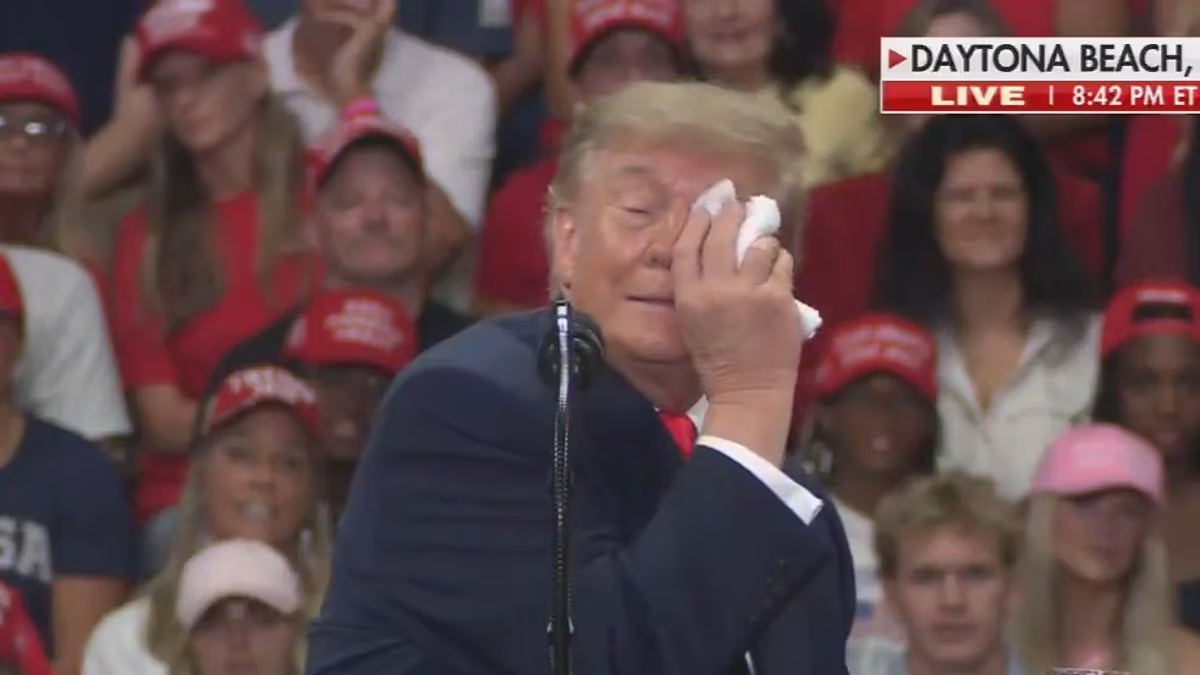
During the event, he paused to dab at one eye with a wet napkin. Trump said he would have used eye drops, but feared that “fake news” reports would claim he was seriously ill.
Behind the scenes, Republican strategists at both the national and state levels had been debating how heavily to rely on Trump during the midterm campaign.
One of the party’s biggest challenges is that many of Trump’s most enthusiastic supporters are considered “low-propensity” voters. They reliably turn out for him, but are less likely to vote in congressional elections.
The thinking was that the most effective way to bring those voters to polling places was to have Trump personally urge them to do so.

Trump paused to wipe his eye at a Daytona Beach rally, joking that “fake news” outlets would probably say he was seriously ill
The growth of early voting also influenced the strategy. In states where ballots could be cast ahead of Election Day, Trump’s supporters could attend a rally and vote as soon as the following morning.
But the approach had obvious limitations. At Trump’s South Carolina event for embattled Republican Senate candidate Darline Graham, many attendees told Our News Outlet they had traveled from neighboring North Carolina. They had come to see Trump, not Graham—and most could not vote in South Carolina.
Republican strategists therefore had to weigh whether Trump could mobilize enough infrequent voters to offset the independents and moderate Republicans he might drive away by appearing in closely contested states.
That danger was visible in South Carolina, where Our News Outlet later met a woman at a nearby polling station who said Trump’s behavior at the rally had changed her vote.
The woman identified as a Republican but said she was so offended by Trump’s remarks about Democratic Senate candidate Dr. Annie Andrews that she voted for Andrews instead.
“That’s not a nice word,” she said of Trump’s insult.

Trump’s rally crowds varied in size, but the Daytona Beach audience was large and energetic. “Crowd size means success,” he told supporters

Supporters wearing “Blacks for Trump” shirts gathered behind Florida gubernatorial candidate Byron Donalds in Daytona Beach
Trump’s closing argument centered on what he described as Republican achievements: sharply lower illegal border crossings and violent crime, record stock markets and low unemployment. “The country is hot,” he repeatedly told cheering crowds. But that message has struggled to reach voters dealing with rising living costs.
During the midterm campaign, Trump’s unscripted speeches became increasingly long, unpredictable and controversial. Along the way, he appeared to coin at least one new term—“Watercane,” among them.
His remarks produced a series of memorable and baffling moments, including praise for Nicki Minaj’s “beautiful a**” and similar comments about the physique of Ohio Republican Senate candidate Jon Husted, whose backside Trump compared to “a pile of muscle.”
In Florida, Trump tried to clarify the Husted remarks, though his explanation only seemed to make the situation more complicated.
On another occasion, someone in the crowd shouted, “We love you.” Trump replied, “I love you,” before apparently realizing the voice had come from a man.
The rallies also carried a strong sense of nostalgia, something Trump himself openly embraced. In Florida, he claimed to have held about 1,100 rallies since 2015. He recognized a group of women from North Carolina who have followed him across the country, as well as the “Front Row Joes.”
He also highlighted “Mr Wall,” a supporter wearing a brick-patterned suit to symbolize the border wall and seated directly in front of the lectern. Trump said he planned to wear a similar outfit once the rallies ended.
“Mr Wall,” whose real name is Blake Marnell, 61, of San Diego, has driven to most of the midterm events, covering roughly 12,000 miles. He told Our News Outlet that Trump appeared more willing than ever to improvise because he was not personally on the ballot.
“I think he gets to be more of a showman at these rallies because there isn’t really a direct consequence tied to people voting for him,” Marnell said. “That gives him more freedom in what he says and in the guests he brings onstage.”
“His energy seems as strong as ever. I’m not seeing anything that suggests this is a different Donald Trump from the one at previous rallies. He simply has more room to maneuver, and he’s using it. I think he’s enjoying himself.”
By the final days of the campaign, Trump clearly appeared to be having fun.
Officials have described the rally stage as a refuge for him—a place where he does not have to confront bad news.
His approval ratings were at historic lows, fuel prices were climbing and the war in Iran continued. But before him stood crowds roaring as if they were attending a concert.
Before his speech, a large screen played a booming video portraying “God Made Trump” as a caretaker of the planet.
Trump closed the Florida rally by displaying CNN footage of a poll suggesting that 98 percent of MAGA Republicans intended to vote for Republican congressional candidates.
He also cited another CNN survey showing Republicans ranked him as their most admired president, placing him several times ahead of Abraham Lincoln.

“Mr Wall” said Trump appeared increasingly free to speak without a script during the midterm campaign

Trump attended a Halloween party at Mar-a-Lago dressed as himself during a break from campaigning

Trump made his final campaign-day appearance for Republican Senate candidate Ashley Hinson in Iowa, where voters were angry about fuel costs
After stopping at Mar-a-Lago on Saturday for a Halloween party—where he went as himself—Trump returned to the campaign trail Sunday for final events in Iowa and Kansas.
The choice of those states was notable. Trump had carried Iowa by 13 points in 2024, yet Republican Senate candidate Ashley Hinson faced danger as diesel prices rose.
Trump typically spoke for 90 minutes to 100 minutes, but his event in Dubuque, Iowa, lasted more than two hours. “This isn’t rambling,” he insisted. “This is genius.” He ended the event by dancing to “YMCA.”
From Iowa, he traveled to Salina, Kansas, where Air Force One flew over the airport for the waiting crowd.
Until recently, Kansas had appeared almost impossible for Democrats. The state last elected a Democratic senator in 1932, during the Great Depression, and Republicans have enjoyed a 94-year streak of dominance—the longest uninterrupted run by either party in any state.
A Republican defeat in Kansas would therefore amount to a political earthquake. That was why Trump was sent there for a second rally in less than two weeks.
“I’m closing it down tonight,” Trump told the crowd. “I could have been home watching television.”
His final appeal to Kansas voters included a promise of a $4.3 billion investment from Fannie Mae and Freddie Mac in the state the following year, a move expected to help about 15,000 people buy homes.
Republican Senator Roger Marshall, who had closely aligned himself with Trump, was clearly pleased to have him there.
“Glory, glory, hallelujah! God made Trump!” Marshall declared.
Overall, Trump’s crowds were smaller than those seen during his presidential campaigns, although that is typical of midterm elections. Team Trump had also become more flexible, arranging events with only a few days’ notice in states where Republican candidates were struggling.
In South Carolina, the arena—previously used for the world cornhole championships—was less than half full.
Florida offered a sharp contrast. Trump filled a large arena, and supporters remained enthusiastic after spending hours in the hot sun. Several people had to be taken away for medical attention.
The turnout encouraged Trump to list some of the largest crowds he had addressed. He claimed the record was more than 100,000 people in New Jersey and explained why audience size mattered so much to him.
“Crowd size means success,” he said.
Trump also treats his rallies as a live focus group, listening for the loudest reactions to his policies and talking points. In Florida, the biggest cheers came for removing Ilhan Omar from Congress, his promise to give every person $5,000 if Republicans retained the House and Senate, and his description of Robert De Niro as a “moron.”

President Trump concluded his rally tour in Kansas alongside embattled Republican Senator Roger Marshall

An aerial view shows one of Trump’s final rallies in Daytona Beach, Florida
The previous week’s rally in Wichita, Kansas, had also drawn a notably large crowd.
Near the front of the line, a man dressed from head to toe in the Stars and Stripes had waited eight hours. Looking back at the thousands behind him, he described them as the “silent majority”—voters who did not speak to pollsters but would make themselves heard on November 3.
Republicans also viewed the number of first-time attendees at Trump rallies as an encouraging sign.
“This is my first rally and I’m very excited,” said nurse Nancy Arias while waiting outside the convention center in Daytona Beach.
Some newcomers said they felt time was running out to see Trump in person. With the Constitution preventing him from seeking another term, they did not want to miss the chance to experience the Trump show live rather than on television.
When John Magnano learned Trump was coming to Daytona Beach, he said he did not want to repeat a mistake he had made years earlier with Elvis Presley.
“Elvis came to our city once, and I thought, ‘I’ll see him next time.’ Then he died the following year,” said the 76-year-old retiree.
“I never got to see Elvis. Trump might not come here again. I like what he’s doing, and I want to see him in person.”
Trump’s rallies were also frequently disrupted, turning the arenas into oversized games of Whac-A-Mole. Protesters would rise from the audience, shout their objections and then be escorted out by heavily built security guards in tight polo shirts.
Some of the protesters’ slogans were unusually inventive. One of the most memorable was: “Shove the ballroom up your fat ass.”
“It’s always at my punchline,” Trump complained in Florida. “I’ve been hit three times at my punchline,” he said as a woman was removed while shouting and making an obscene gesture toward the crowd.
Trump claimed the protesters had been paid $250 each. He added that it was unfortunate they were arrested and could damage their own lives.
“They’re losers, sir!” Mr Wall shouted.
“Is there anything like a Trump rally?” the president asked as he brought the event to a close.

Trump campaigned in Florida for Republican Senator Ashley Moody

A protester shouts before security removes her from one of Trump’s final campaign rallies
Outside the venues, vendors selling Trump merchandise appeared satisfied with business—perhaps another sign that Republican enthusiasm remained alive.
In South Carolina, one seller promoting “Trump 2028” hats rapped a sales pitch: “Don’t be a Dumocrat, get your Trump hat. You’ll look good in that.” He was too busy making sales to speak with reporters.
Nearby, Robert Thomas, 53, said he had sold thousands of Trump hats and shirts at hundreds of rallies over the past decade. For a midterm campaign, he described business as “pretty good.”
“People need something to support, something to believe in,” he said. Hats reading “Jesus Is My Savior, Trump Is My President” were among the strongest sellers.
Still, Thomas expected sales to weaken by 2028.
“Trump can’t run again. The only way would be for Vance to run and then step down, and that’s not going to happen,” he said.
“I’m not a Vance fan. He’s just a little yapping dog standing behind the big dog.”