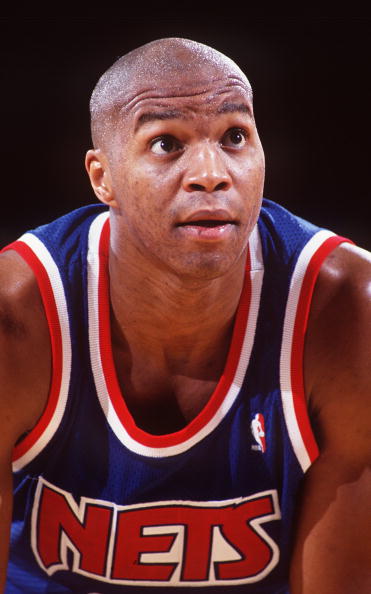

What is Derrick Coleman’s Net Worth?
Derrick Coleman is a retired American professional basketball player who has a net worth of $250 thousand. Unfortunately, Derek is one of the most infamous examples of an NBA player going broke after retiring. Derrick earned $91 million in salary during his time in the NBA. In his 2010 bankruptcy filing, Coleman listed $4.7 million worth of debt and assets of just $1 million. He reportedly invested millions of dollars in real estate projects around Detroit just a few years before the worldwide economic crash. He also owned stakes in a Detroit hotel, a doughnut shop, and a pizza place. He earns $90,000 annual pension from the NBA that can’t be touched by bankruptcy.
Derrick Coleman spent 15 seasons in the NBA and is best known as the #1 overall pick in the 1990 NBA Draft. A powerful and unusually skilled 6-foot-10 forward, Coleman entered the league with the tools to become one of the defining big men of his generation. He could score in the post, rebound at an elite level, handle the ball, pass, block shots, and stretch defenses with a perimeter game that was ahead of its time for a power forward. Coleman was named NBA Rookie of the Year in 1991, became an All-Star in 1994, and earned two All-NBA Third Team selections during his peak with the New Jersey Nets. Although injuries, team instability, and questions about consistency kept him from reaching the superstar ceiling many predicted, Coleman still had a long and productive career with the Nets, Philadelphia 76ers, Charlotte Hornets, and Detroit Pistons. He finished his NBA career with more than 12,000 points, 7,000 rebounds, and a reputation as one of the most talented but polarizing players of the 1990s.
Early Life
Derrick Demetrius Coleman was born on June 21, 1967, in Mobile, Alabama, and was raised in Detroit, Michigan. He attended Northern High School in Detroit, where he emerged as one of the top basketball prospects in the country.
Coleman went on to play college basketball at Syracuse University, where he became one of the greatest players in school history. Wearing the program’s famous #44 jersey, Coleman developed into a dominant force in the Big East. He was known for his strength, rebounding, scoring touch, and ability to play both inside and away from the basket.
During his four seasons at Syracuse, Coleman helped keep the Orange among the top programs in the country. He earned multiple All-Big East honors, was named Big East Player of the Year in 1990, and was recognized as a consensus First-team All-American as a senior. Syracuse later retired his #44 jersey, placing him among the most important players in the program’s history.
NBA Career
The New Jersey Nets selected Coleman with the #1 overall pick in the 1990 NBA Draft. He immediately validated that selection, averaging 18.4 points and 10.3 rebounds per game as a rookie and winning the 1991 NBA Rookie of the Year award.
Coleman quickly became the centerpiece of a promising Nets core that also included Kenny Anderson and Dražen Petrović. At his best, he looked like a franchise-changing big man. During the 1992-93 season, he averaged 20.7 points, 11.2 rebounds, 3.6 assists, and 1.7 blocks per game. The following season, he averaged 20.2 points and 11.3 rebounds while earning the only All-Star selection of his career.
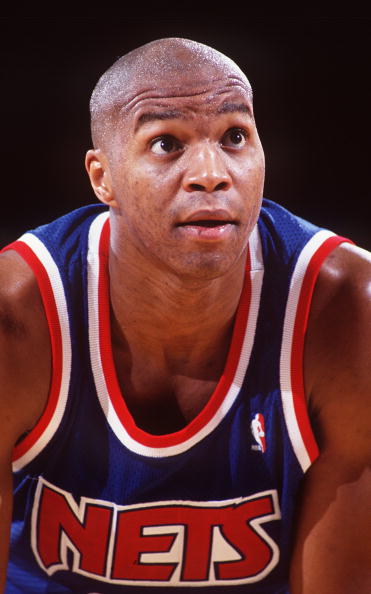
He was named to the All-NBA Third Team in both 1993 and 1994, but his Nets tenure was also marked by frustration. The team suffered a devastating blow when Petrović died in a car accident in 1993, and Coleman later clashed with coaches and management. In 1995, he was traded to the Philadelphia 76ers.
Coleman spent parts of five seasons with Philadelphia across two separate stints. He also played for the Charlotte Hornets and finished his career with the Detroit Pistons, giving him a final chapter in the city where he had grown up. Over 781 regular-season NBA games, Coleman averaged 16.5 points, 9.3 rebounds, 2.5 assists, and 1.3 blocks per game.
Getty Images
Contracts, Salaries & Career Earnings
Coleman entered the NBA just as player salaries were beginning to climb dramatically, and his status as a #1 overall pick helped him become one of the league’s major earners of the 1990s.
Over the course of his NBA career, Coleman earned approximately $87 million to $91 million in salary, depending on the source and accounting method. His biggest earning years came after he had established himself as an elite young forward with the Nets. Even after injuries and inconsistency began to affect his career, his size, skill, and production kept him valuable around the league.
Coleman made significant money with New Jersey, Philadelphia, Charlotte, and Detroit. His peak salaries came during the late 1990s and early 2000s, when he was still being paid like a major frontcourt star despite no longer being viewed as a future MVP-level player. His total career earnings made his later financial problems especially striking, as he became one of the more prominent examples of a former NBA star who earned a fortune but later entered bankruptcy.
Bankruptcy
In 2010, Coleman filed for Chapter 7 bankruptcy. The filing was widely covered because Coleman had earned close to $90 million during his NBA career. According to reports from the time, he listed millions of dollars in liabilities and a much smaller amount in assets.
Coleman’s bankruptcy was not simply the result of one bad purchase or a single failed investment. His post-playing financial problems were tied to a combination of real estate losses, business debts, and investments that struggled during the broader economic downturn. He had been involved in several business ventures in Detroit, including restaurant interests, retail projects, real estate investments, and franchise operations.
Among the ventures connected to Coleman were Hungry Howie’s pizza franchises, Tim Hortons locations, and the Detroit restaurant Sweet Georgia Brown. When the economy and real estate market collapsed, several of those investments reportedly suffered badly. His bankruptcy filing also listed debts to lenders and creditors, including obligations connected to real estate and business ventures.
The bankruptcy became a cautionary tale about the risks faced by professional athletes after retirement. Coleman had earned more money than most players of his generation, but failed investments, debt, and timing combined to wipe out much of that fortune.
Post-NBA Life
After leaving the NBA, Coleman remained closely connected to Detroit. He pursued business interests, stayed involved in basketball circles, and became known for community work in Michigan.
One of the most widely praised chapters of his post-playing life came during the Flint water crisis, when Coleman helped deliver bottled water and supplies to residents affected by the disaster. The effort brought positive attention to Coleman years after his playing career and showed another side of a figure who had often been criticized during his NBA years.
Coleman’s career is sometimes remembered as a story of unfulfilled potential, but his actual résumé remains substantial. He was a #1 overall pick, Rookie of the Year, All-Star, two-time All-NBA selection, and one of the most versatile big men of his era. His financial downfall later made him part of a larger conversation about athlete wealth, but on the court, Derrick Coleman was one of the most talented forwards of the 1990s.
All net worths are calculated using data drawn from public sources. When provided, we also incorporate private tips and feedback received from the celebrities or their representatives. While we work diligently to ensure that our numbers are as accurate as possible, unless otherwise indicated they are only estimates. We welcome all corrections and feedback using the button below.