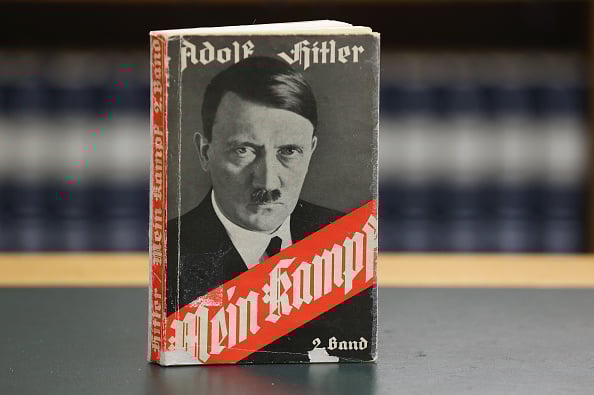
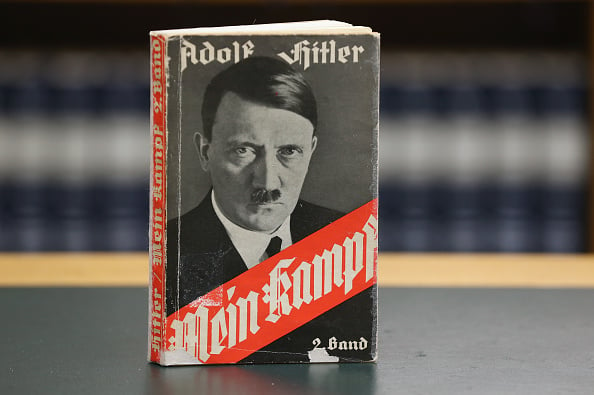
Many people don’t realize that, aside from being one of the most infamous and evil figures in history, Adolf Hitler was also one of the richest authors of all time. The initial royalties from Hitler’s bestselling book, “Mein Kampf”, funded the early Nazi Party’s rise to power and helped Hitler secure his future dominance through bribes and gifts given to prominent German political figures. “Mein Kampf” would eventually go on to sell over 10 million copies worldwide during his lifetime. These royalties granted Hitler a vast personal fortune, which he used to fund a lavish lifestyle that included a fleet of custom Mercedes-Benz vehicles and several luxurious mansions across his empire.
Furthermore, Hitler made millions licensing his image to his own government for use on everything from postage stamps to political posters. It should be noted that in addition to his personal wealth, Hitler and the Nazis had access to vast amounts of stolen property, precious metals, and priceless works of art; however, for this article, we are going to focus on how much Hitler made personally, from “legal” endeavors, during his lifetime.
Interestingly, the question of Hitler’s “Mein Kampf” royalties has never been more relevant than it is today, thanks to the advent of e-readers like the Amazon Kindle and Apple iPad. Believe it or not, “Mein Kampf” has frequently become an e-book bestseller. In the early 2010s, a $1 electronic version of the book produced by a Brazilian publishing company hit #1 on Amazon’s “Propaganda & Spin” chart. While that might be expected given the category, the book also reached number two in the “Political Science” category.
Many media outlets have compared the book’s electronic popularity to similarly controversial or “guilty pleasure” works like “Fifty Shades of Grey”. Because many people were embarrassed to be seen reading such novels in public, e-book sales were exceptionally high. The same argument can easily be made about Hitler’s book. Who would want to be seen at an airport, a coffee shop, or a dentist’s office holding a physical copy of “Mein Kampf” in front of their face? With an e-book, no one is the wiser. So, who is benefiting today from this surge in electronic popularity? And what about the hardcover sales that remain surprisingly strong in various parts of the world? Are there some Hitler descendants today whose lifestyles are funded by their great-great-uncle’s book sales?
Who is cashing Mein Kamp royalty checks today?
Hulton Archive/Getty Images
Why Did Hitler Write Mein Kampf?
Hitler wrote “Mein Kampf” in 1923 while serving a five-year sentence in Landsberg Prison after his failed Beer Hall Putsch. He dictated the book to two cellmates, Rudolf Hess and Emil Maurice, over roughly a year and a half. The idea for writing a book was initially conceived as a way for Hitler to pay down the massive legal debts he had accumulated during his defense. At the time, he had relatively low expectations for the work, hoping primarily that it would be popular among fellow National Socialist Party members and provide a small stream of income.
Hitler Becomes A Millionaire
In its first year of publication, 1925, “Mein Kampf” sold a modest 9,000 copies and earned Hitler no royalties at all. As his political profile began to rise, however, so did the sales. In 1930, as the Nazis gained traction in the Reichstag, he sold 55,000 copies. In 1933, the year Hitler became Chancellor, sales exploded to over 850,000 copies.
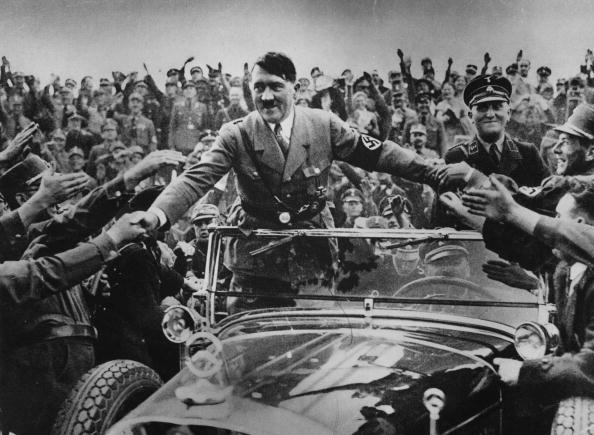
Once he held the reins of power, the German government effectively became Hitler’s largest customer. The state purchased and distributed millions of copies to soldiers and average citizens. Perhaps most famously, every married couple in Germany was given a “free” copy of the book on their wedding day—a gift paid for by the German taxpayer that funneled direct royalties into Hitler’s pockets.
At his peak, Hitler was earning over $1 million a year from “Mein Kampf” royalties. In the purchasing power of 2026, that is the equivalent of roughly $23 million a year. In total, by the time he committed suicide in 1945, Hitler had earned 7.8 million Reichsmarks from book sales. When adjusted for his “wealth status” and the relative size of the economy, that fortune is equal to roughly $220 million in 2026 US dollars.
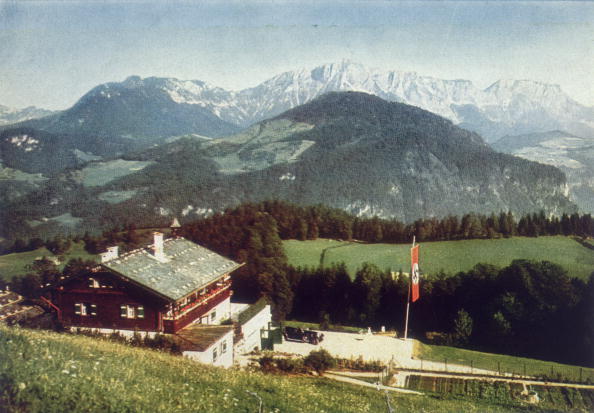
Hitler used this fortune to fund a decadent lifestyle. He earned enough from his royalties to accumulate a tax bill that today would be worth over $15 million, which he promptly “forgave” through a retroactive tax exemption the moment he became Chancellor. While he was still a “struggling” politician, Hitler once wrote to a Mercedes-Benz dealer in Munich, asking for a loan against future royalties so he could buy the Mercedes 11/40 model. The dealer declined. Only a few years later, Hitler would own a fleet of custom-built Mercedes. He also invested millions of his own dollars into purchasing and renovating the Berghof property, transforming it from a small mountain chalet into a massive, high-tech estate with screening rooms, libraries, and tennis courts.
Heinrich Hoffmann/Hulton Archive/Getty Images
Mein Kampf’s International Royalties
Hitler also earned royalties from international book sales up until 1939. While the amounts were more modest, they were not negligible. Between 1933 and 1938, his UK royalties amounted to roughly $500,000 in today’s money. In 1939, the United States government intervened by invoking the “Trading with the Enemy Act”, seizing control of all of Hitler’s US publishing royalties. By the end of the war, the US had seized approximately $255,000 (roughly $5 million in 2026 dollars) and eventually distributed the funds to war refugee charities.
Sean Gallup/Getty Images
Who Makes Money off Hitler’s Royalties Today?
When Hitler committed suicide in 1945, his nephew Leo Raubal (the son of Hitler’s half-sister) was technically his heir. Leo had a legitimate legal claim to the royalties, which even then were worth millions. However, Leo adamantly refused to touch a single cent of “blood money.”
Consequently, the copyright to “Mein Kampf” was seized by the State of Bavaria, where Hitler was officially a resident. For 70 years, Bavaria successfully used its copyright to block the publication of the book in Germany. However, under German law, copyrights expire 70 years after the author’s death. On January 1, 2016, “Mein Kampf” officially entered the public domain.
Today, anyone with a printing press or a digital publishing account can sell the book. In the United States, the rights were owned for decades by Houghton Mifflin, which faced immense public pressure regarding their profits. For years, they donated their royalties to organizations like the Anti-Defamation League. Today, most mainstream publishers follow this ethical standard, ensuring that profits from the book are used for education and Holocaust remembrance. However, the same cannot be said for the hundreds of “independent” publishers on the Kindle store who simply pocket the proceeds from their $0.99 versions.
Other Sources of Hitler’s Income
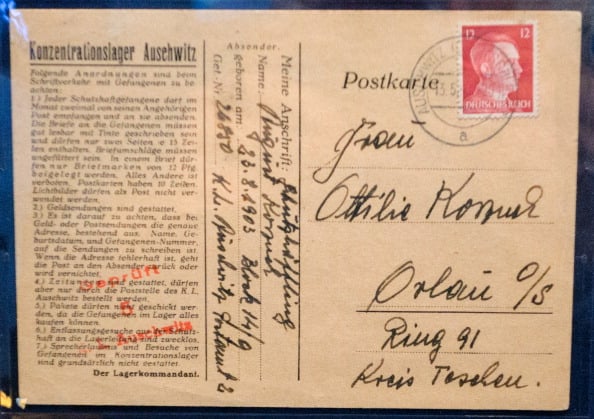
Hitler earned additional tens of millions of dollars licensing his image to the state for political purposes. During his reign, Hitler allowed his face to be used on German stamps and posters that fueled the Nazi propaganda machine. He did not provide this service for free. While the German photographer Heinrich Hoffmann technically owned the rights to Hitler’s official state portraits, most historians agree that Hoffmann acted as a proxy for the Führer himself. As with the rights to “Mein Kampf”, the rights to his image were eventually controlled by the State of Bavaria, with any residual profits directed toward charity.
PAUL J. RICHARDS/AFP/Getty Images
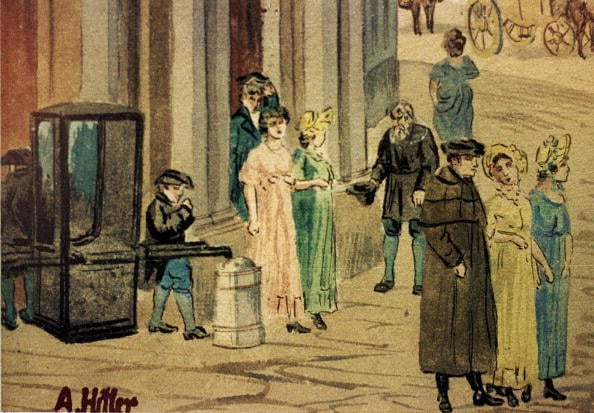
Furthermore, Hitler’s early career as a painter in Vienna left behind hundreds of watercolours. While the US government seized many of these after the war, some remain in private hands. Today, a single Hitler painting can fetch $30,000 to $50,000 at auction. While Hitler’s surviving distant relatives (who live under assumed names today) could technically claim these assets, they have maintained a strict “pact of silence,” refusing to ever profit from their ancestor’s name.
BEHROUZ MEHRI/AFP/Getty Images
In Conclusion
History must remember that Hitler’s rise was not just fueled by rhetoric, but by a massive financial engine built on the sales of “Mein Kampf”. The book made him a multi-millionaire before he even became a dictator. Today, the book remains a bestseller in the digital shadows, but in an ultimate irony, the “legal” royalties from his work now serve to fund the very humanitarian and Jewish charities that Hitler dedicated his life to destroying. For every digital copy sold by a legitimate publisher today, a few cents are likely going toward ensuring his ideology never rises again.