
In Hollywood’s so-called Golden Age, being famous did not necessarily mean being rich. The public saw mansions, premieres, fur coats, convertibles, and screaming crowds. But behind the glamour, many of the biggest film stars of the era were essentially employees. They were locked into long-term studio contracts, paid weekly salaries, assigned roles, loaned out, suspended, or discarded when the studio decided their usefulness had expired.
The music industry could be even worse. Record companies and publishers often controlled the rights, while artists who created generation-defining songs were left fighting for scraps. A singer could have a hit record, sell millions of copies, and still discover that the label, publisher, manager, or promoter made the real money.
Under all standard assumptions, Roy Rogers should have followed some version of that path.
He was a singing cowboy in B-westerns. He worked in a genre that Hollywood rarely treated as prestige entertainment. His movies were often produced quickly and cheaply. At best, one might have expected Rogers to enjoy a strong run, fade with the decline of the movie western, and then spend his later years earning appearance fees at fairs, rodeos, and nostalgia events.
That is not what happened.
When Roy Rogers died in 1998 at the age of 86, his net worth was more than $100 million. That is the same as roughly $200 million in today’s dollars.
So how did a man who started as a studio cowboy become one of the richest entertainers of his era?
It all goes back to one brilliant contract.
The Contract That Changed Everything
In 1937, Rogers, then still legally Leonard Slye, signed a written agreement with Republic Productions. At the time, he was not yet a global icon. He was a rising western performer working inside the old studio system.
The key to the contract was simple but incredibly powerful: Rogers effectively accepted less immediate studio money in exchange for control of his own name, voice, and likeness for commercial use.
That might not sound revolutionary today, when celebrity brands, licensing deals, and image rights are standard business concepts. But in the 1930s, it was an extraordinary move. Studios typically controlled their contract players. They created the images, packaged the stars, assigned the roles, and profited from the machinery around them.
Rogers made sure he owned the most important asset of all: Roy Rogers.
Republic could use him to make and promote Roy Rogers movies, but the studio did not own the broader commercial universe attached to his name. Rogers controlled his image for endorsements, advertising, licensing, and merchandising. He also controlled the name and likeness of his horse, Trigger.
That decision turned out to be worth far more than any studio salary he could have negotiated.
The Roy Rogers Merchandising Machine
Once Rogers controlled his own image, he and his manager, Art Rush, built one of the most successful celebrity merchandising operations in history.
At the height of his fame, the Roy Rogers brand was everywhere. His name and likeness appeared on clothing, toys, lunchboxes, cap guns, action figures, comic books, cereal boxes, and countless other products aimed at children and families. Sears alone reportedly carried hundreds of Roy Rogers-licensed items at the peak of the craze.
Trigger was not just a horse. Trigger was an asset. Bullet, Rogers’ dog, was also part of the brand. Dale Evans, Rogers’ wife and co-star, became part of the same wholesome western universe. The entire operation functioned less like a traditional actor’s career and more like a consumer-products empire.
In the middle of the 20th century, few entertainers understood merchandising as well as Roy Rogers. The only obvious comparison was Walt Disney. Disney had Mickey Mouse. Rogers had himself, Trigger, Dale, Bullet, cowboy hats, toy guns, cereal boxes, lunchboxes, and millions of children who wanted to bring a piece of the frontier into their bedrooms.
The genius was not merely that Rogers became famous. The genius was that he owned the rights that allowed him to monetize that fame.
Why Ownership Mattered
Most stars of the old studio era were paid for their work, not for the full commercial value of their celebrity. A studio could turn an actor into a household name, but the actor did not necessarily own the ecosystem created around that name.
Rogers was different. Because he controlled his name and likeness, he did not have to split his merchandising upside with Republic Pictures in the same way many stars would have had to share, surrender, or never even access those opportunities.
Every cap gun, lunchbox, shirt, comic book, and toy bearing his image represented more than a marketing gimmick. It was a royalty stream. And unlike a movie salary, a royalty stream could keep paying long after filming ended.
That distinction is the difference between being a well-paid employee and being an owner.
Rogers was not just starring in westerns. He was building a company around himself.
Television Reruns Kept The Machine Alive
Rogers also understood the power of television earlier than many film stars of his era. When television began threatening the old movie business, he did not resist it. He embraced it.
“The Roy Rogers Show” premiered on NBC in 1951 and ran for 100 episodes over six seasons. The show gave Rogers, Dale Evans, Trigger, and Bullet a new national platform at exactly the moment when American families were bringing televisions into their homes.
Just as importantly, Rogers was not merely an actor collecting a paycheck. He formed Roy Rogers Productions, which gave him a degree of ownership and control that many older studio performers never enjoyed.
That mattered because television reruns could turn a completed show into a long-term financial asset. A traditional actor might be paid once and then watch the studio profit from reruns for decades. Rogers’ structure allowed the show to keep feeding the larger Roy Rogers business.
Every rerun helped sell the brand. Every broadcast introduced him to another generation of children. Every episode kept the lunchboxes, toys, comics, music, and appearances relevant.
In other words, the reruns were not just entertainment. They were advertising.
The Music Business
Rogers also had a major music career. Before he became the King of the Cowboys, he was a founding member of the Sons of the Pioneers, one of the most influential western singing groups of all time.
Music became another important layer of the Rogers business. His songs, recordings, radio appearances, films, and television shows all reinforced one another. Fans who loved the movies bought the records. Kids who watched the show wanted the merchandise. Families who knew the songs trusted the restaurants. Each piece made the others more valuable.
That kind of cross-platform strategy feels obvious today. In Roy Rogers’ prime, it was remarkably advanced.

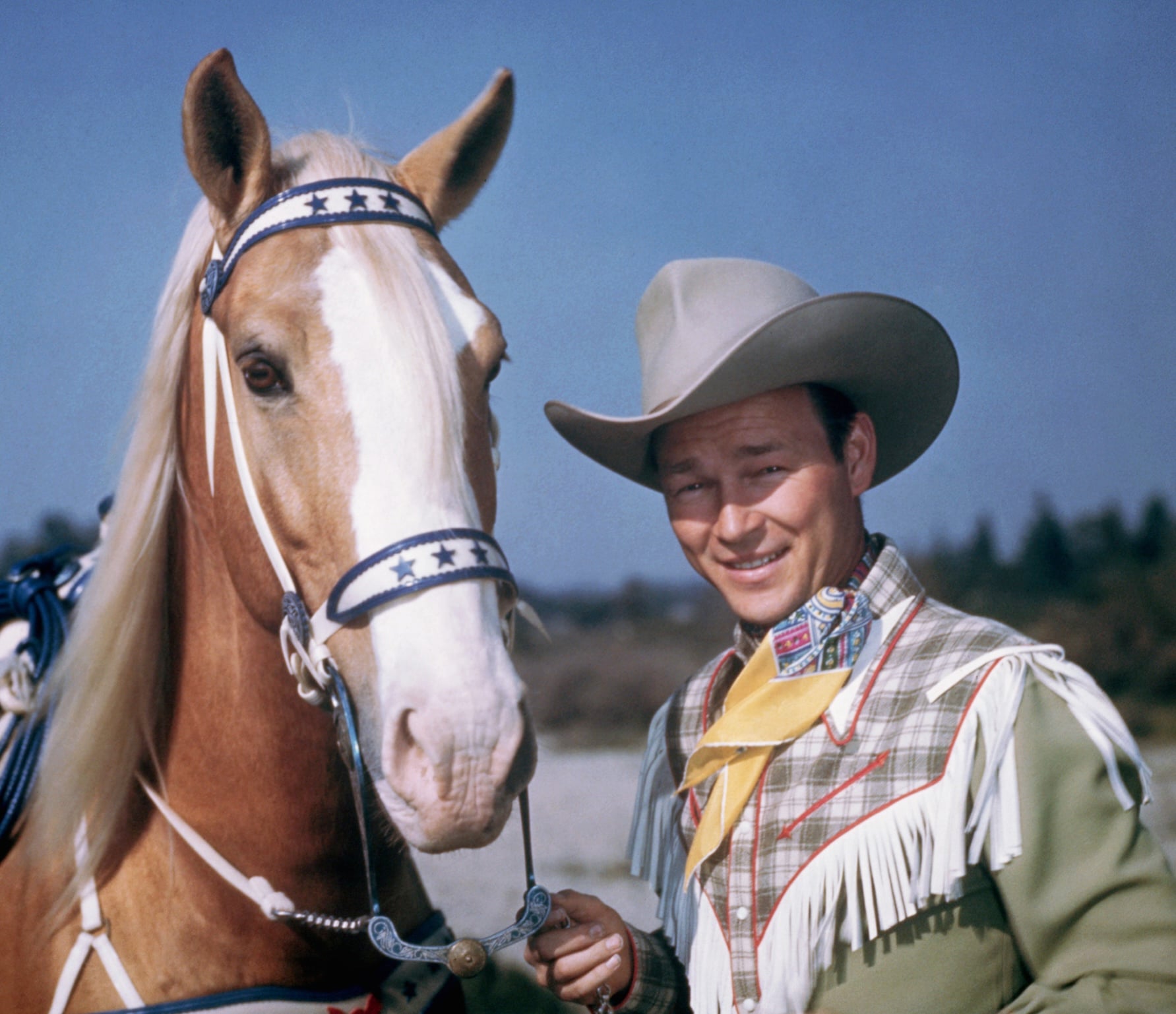
Roy Rogers with Trigger (via Getty)
Then Came Roast Beef
In 1968, Roy Rogers entered the fast-food business.
That year, Marriott launched the Roy Rogers restaurant chain after acquiring and converting earlier restaurant concepts. The idea was simple: Marriott would supply the corporate infrastructure, operational experience, and expansion strategy, while Rogers would supply something money could not easily buy from scratch: instant trust.
The Roy Rogers name meant wholesome, family-friendly Americana. It meant cowboys, clean entertainment, and nostalgia. For a restaurant chain trying to attract families, that was incredibly valuable.
The restaurants became known for a menu that combined roast beef, fried chicken, and hamburgers, along with the Fixin’s Bar. The brand grew rapidly through the 1970s and 1980s, especially in the Mid-Atlantic and Northeast. At its peak, Roy Rogers Restaurants had more than 600 locations.
Rogers was not simply an absentee name on the sign. He made personal appearances, shook hands, signed photos, and helped promote the chain. He gave the restaurants something that most fast-food brands could never manufacture: a living, breathing celebrity identity backed by decades of goodwill.
And for Rogers, the chain created another lucrative income stream long after his leading-man movie career had ended.
Real Estate And Ranches
Rogers also put money into land.
Like many smart early Hollywood figures, he invested in California real estate before certain areas exploded in value. He and Dale Evans owned ranch property in the San Fernando Valley, an area that transformed dramatically as Los Angeles expanded after World War II.
They later became closely associated with Apple Valley and the High Desert. Rogers owned ranch properties that were not merely personal retreats. They were equestrian facilities, filming spaces, promotional assets, and pieces of the western lifestyle he sold to the public.
His Double R Bar Ranch near Victorville became part of his legend. It included horse facilities, open land, and a western atmosphere that fit perfectly with the Rogers brand.
The real estate was not the whole story of his fortune, but it reflected the same instinct that guided his career: convert income into assets. Rogers did not simply spend his fame. He turned it into property, rights, royalties, and equity.
The Original Celebrity Brand
What makes Roy Rogers’ business empire so impressive is that he built it decades before modern celebrity branding became standard.
Today, it is normal for entertainers to launch tequila companies, cosmetics brands, fashion lines, production companies, restaurants, podcasts, and licensing ventures. Modern celebrities are constantly told to own their name, own their masters, own their content, own their equity, and own their upside.
Roy Rogers was doing that before most people had a television set.
He understood that fame by itself was fragile. A movie career could cool. A genre could fall out of fashion. A studio could stop calling. But ownership could endure.
He owned his name. He owned his likeness. He controlled the commercial value of Trigger. He built a merchandising empire. He moved into television production. He benefited from reruns. He expanded into music, publishing, personal appearances, restaurants, and real estate.
That is why Roy Rogers did not end up as a washed-up former cowboy star scraping by on nostalgia. He ended up as one of the wealthiest entertainers of the 20th century.