
On 7 October 2023, Hamas terrorists attacked southern Israel , killing more than 1,200 people and taking 254 hostage.
At the Nova music festival, 378 party-goers of all nationalities, mostly in their early 20s, were massacred.
Now, in an immersive exhibition in east London about Nova, visitors can crunch in the desert sand and see the burnt-out cars, bullet-ridden Portaloos and everyday items left behind as people fled, set to the sounds of terrorists’ cries and panicked calls home.
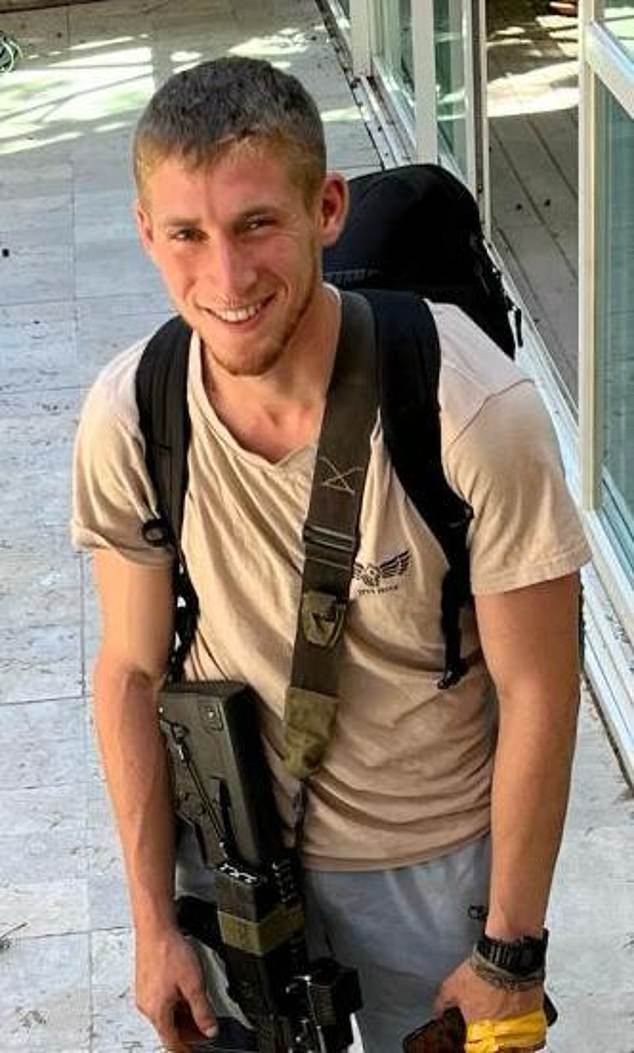
A room here is dedicated to Aner Shapira, a British Israeli, 22, who lost his life in a bomb shelter that day – but not before saving ten others. Last inside, Aner positioned himself by the entrance. When terrorists rolled grenades into the tiny space, he picked them up and threw them out again. The final one exploded in his hand, causing his death.
Shira Shapira, 51, an architect and deputy director general of Israel’s heritage ministry, is Aner’s mother. She lives in Jerusalem with her husband Moshe and their six surviving children. Here she pays tribute to her eldest son.


The 6 October 2023 was a Friday night, a Shabbat (the Jewish Sabbath), and the start of a festival called Simchat Torah. Aner wasn’t meant to be at our family meal in Jerusalem: he had planned to stay at Nova on Friday night as well as Saturday. But it was a beautiful evening and all seven children were home.
Aner had a girlfriend of three and a half years, Shelly, but she wasn’t with us that night. It was my daughter Talia’s 21st birthday, and my youngest daughter, aged ten, made a wonderful meal: soup and fish. We’d just finished years of renovation work on our home, and I remember Aner standing in the kitchen, looking out to the roof terrace. ‘The house turned out really beautiful, Mum,’ he said.
At around 11.30pm, Aner got up to leave for the Nova festival an hour and a half’s drive away – he was meeting his best friend, Hersh Goldberg-Polin. We didn’t make a fuss when saying goodbye; how was I to know this was the last time I would see my son?
I always had an incredibly close bond with my eldest child who, like me, was a British citizen. My parents met and married while studying for their PhDs at Oxford, and I was born there. Though our family moved to Israel when I was under a year old, we’ve always had close links with the UK. My mother, a professor of philosophy of science, and my father, a law professor, still come to England when they want to read and research in the university library.
Aner shared his grandparents’ love of language, talking and writing. He was always so interested in everything: as a toddler he loved to watch the construction workers at the end of our road. He particularly liked the ‘tactor’ (he couldn’t manage the letter ‘r’), so my husband Moshe made him a yellow tractor outfit for Purim, the Jewish festival where we dress up.
When Aner was 18 months old, his sister Talia came along, eventually followed by four more sisters and a brother. Music was Aner’s great love and because he played piano, all the children took up instruments.
Aner was the big brother of the house, but he would also protect the kids in his class. Even when he was a small, thin boy, if he saw anyone being a bully in school, he would confront them. He continued this approach when he began his national service in the army, as all young people do in Israel, and he protected others until the last hour of his life.

The first we knew something was wrong was 8am on the 7 October when alarms sounded in Jerusalem. Because we were observing Shabbat, we weren’t using our phones or listening to the radio. But at 10am my mother came rushing around: something serious was happening in the south but we didn’t have any details.
At this point I wasn’t too worried and I didn’t want to pick up my phone on Shabbat. But when Moshe came home from synagogue at 10.30am, we tried to call Aner. It went straight to voicemail. Then, 15 minutes later, his girlfriend Shelly rang and told us she’d spoken to Aner at 5am but hadn’t been able to reach him since. Shelly told us that terrorists had attacked the party – that’s when I understood the terrible truth.
‘Wait, what are you saying?’ I asked. ‘It is not right, it’s not happening, it can’t be!’ I started screaming. My other children tried to calm me down. ‘You don’t know Aner is involved,’ they said. But in that moment, at quarter to 11 in the morning, I just knew. I couldn’t breathe; I screamed for an hour. I knew that if Aner had been OK, he would have found a way to call me.
We had no more news until Monday morning. It was an unbearable 48 hours. I wanted to drive to the south but it was too dangerous. We were constantly on the phone, on WhatsApp. Rumours were swirling everywhere: at first, that certain people were found alive at various kibbutzim or settlements, and those names included Aner and Hersh. But, deep down, I knew the truth.
Finally, on Monday, I got a call from a young girl, one of the survivors from the bomb shelter, who was so upset she could barely talk. But she told us how Aner, wearing just a T-shirt, shorts and flip-flops, with no weapons, had taken charge at the front of the shelter. ‘I’ll catch the grenades and throw them back – and anything happens to me, you throw them out,’ he said.
‘Aner was a hero,’ said the girl. ‘He took command. I am alive thanks to him. He was the angel who kept us safe.’ It later transpired that she knew Aner hadn’t survived but she couldn’t bring herself to tell us – only that he had been severely injured when a grenade went off in his hand. So we still had hope.
It was only on the Thursday that we got the knock on the door. Two people from the military authorities told us the news. Did I finally accept that my son was dead? The answer is that I still don’t accept it. Sitting here, talking about it, I act as if I understand, but I don’t feel it. I still feel that Aner is alive.
Because of my son, lives will flourish and families will grow. One couple who were hiding in the shelter, Ziv Aboud and Eliya Cohen (Eliya came home after being held hostage in Gaza for 505 days) are getting married in August.
Two and a half years on, I cannot tell you how proud I am of my son. Before 7 October 2023 there were only 14 boys called Aner in Israel – it’s a rare Old Testament name. Now we have more than 250 in our country alone. There are baby Aners in Australia and the US, as well as in Europe.
To his very last moment, Aner knew how people should act. I gain so much comfort from this. I later learned that when Aner died, all the kids in the shelter were still alive, so in my mind, he saved them all. In the end, ten survived from that day: seven survivors who were able to go home and three hostages who later came back from Gaza.
The survivors give me comfort, but at times the rest of the world does not. The way the international community has reacted to Israel and our loss on 7 October hurts me. I don’t understand the mothers who refuse to mourn with us, to feel any sympathy. It’s unbelievable to me.


In the exhibition you see all these beautiful faces: young men and women who came to celebrate, to dance. And people came to slaughter and rape them. To me, it is crystal clear: love and goodness versus evil, terror and hate.
Despite what you might hear, most people in Israel want to connect and help each other. One of the people Aner saved in the shelter was a Muslim, for example. In memory of Aner, Moshe and I have funded an NGO called The Aner Foundation, to focus on young adults and make the world better through music and creativity.
To lose my son is the most terrible thing a mother can imagine. Aner did not have children but he gave life in a different way. And to give life is the most important thing a man can do.
The Nova Exhibition runs until 5 July at 30 Curtain Road, London EC2A; novaexhibition.com