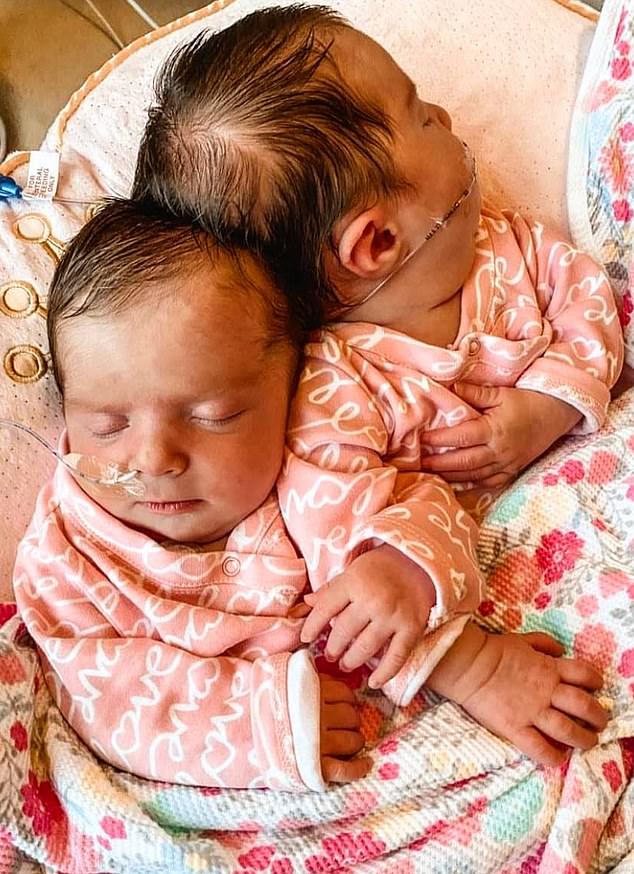
There are so many amazing firsts when you have children. That first smile or laugh, the first time they call you ‘mama’. But it was seeing my two beautiful daughters gaze into each other’s eyes for the first time that took my breath away.
Because, despite being identical twins, it was ten long months before Abigail and Micaela could see one another’s faces.
Why? My miracle girls were born joined at the head, facing in opposite directions.
Conjoined twins, identical twins who develop with their bodies fused together, are incredibly rare.
As for craniopagus twins, like mine, that only happens in two per cent of all conjoined births. Craniopagus twins occur in just one in every 2.5 million births.
But as I prepared myself for my first pregnancy scan in July 2019, I didn’t know any of this.
Growing up with four siblings, I’d always loved the idea of having lots of children. Thankfully in 2006, when I was 20, a mutual friend introduced me to Anatoliy. Like me he came from a family of five children and wanted a big brood. We clicked instantly and I really fell for this kind, thoughtful man.
Four years later we were married and couldn’t wait to start our family. In 2011 our eldest son was born, followed by two more boys in 2012 and 2014.

Liliya was speechless at the beauty of her baby girls Abigail and Micaela

‘Growing up with four siblings, I’d always loved the idea of having lots of children,’ writes Liliya
Anatoliy and I knew that we weren’t done, but from the start my next pregnancy, aged 33, was unlike the others.
At nine weeks I began bleeding and, scared I was miscarrying, I went to hospital. But when the nurse did a scan, she reassured me that the bleeding was likely caused by the fact I was having twins. I was thrilled we were having two more.
It meant when I returned a week later for a more comprehensive routine scan, I wasn’t worried and told Anatoliy he didn’t need to take time off work to come with me.
This time, however, within seconds the chatty, smiling sonographer fell silent, her expression turning from shocked to grave.
As I looked over at the black-and-white screen she suddenly dropped the probe, said: ‘I really need to see the doctor’ and actually ran from the room. I lay there stunned, my stomach still covered in gel.
Desperately trying not to panic, it felt like an age before she hurried back in with someone else.
Once the probe was back on my stomach, the doctor was saying, ‘Yes I see’ and ‘Oh my goodness’. I was terrified.
He then said the words that would change our lives forever: ‘It looks like you have conjoined twins.’
Afterwards, I was in so much shock I don’t remember the walk back to the car park, clutching the slip of paper in my hand for another appointment for an urgent scan in a few days’ time at a specialist clinic.
I sat in my car, fear and adrenaline pumping through me.
‘It can’t be true,’ I thought in horror. I’m a sensible, practical person, who can handle life’s ups and downs, but in that moment I was utterly lost.
Somehow, I managed to call Anatoliy, and through my panicked tears did my best to explain what had happened.
‘I’ll be home as soon as I can,’ he told me. ‘Please don’t worry, I love you.’ As I drove away from the hospital, I honestly thought I was going mad. It was all so overwhelming, I didn’t know what to think.
I can’t fully explain what happened next, but as I sat at a red traffic light, I felt this wave of perfect peace come over me. I felt absolutely calm and, in that moment, I just knew that everything would be okay.
An hour later I was on the sofa when Anatoliy arrived back at our home in California. I met his worried face with a smile and told him everything that had happened.
‘You know what,’ he said, hugging me close, ‘these children inside you are ours and we love them already.’ Whatever happened, we would get through this together. We’d just take each day as it came.
A few days later I was having another scan at the specialist clinic. This time Anatoliy was by my side.
We both looked at the huge screen on the wall, lit up with the image of our tiny babies. It was incredible.
For 90 minutes the doctors examined every detail, explaining that, while at 11 weeks they were too tiny to see everything, the girls had their own arms and legs, but were joined at the head, making them one of the rarest kinds of conjoined twins.
We then sat in another room, where a doctor talked to us about the reality of a craniopagus pregnancy.
He spelt out the fact that very few twins like this survive until birth and, if they do, might die soon after. That surviving babies often have significant, lifelong health problems with their hearts and brains, and the chances of a successful separation were extremely low. He talked about termination as an option.
I heard it all but, gripping Anatoliy’s hand, I knew that however frightening it all seemed, we were going to continue with the pregnancy. That sense of peace and certainty I’d experienced a week before was as strong as ever. However, it would be tested.
In the following months it felt as if I was constantly at the hospital, hearing frightening news. At one appointment, they said there was a problem with their hearts that would make separation extremely unlikely. At another, I was told they might die soon after birth.
For Anatoliy and the boys, who knew that their sisters in Mummy’s tummy were joined together, this became our new normal. We all talked to the girls constantly, telling them we couldn’t wait to meet them. I focused on the present, just as I’d promised myself I would.
Friends and family were amazing, although many were clearly baffled at how I was handling it all.
Instead of constantly crying or worrying, I was chatting at lunches, watching my boys at their swimming lessons. Focusing on daily life kept me grounded and the inevitable moments of worry and fear at bay.
At my baby shower that November, at eight months pregnant, 80 people celebrated with us. I was thrilled to share the news that an MRI scan had confirmed there was a good chance the girls could be separated in the future.
Meanwhile, my 35-week caesarean delivery was planned as meticulously as a military campaign. There would be more than 200 specialist medics involved – each baby would have her own team of neurologists, heart experts and plastic surgeons. Doctors would be in the delivery room and the neonatal intensive care unit, where the girls would be taken straight after birth.
Based on my MRI scans, they even created a conjoined twins doll that showed the twins’ position so they could practise ahead of the delivery.
But even the best-planned births can go awry.
The night before my caesarean, my waters broke.
The huge team had to be called in early as my blood pressure dropped, leaving the girls and me in danger. Thankfully I was rushed into surgery in time.
With all the drugs I’d been given, I don’t remember much about the birth. In a fog of medication, I didn’t see the girls before they were whisked away.
A few anxious hours later, having heard they were doing well, Anatoliy pushed me in a wheelchair to the NICU.
Seeing the girls, I was speechless at their beauty. I didn’t focus on their heads or think ‘they look different’. I didn’t notice the monitors and wires. I simply said: ‘They’re perfect.’
Crying tears of happiness, we named them Abigail and Micaela. Holding them for the first time the following day felt so natural.

‘Holding them for the first time the following day felt so natural,’ Liliya writes
For seven weeks they were in the NICU, and I’d shuttle between home and the hospital. The nurses showed me how to move the girls from their backs to their tummies, so they weren’t always lying in one position.
They were so tiny it wasn’t hard to work out ways to breastfeed them one at a time or change them. But when they were able to breathe safely by themselves, it was time to bring our girls home, where we had to get creative.
A regular cot wasn’t big enough so we used a big travel one. I couldn’t take them out to do all the usual mum and baby things – no buggy would have been suitable – so we stayed close to home.
The boys, who had met their new sisters the week before they came home, loved to help.
During our many hospital trips, when we needed an ambulance to transport us, some people would stare and ask questions. It didn’t upset me; I was proud to show off my daughters.
As the months passed, we watched them develop their own personalities, Micaela relaxed and Abigail alert. Seeing them hold hands even though they couldn’t see each other’s faces, I’d think: ‘I’m alive, they’re alive and it’s truly a miracle.’
Of course, their journey was far from over. It took months to prepare them for the separation surgery. When the girls were six months old, doctors placed a custom-designed tissue expander underneath the skin of their heads so that there would be enough skin to cover their individual skulls once they were separated
Finally, at ten months old, they were ready.

When they were able to breathe safely by themselves, the girls were brought home

As the months passed, Liliya and Anatoliy watched the girls develop their own personalities, Micaela (on her dad’s left) seemed relaxed and Abigail (on her dad’s right) more alert
They were facing a 25-hour procedure involving 30 medics, and the operating room at UC Davis Children’s Hospital in California had to be custom built to accommodate the level of surgical complexity. While the girls had individual brains and experienced the world separately, there was some shared brain matter.
However, it was separating the veins that would be most risky. And once the separation was done, doctors would have to reconstruct their skulls.
Knowing the risks of such a major operation – from blood loss, stroke or brain damage to the risk we might lose one or both of them – was terrifying.
But we wanted to give them the chance to be separated, however difficult that process might be.
Kissing them both before the surgery, my heart was pounding. The next 25 hours were the longest of my life, adrenaline spiking at every update from the team. Finally, a call arrived to say we now had two, separated little girls. The relief was so great I struggled to breathe.
I cried with happiness when I saw the girls in their own cots for the first time, then held one in each arm and marvelled at how light they were. When I saw them look directly into one another’s eyes, it was another miracle.

Liliya holds one of her girls after the surgery – a gruelling, 25-hour procedure involving 30 medics

‘When I saw them look directly into one another’s eyes, it was another miracle,’ writes Liliya
On Christmas Eve, two months later, we brought them home. It was the best gift imaginable.
Their close bond has never wavered. Seeing them learn to sit up, crawl and walk, all things that would have been impossible if conjoined, brought yet another wave of thankfulness. Inevitably there have been many medical appointments over the years – they have seen heart specialists, eye specialists and neurologists – which the girls take in their stride.
Now six, they’re cheeky, affectionate girls, who love playing with books and dolls, chattering together and getting messy with craft projects.
We’re homeschooling them and, while they’re not hitting all their milestones yet, they are doing so well. While the girls have beaten the odds, they will need regular medical monitoring throughout their lives.

‘Seeing them learn to sit up, crawl and walk, all things that would have been impossible if conjoined, brought yet another wave of thankfulness,’ writes Liliya

Abigail (left) and Micaela (right) at their fifth birthday party. The girls love playing with books and dolls
We don’t know yet if they will need future surgery, or if, as adults, they will be able to live fully independently.
For now we are just taking it one step at a time, and celebrating their miraculous progress.
The joy they brought only encouraged Anatoliy and me to have more children. Micaela and Abigail love being big sisters to Adam, four, and Nikolay, one, in addition to their three big brothers. As a mother of seven, life is hectic in the best possible way.
I will never forget the moment of pure fear that struck me when I learned the girls were conjoined, nor the peace that followed.
It taught me how to focus on the blessings I have each day and be thankful for the light all my children have brought to my life.
As told to Kate Graham