
Australia’s biggest hardware retailer has quietly made one of its boldest moves yet.
Bunnings Warehouse has begun selling flat-pack homes with prices starting from $26,100.
The move marks a major expansion beyond tools and timber for the Aussie-loved brand and into the fast-growing world of modular housing as the nation’s housing crisis shows no sign of easing.
The retail giant has partnered with Australian start-up Elsewhere Pods to offer compact, prefabricated pod homes that can be purchased online or through Bunnings’ Special Orders desk in-store.
The range currently includes two models: a 2.7m by 2.4m pod priced at $26,100, and a larger 4m by 2.4m studio costing $42,900.
While modest in size, the pods are being marketed as a flexible solution for a range of uses – from home offices and guest accommodation to teenage retreats, crisis housing and short-term rental stays.
Delivered as flat packs, the units come with pre-fabricated wall panels, insulation and eaves, and can be assembled in as little as two days, positioning them as a DIY-friendly alternative to traditional construction.
In some council areas, the structures can be installed without triggering full building or planning approvals, which is a major drawcard for buyers seeking speed and simplicity.

Bunnings Warehouse has begun selling flat-pack homes with prices starting from just $26,100

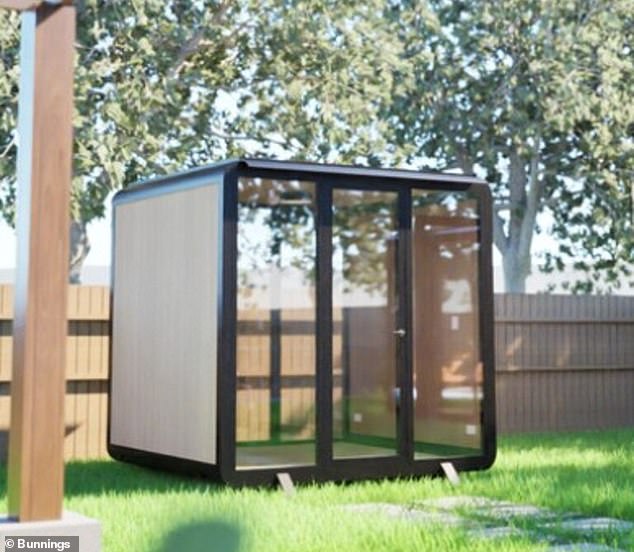
The retail giant has partnered with Australian start-up Elsewhere Pods to offer compact, prefabricated pod homes that can be purchased online or through Bunnings’ Special Orders desk in-store. Pictured: a larger 4m x 2.4m studio priced at $42,900
However, experts stress that rules vary significantly between councils and states, and homeowners should always confirm local requirements before building.
Bunnings has said the pods reflect growing demand from customers looking for fast, affordable ways to add functional space to their properties.
‘They provide an affordable way for customers to add functional space to their homes,’ Bunnings chief operating officer Ryan Baker said.
The retailer’s move comes as Australians grapple with soaring property prices, a shortage of rental stock and lengthy build times for detached homes, which can stretch well beyond a year.
As costs rise and timelines blow out, many homeowners and investors are increasingly turning to modular, prefabricated and kit-built housing as a practical alternative.
‘Some of them are very nice and while small, it’s better than nowhere,’ one person commented.
Elsewhere Pods founder Matt Decarne said demand has surged as buyers look for housing solutions that bypass traditional bottlenecks.
‘Many tiny homes, including some of our designs, don’t trigger planning or building approvals, which is a huge drawcard,’ he said.

The range currently includes multiple models: a 2.7m by 2.4m pod priced at $26,100 and a 5.4m x 3.6m ‘studio’ for $27,157 (pictured). They are being marketed as home offices and guest accommodation to teenage retreats, crisis housing and short-term rental stays

Since launching, Elsewhere Pods has recorded more than $9 million in sales, underscoring the appetite for compact housing solutions across the country. The company says nearly a third of its sales are for off-grid accommodation and eco-tourism projects
The partnership with Bunnings was announced in September and quietly rolled out with the retailer last month.
Since launching, Elsewhere Pods has recorded more than $9 million in sales, underscoring the appetite for compact housing solutions across the country.
’40 years ago, they were called Bird Avairy’s and were full of Budgies,’ one person joked of the size and liveability of these homes.
The company says nearly a third of its sales are for off-grid accommodation and eco-tourism projects, particularly in regional and lifestyle destinations where speed, sustainability and flexibility are key.
The move also reflects a broader shift in Australia’s housing landscape, with major lenders, including Commonwealth Bank, signalling growing support for prefabricated construction, while kit-home manufacturers have multiplied nationwide.
State governments in Queensland and Victoria have also moved to relax planning rules around secondary dwellings, such as granny flats, in an effort to ease housing pressure.
According to industry data, builders now expect to deliver around ten times more granny flats than they did in 2022, as families look for ways to house adult children, ageing parents or generate rental income on existing blocks.
Market forecasters say the momentum is only just beginning, and analysis suggests Australia’s prefabricated buildings market – which includes modular and flat-pack homes – is set to grow by around seven per cent annually, reaching an estimated $18 billion by 2030.
For Bunnings, the move represents a significant evolution of its brand, from supplying the materials to build homes, to offering ready-made housing solutions themselves.