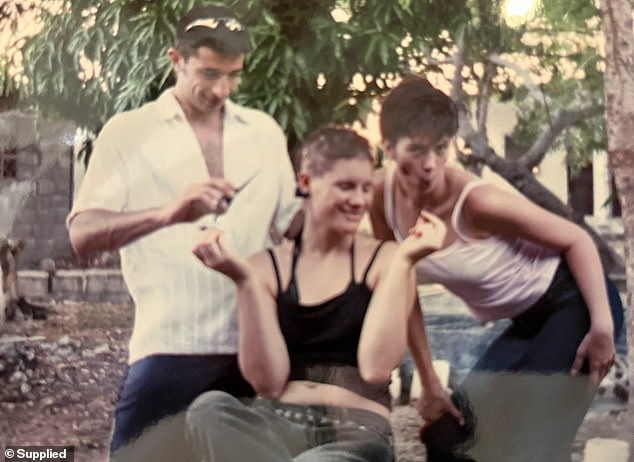

At 19, Nerida Mills was travelling the world, living what she describes as her ‘best life‘, when she noticed a small patch of hair falling out behind her ear. Within weeks, most of her hair was gone.
‘I was diagnosed with alopecia,‘ she tells Daily Mail. ‘They told me my hair would fall out over three months, stay out for three months, grow back over three months and then reset. I was like, I can handle that. It‘s not a problem.‘
It didn‘t reset. Instead, it became the beginning of what she describes as more than two decades of chronic health issues that never quite made sense together.
‘Over 20 years, it was constantly misdiagnosed,‘ she says.
In the years that followed, Nerida was dealing with ongoing gut problems, constant exhaustion, hormonal fluctuations and a kind of low-level neurological disruption that would come and go. Her hands would go numb. She would get tingling in her fingers. At times, it would creep up into her face.
‘I had gut issues constantly, exhaustion constantly, hormonal fluctuations and just this agitation in my system,‘ she says.
She says the symptoms were persistent but often subtle enough to be explained away, both by doctors and, at times, by herself.
‘It was the kind of stuff that you can excuse,‘ she says. ‘You go, well, I had gut issues, so that makes sense. Or my hormones are all over the place, so that makes sense.‘
But the pattern never quite added up. The symptoms didn‘t resolve. They shifted, resurfaced and slowly intensified over time.

Nerida Mills (centre) was 19 years old and travelling the world when her hair started to fall out

Nerida (pictured with one of her sons) said she had an ‘underlying knowing that something wasn’t right
‘There was just an underlying knowing that something wasn‘t right,‘ she says.
She saw doctor after doctor, trying to get answers for symptoms that were affecting multiple systems in her body. Instead, she says, the explanation kept coming back to one thing.
‘That it was stress. That I just needed to regulate my stress better.‘
The problem, she says, was that it didn‘t reflect her reality.
‘I loved my life,‘ she says. ‘I wasn‘t sitting there thinking I‘m overwhelmed, I can‘t cope. That wasn‘t my experience at all.‘
At times, those conversations went further than dismissal.
‘I had doctors laughing at me, doctors yelling at me, doctors telling me I should stay in my own lane,‘ she says. ‘I had one doctor tell me I was delicate and needed to toughen up.‘
Over time, that constant message began to seep in. Even as she continued to advocate for herself, doubt crept in.
‘You start questioning yourself,‘ she says. ‘Am I actually crazy? Am I making this up? Am I trying to get attention?‘
By her mid-thirties, Nerida was raising three children and doing everything she could to manage her health. She focused on diet, supplements and lifestyle, trying to stay functional despite the ongoing symptoms, but the underlying issues never fully went away.
In 2020, everything changed. What had once been manageable became impossible to ignore.
‘I walked into my house and the world just warped,‘ she says. ‘My visual perception completely distorted. My ears started popping, I felt like I was going to spew, I thought I was going to pass out. I couldn’t stand.‘

Even when Nerida’s symptoms left her confined to a wheelchair, doctors still dismissed her

Just one week after the ruptured cyst that nearly killed her, Nerida delivered a TEDx talk titled Being Human, standing on stage while still in the depths of her illness

Dr Mualla McManus, founding director of the Karl McManus Foundation , says the condition is complex and often misunderstood.
She went to a doctor, hoping for answers. Instead, she says, she was met with disbelief.
‘He laughed at me and said, “What are you doing? Just walk properly.“‘
At hospital, the response was no more reassuring. She says she was told it was stress and she needed to rest, despite experiencing severe neurological symptoms.
‘They said, “You‘re just under a bit of stress, you need to go home and relax.“‘
Over the following weeks, her condition deteriorated rapidly. Her balance and coordination worsened, and walking became increasingly difficult. At times, she needed to be physically supported just to move around. Eventually, she required a wheelchair to leave the house.
‘By the end of February, I wasn‘t able to leave the house without a wheelchair or someone literally walking with me, holding me up,‘ she says.
The impact on her day-to-day life was profound. She became largely housebound and reliant on others for basic care.
‘The first six months were pretty solid,‘ she says. ‘I couldn‘t do anything. I had people coming over to help me bathe, help with the kids, cook food.‘
Eventually, she was diagnosed with functional neurological disorder, a term used when the nervous system isn‘t working properly but no clear cause is identified.
‘I remember thinking, that sounds like an umbrella statement,‘ she says. ‘Like you don‘t know why.‘
By this stage, she had stopped pushing back. ‘I stopped arguing with doctors years ago,‘ she says.
That loss of trust would go on to have serious consequences. In 2021, Nerida experienced severe abdominal pain caused by what would later be identified as a ruptured ovarian cyst and internal bleeding. After years of being dismissed, she hesitated to seek help.
‘I was so resistant to going to the emergency department,‘ she says. ‘I was just so sick of being told that it was all in my head.‘
Instead, she tried to push through the pain at home.
‘I nearly didn‘t go,‘ she says. ‘If my partner hadn‘t been there that night, I probably would have died.‘
The turning point came when a practitioner suggested testing for co-infections associated with tick-borne illness. Several came back positive, leading to further testing.
‘I had Epstein-Barr virus, Chlamydophila pneumoniae and cytomegalovirus,‘ she says.
Then, at 40 – after 23 years of searching for answers – Nerida was diagnosed with Lyme disease.
‘I had never even heard of it,‘ she says.
Looking back, she believes the origin of the illness makes sense. Before her symptoms began, she had been living in Santa Cruz, California, working at a horse-riding facility and spending long days outdoors.
‘There were massive horse flies biting me all the time,‘ she says. ‘I was also hiking a lot. It was within about two weeks of leaving there that my symptoms started.‘
While she says she can‘t pinpoint the exact moment of transmission, the timing has always stood out.
‘I didn’t even find out about Lyme for over 20 years,‘ she says. ‘But when I look back at that period, it lines up.‘
Lyme disease is an infectious disease caused by the bacterium Borrelia burgdorferi, typically transmitted via a tick bite.
Dr Mualla McManus, founding director of the Karl McManus Foundation, says the condition is complex and often misunderstood.
‘Lyme disease is an infectious disease caused by Borrelia burgdorferi,‘ she says. ‘It can cause non-specific symptoms and symptoms can vary from patient to patient. This lack of specificity makes it difficult to diagnose.‘
She explains that symptoms can include fatigue, flu-like illness, brain fog and muscle pain, but that presentation differs widely between patients.
‘It can mimic a lot of diseases,‘ she says. ‘It is often misdiagnosed.‘
In Australia, Lyme disease remains controversial. Health authorities maintain that the specific bacteria responsible has not been identified in local ticks, meaning cases diagnosed here are generally considered to have been acquired overseas.
‘The debate in Australia centres on patients claiming to have Lyme disease after being bitten in Australia, while the government stipulates Lyme bacteria has not been identified in Australian ticks,‘ Dr McManus says.
She adds that diagnosis can be further complicated by the way the infection interacts with the immune system.
‘Diagnostic tests assume the patient has a healthy immune system, so results can be false negative,‘ she says. ‘Someone with Lyme disease usually has multiple infections, not just Borrelia, which also complicates things.‘
For Nerida, that controversy had real consequences. Even after receiving a diagnosis, she says she struggled to have it acknowledged within the healthcare system.
‘Even after I was diagnosed, I had specialists say, “We can’t take that into consideration“,‘ she says. ‘I was like, what the actual… how can you not take that into consideration?‘
She says the lack of recognition made it significantly harder to access care.
‘One hundred per cent it made it harder,‘ she says. ‘I can‘t even imagine how many people in this country are suffering and being told they just need to chill out.‘
Her treatment journey was complex and largely self-directed, involving multiple therapies aimed at supporting her immune system and targeting the infection.
‘There‘s no roadmap,‘ she says. ‘You‘re figuring it out as you go.‘
It was also expensive, costing tens of thousands of dollars over several years.
Gradually, things began to improve. The crashes became less frequent and her body began to stabilise.
‘By the end of the treatment, I stopped being wiped out for those extra days,‘ she says. ‘For the first time, I could actually function consistently.‘
Follow-up testing through an overseas laboratory showed no detectable signs of the infection.
‘I believe that I‘m cured,‘ she says. ‘I know that‘s very controversial. But there are no signs or symptoms in my system any more.‘
Now 44, she says she feels stronger than she has in years and is rebuilding her life with a renewed sense of confidence.
Despite everything she was going through, Nerida continued to push forward in ways that now feel almost impossible to comprehend.
Just one week after the ruptured cyst that nearly killed her, she delivered a TEDx talk titled Being Human, standing on stage while still in the depths of her illness.
‘I look back at that now and I don‘t even know how I did it,‘ she says.
Last year, she also published a book, Life As Medicine, documenting everything she learnt across two decades of chronic illness, misdiagnosis and recovery.
And last month, she completed a 19.7km open water swim off the coast of Western Australia, a goal she had held on to throughout her illness.
‘I always knew that would be my reclamation of health,‘ she says. ‘No matter what, I had to swim that.‘
After the original event was cancelled, she found another way to complete the distance weeks later.
‘It was everything,‘ she says.
For Nerida, the biggest impact of her experience wasn‘t just the illness itself, but the lack of belief she encountered along the way.
‘The hardest part wasn‘t being sick,‘ she says. ‘It was not being believed.‘
After everything she‘s been through, that‘s the part she says still stays with her.
New to DailyMail+? Here are our most-read stories from the past week
Punching walls. A bride accused of sleeping with a footy team… FORTY MAFS bombshells Nine cut from the show: ALI DAHER exposes all the unseen shockers from an ‘out of control’ season
Leaked: The property tax revolution plotted for Australia. Secret plan reveals Jim Chalmers’ radical changes for capital gains taxes – including a twist no one expects
Tragic Annabelle Price’s secret last love revealed by insiders – and why her funeral is on hold… Plus, dangerous witch hunt for ‘rich lister’ linked to bikies: THE GROUP CHAT
Insiders spill on Antony Catalano’s France-Soir dinner with another woman before his alleged drug-fuelled assault on wife Stefanie ‘while demanding to see her phone’
Mortifying new photos leak of ‘middle-class’ drug queen Tess Rowlatt after she vowed to get clean – as friends reveal exactly how she went from Monash party girl to ice dealer
The Aussie ‘elites’ clinging to Harry and Meghan are the most unbearable part of this tour. Their fawning fan club won’t forgive me for this: AMANDA GOFF
Incestuous abuse, outrageous on-set behaviour and now accusations against Katy Perry: Inside story of how Ruby Rose went from Hollywood’s hottest wildcard to spending years in the wilderness
‘Dangerous’. ‘Untested’. But when a mum-of-three with chronic back pain tried a controversial peptide, she noticed changes she could not explain… Now, doctors reveal the risk behind the hype
The cocaine mums’ new habit has shocked even me. I thought I’d seen it all – but what happened at a posh children’s party was so disturbing, I can’t shake it: JANA HOCKING
Eye-watering debts of ‘business savage’ life coach Felicity Morgan’s company laid bare in damning dossier – as we reveal her forgotten former life and her husband fires off from Bali