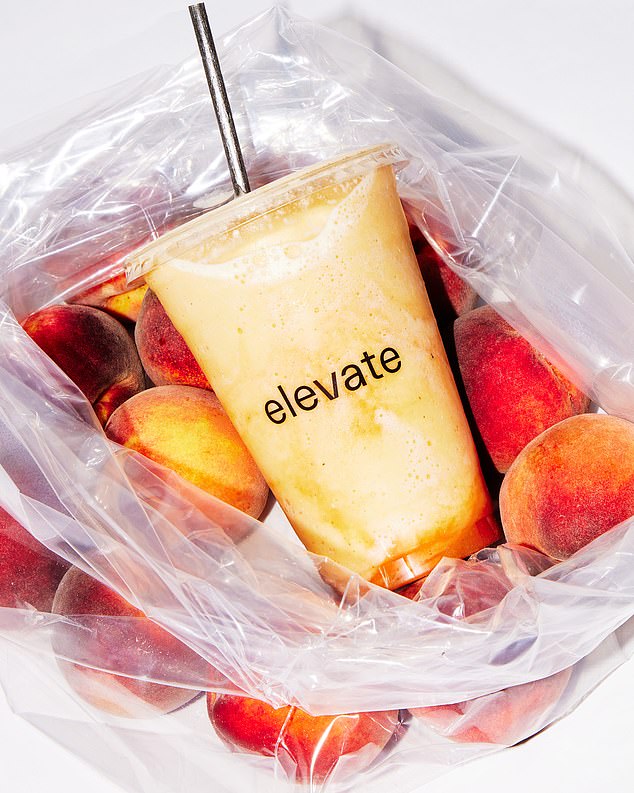

It’s Saturday morning in Soho and I’ve just finished a spin class. I join a queue snaking through the Selfridges Foodhall for a smoothie that will eat into a good chunk of my £70 weekly food-shop budget. Twenty minutes and £9.90 later, I emerge clutching a bright orange concoction that TikTok has promised me is London’s answer to the viral $22 smoothies from Erewhon, Los Angeles. Mine is the Peach Vanilla Glaze by London-based smoothie chain Elevate – a sunshine-coloured blend of white and yellow peaches fortified with hyaluronic acid and marine collagen. The ingredients list reads less like a drink and more like a luxury skincare serum. The modern smoothie isn’t just something you drink; it’s something you aspire to.
Erewhon is the LA luxury supermarket chain that transformed smoothies into social currency. Its influencer collabs with the likes of Hailey Bieber, Sofia Richie and Bella Hadid routinely sell out: strawberry pink ‘glaze skin’ smoothies costing $21 are consumed with the devotion flat whites are in London.
Last summer, Soho House became one of the first UK brands to lean fully into the trend, launching a range of protein smoothies across its health clubs. The drinks are fiercely photogenic: chocolate brown from cacao nibs, soft pinks from berries, and bright greens from matcha. Its bestselling Beach House (£9) is a swirl of strawberries, goji berries and cherries, blended with blue kefir and coconut milk, and topped with chia seeds and protein powder.
Now the trend is spreading beyond private members’ clubs. Brands like Blank Street have helped pave the way for drinks to become lifestyle accessories, while salad chain Atis has launched a smoothie line.
‘People are looking for small daily rituals that bring joy,’ explains Atis co-founder Ellie Warder. ‘Smoothies and functional drinks are moving into that space.’

Peach Vanilla Glaze, £9.90 – 301 kcals, 48g carbs, 26g sugar, 12g protein, 6g fibre
And ‘functional’ is the word you’ll hear repeatedly, of ‘gut health’ smoothies, ‘lean’ smoothies, ‘beauty’ smoothies. Drinks are enhanced with creatine, collagen peptides, probiotics and adaptogens – ingredients once confined to wellness forums blitzed into £10 drinks for office workers in activewear.
Elevate founder Julia Baldet says the concept was born from frustration with a lack of healthy but desirable grab-and-go options in London. ‘Everything sat at one extreme or the other,’ she says, ‘either clinical wellness brands or grab-and-go food with little nutritional value.’
Crucially, flavour comes first. ‘If something is highly functional but people don’t genuinely crave it, they won’t come back for it,’ she says.
Erewhon-style smoothies enable us to feel good but still do luxury consumption. A £10 smoothie is easier to justify than a £100 facial, with both promising the same thing: better skin, more energy, a shinier version of yourself.
According to Kristen Stavridis, registered nutritionist and author of recent book The Fibre Fix, the popularity of super smoothies reflects a broader shift in wellness culture post-pandemic. ‘We’ve seen a rise in health-focused behaviours since Covid,’ she says. ‘Social media has transitioned away from party culture towards wellness – Pilates, green juices and healthy routines.’
But she’s wary of the ‘health halo’ surrounding many of the products. Terms like ‘gut health’, ‘collagen-boosting’ and ‘skin glow’ sound scientific, but the reality is often less so.
‘Some ingredients do have nutritional grounding,’ she says of protein, fibre or ingredients that support energy. ‘But a lot of claims don’t always have strong evidence behind them, especially when drunk as a one-off.’
There’s also the question of whether the smoothies are actually filling. While many are marketed as meal replacements, Stavridis notes that most contain only 200 to 450 calories and little fibre. ‘They’re usually too low in energy to function as a meal,’ she says. ‘They work better as a snack or with something more substantial.’
That hasn’t stopped them becoming status symbols. Wellness is increasingly becoming the new luxury.
In an era when buying property seems impossible and even a cocktail can cost £18, dropping £10 on a smoothie infused with blue spirulina and sea buckthorn is an achievable indulgence.
The irony, of course, is that many nutritionists would still rather you just ate some oats. Stavridis says a genuinely nutritious homemade smoothie doesn’t need half the ingredients found in most premium blends. ‘Fruit and vegetables, oats, yogurt or protein powder, and healthy fats like nut butter or flaxseed are enough,’ she says.
Still, practicality has never been quite as seductive as smoothies with names like The Glow. And as I leave Selfridges sipping my £9.90 beautiful orange drink, I can’t pretend I’m above it all. My skin may not be transformed, but the smoothie is excellent. And for 20 minutes, carrying it through central London, I do feel like someone whose diet is finally the picture of health.