In yesterday’s Mail on Sunday, Audrey Hepburn’s son told of her role in the Resistance in Occupied Holland, and how shrapnel, lodged in her neck from a shell explosion, contributed to her legendary poise. In today’s final extract of his biography of the Breakfast At Tiffany’s star, he reveals what inspired her iconic style…
Don’t show off or make a spectacle of yourself, was the stern advice given to Audrey Hepburn by her Dutch mother.
Baroness Ella van Heemstra – who’d once been a fervent admirer of Hitler – was like a one-woman Panzer division. She seemed to have a constant need to criticise the people she loved, and her never-ending flow of put-downs led Audrey to doubt herself constantly.
Even when she became an established star, Ella’s uncompromising attitude was that she’d done surprisingly well for herself, considering she had ‘no talent’ and wasn’t interesting.
It was little wonder that Audrey Hepburn was unable to appreciate her own worth, or that she was grateful and surprised whenever people paid her a compliment. Indeed, she never saw herself as particularly beautiful, talented or lovely in any way.
Few women apart from the late Queen were as photographed in their lifetime as my mother, the movie star Audrey Hepburn. Even now, more than 30 years after her death, her image is regularly reproduced on everything from T-shirts to artwork, coffee mugs to style features in magazines.
It got to the point where, while I was traveling with my own children, we used to play a game called ‘three minutes to find Granny’. Few of us ever lost.
Audrey, of course, would have considered the industry that’s grown around her as quite preposterous. Certainly, she could never have envisaged the seemingly insatiable appetite for her image, let alone her elevation to style icon for succeeding generations.
‘I wanted to work, and I behaved nicely,’ she said once. ‘I was polite and normal. I think that communicated a certain something to people. That’s all.’
She often made fun of her looks. I remember her describing herself as flat-chested and lanky, ‘with never enough up top’, adding that her feet were too big, her face too wide, her nose bumpy and one of her teeth crooked.

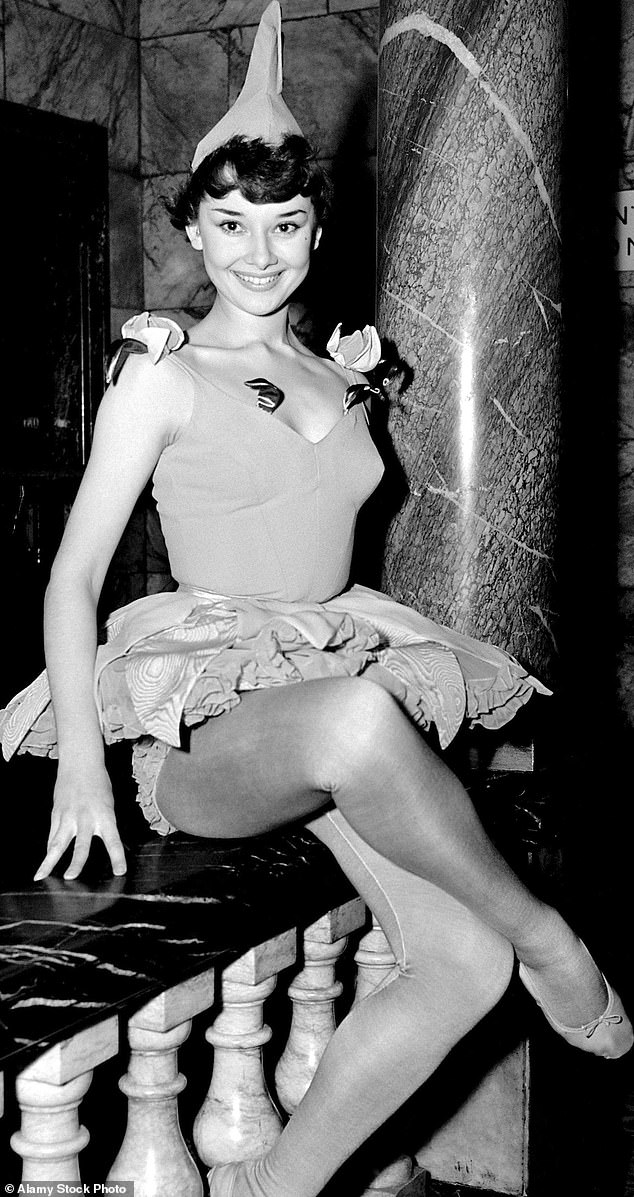
Hoping to make a living from her ballet training, Audrey took work as a chorus girl in cabaret shows. Pictured in the West End revue Sauce Piquante in 1950

Baroness Ella van Heemstra – who’d once been a fervent admirer of Hitler – was like a one-woman Panzer division. She seemed to have a constant need to criticise the people she loved
Envious of small girls with ‘pretty shoulders and pretty little feet’, she said once: ‘You could even say that I hated myself at certain periods. I was too fat or maybe too tall or just plain too ugly. I couldn’t seem to handle any of my problems or cope with people I met.’
Mum had enough self-worth, however, to resist later studio suggestions that she change her name or have her nose or wonky tooth fixed.
Famously, when one director asked her if she’d wear false boobs, she replied: ‘But I am!’
While often discouraging, Audrey’s mother at least taught her how to appreciate good clothes. ‘In the right clothes, you can be anything you want to be,’ she told her daughter at the end of the Second World War. ‘And never underestimate the power of quality fabric or a simple line.’
Then would come the inevitable rider: ‘For an ugly duckling who’s as thin as a reed, you could almost pass for attractive.’
After years of malnutrition in occupied Holland, Audrey had emerged from the war emaciated and in poor health. All her family’s money and valuables had been lost or stolen by the Nazis, so she and Ella survived initially on food and clothing provided by the United Nations Relief and Rehabilitation Administration.
Her first proper meal in years was sugary porridge with condensed milk. She ate so much of it, she became ‘deadly ill’, she said, as she wasn’t used to absorbing anything so rich.
Once peace was declared, Audrey, then aged 16, was desperate to go to the movies – an experience denied to her for years.
As the local cinema had been levelled by shelling, Canadian troops erected a screen across a narrow street and set up a projector and chairs in the town square. One of the first films she saw was Spellbound, starring Gregory Peck – who would become her first Hollywood co-star and a lifelong friend.
Two years later, she took advantage of her British nationality – courtesy of an Anglo-Irish father who’d long since abandoned her and the baroness – to live in London. Hoping to make a living from her ballet training, she took work as a chorus girl in cabaret shows.
Comedian Bob Monkhouse encountered her as a 20-year-old dancer in a 1950 West End revue called Sauce Piquante. Their co-stars included Norman Wisdom and Tommy Cooper.
Monkhouse recalled that the other girls in the chorus line were jealous of how much attention she attracted from the audience, even though she was the worst dancer.
One told Monkhouse: ‘They can’t take their eyes off that face! Those eyes! That bloody smile! She’s a darling girl but, honestly, I could just murder that Audrey Hepburn.’ Monkhouse had a theory about why she seemed to affect people so profoundly. ‘She had an air of defencelessness, of helplessness,’ he said.
At the suggestion of her fellow chorus girls, Mum auditioned for a few bit parts in B-movies because she needed the cash. She appeared for a few seconds in the 1951 movie The Lavender Hill Mob, wearing a pale couture dress with a black belt and gloves as she kissed the cheek of the film’s British star, Alec Guinness.
Join the debate
How much do parents’ harsh criticisms shape or sabotage their children’s confidence and success?

Even before she was 20, Audrey had come to value the much-needed confidence boost she got from good clothing. It was a kind of armour

Even those who know little about fashion can often identify one of the most iconic dresses ever seen in a Hollywood movie. It was worn by my mother in Breakfast At Tiffany’s
Despite the brevity of her performance, she made an impression. ‘She only had half a line to say, and I don’t think she even said it in any particular or interesting way,’ Guinness reported later. ‘But her fawn-like beauty and presence were remarkable.’
What made her so distinctive for the times was her original personal style. She’d cut her hair short for the sake of simplicity, and owned only a skirt, a blouse or two and one good dress – all of which she’d made herself. She’d jazz up her outfits with a beret and one of the many silk scarves she’d been collecting since the war.
When she could afford it, she bought a turtleneck sweater and slacks – more or less the opposite of what fashionable girls were wearing. She’d then add subtle embellishments such as a belt that cinched in her waist.
On her size eight-and-a-half feet, she wore ballet flats, partly because they were more comfortable than heels and partly to detract from the fact that she was taller than most girls her age. With her dancer’s posture and European sophistication, she was able to carry off the look.
Even before she was 20, Audrey had come to value the much-needed confidence boost she got from good clothing. It was a kind of armour. Before long, she was signed by the British television and movie company ABC for the princely sum of £50 a week. She could hardly believe her luck.
With customary humility, she said: ‘I probably hold the distinction of being one movie star who, by all laws of logic, should never have made it. At each stage of my career, I lacked the experience.’
Although she had only a minor part in the 1952 film Secret People, it introduced her to the British screenwriter and film director Thorold Dickinson. Audrey had what he later called a ‘silent movie star quality’, meaning that her facial expressions and the way she moved her body mattered more than her dialogue.
In 1951, Dickinson was approached by William Wyler, an Oscar-winning director looking for an unknown actress to play opposite Gregory Peck in Roman Holiday. The role was that of a princess who briefly escapes from the rigorous confines of her life, so Wyler wanted someone with a European accent and an air of royalty about her.
After studying the work of several unknowns, Wyler selected five young women for screen tests to be filmed by Dickinson on a soundstage at Pinewood Studios. The list included my mother.
Realising how nervous she was, Dickinson kept the camera rolling after he’d filmed a scene she’d rehearsed a dozen times, and began casually chatting with her about her wartime experiences.
‘He was fully aware that I was petrified and didn’t know how to go about a test,’ Audrey recalled. ‘He asked me questions and I soon forgot about the camera. What he did was very good and very clever and very fortunate for me because once I’d played my scene, which I did very badly, he just had me sit and talk to him.’
Even after she thought the test was over, the camera caught her giggling with relief and asking: ‘How was it? Was I any good?’
That footage was enough to convince Wyler that the young unknown Audrey Hepburn was perfect to play the role he had in mind.
In his letter to Dickinson a few weeks later, he wrote: ‘The test you made is a fine piece of work . . . You gave us a good look at the girl’s personality and charm, as well as her talent. As a result, a number of the producers at Paramount have expressed interest in casting her.’
Only a few years after being saved from starvation by international aid, my mother had begun what she always referred to as her ‘lovely career’.
One of her worries was how she’d look on the big screen. Still extremely unsure of herself, she was convinced her physical flaws would ruin every shot.
‘I just don’t see what all the fuss is about,’ she’d say, staring into the mirror. She certainly didn’t appreciate that she could wear almost anything and look good.
This was a talent recognised early on by Edith Head, the Oscar-winning in-house costume designer for Paramount Pictures, who oversaw Audrey’s costumes for Roman Holiday.
The first time they met, Mum was wearing an elegant dark suit with a white collar and cuffs, and a fetching sprig of lily of the valley pinned to her lapel.
Head said of her: ‘She was a little girl with the poise of the Duchess of Windsor. If she were not an actress, she’d be a model or designer.
‘As it is, she’s all three: a girl way ahead of high fashion, who deliberately looks different from other women, who has dramatised her own slenderness into her chief asset.’
Even so, Head could be very critical. While measuring Audrey for costumes, she flatly told her that her face was too square, her breasts too small, and her collarbones so prominent that they created ugly hollows. Her redeeming feature, Head said, was her waist.
‘[Audrey] has the slimmest waist since the Civil War – 19-and-a-half inches,’ she told the Press. ‘You could get a dog collar around it.’
With that in mind, she designed my mother’s outfits with skintight bodices to accentuate her wasp waist.
What few appreciated, however, was that Audrey quickly became the designer’s most diligent student, eager to learn what worked for her and what didn’t in order to make the most of her assets. And Head, a grande dame of Hollywood, came to value her unerring eye.
As my mother needed to look like an ordinary Italian girl for most of her scenes in Roman Holiday, the designer took her shopping and allowed her to help choose her own costumes.
It was like giving a child the key to the toy box, and Audrey loved it.
Their outings invariably ended with my mother insisting on a post-spree ‘celebration’ in a patisserie, where she’d devour pastries with the glee of a toddler. There was only so much she could eat, however, as she had to fit into the costumes.
A fast learner, Audrey came to appreciate what tones worked best for her on-screen, declaring, ‘Bright colours overpower me and wash me out. Paler ones bring out my eyes and make my hair seem darker.’ She remained loyal to one make-up stylist, Alberto de Rossi, whom she first met while making Roman Holiday. Instead of plastering her with the usual pancake, he had such a light touch that her skin looked natural.
‘[She] has such beautiful bone structure that her features need little shading,’ he said at the time. About her overall look, he was succinct. ‘Women have always wanted to imitate her. They always will.’
It was Alberto who created the famous Audrey Hepburn eyes by painstakingly drawing eyeliner to follow their natural shape, then applying mascara before separating each individual eyelash with a safety pin.
It was a technique Audrey adopted for the rest of her life, though it wasn’t for the faint of heart. I can still remember how long it took her to get her eyes right, because – from an early age – I used to sit under her dressing-table while she did it.
![‘[Audrey] has the slimmest waist since the Civil War – 19-and-a-half inches,’ Oscar-winning costume designer Edith Head told the Press. ‘You could get a dog collar around it.’](https://i.dailymail.co.uk/1s/2026/03/29/21/107511763-15689623-image-m-120_1774815384377.jpg)
‘[Audrey] has the slimmest waist since the Civil War – 19-and-a-half inches,’ Oscar-winning costume designer Edith Head told the Press. ‘You could get a dog collar around it.’
Despite taking trouble over her appearance, however, she never fully appreciated how beautiful she was or how she affected people.
Whenever someone made a remark about her lovely eyes, Audrey – always convinced her eyes were too small – would protest: ‘No, no. The most beautiful eye make-up perhaps, but all the credit belongs to Alberto.’
How Givenchy showcased that 19in waist
Even those who know little about fashion can often identify one of the most iconic dresses ever seen in a Hollywood movie. It was a long, black gown featuring a string of costume pearls – still copied to this day – and it was worn by my mother Audrey Hepburn in Breakfast At Tiffany’s.
In 2006 it achieved the highest price paid at auction for a dress from a movie when it sold for more than a million dollars.
The designer, Hubert de Givenchy, had become world-famous through his association with my mother. Yet, the first time they met, in 1953, he’d dismissed her as an unknown waif and tried to shoo her away.
That year, aged 24, Audrey had dared to take on the doyenne of Hollywood costumiers – Edith Head – who’d been hired to supply all the outfits for her next movie.
The plot of Sabrina featured a plain chauffeur’s daughter who moves to Paris to escape a broken heart – only to return transformed into a swan. It was Audrey’s idea that Sabrina should then wear haute couture outfits, designed in Paris by a real French couturier – the kind normally only available to the European elite.

On the set of Sabrina in 1954. It was Audrey’s idea that Sabrina should then wear haute couture outfits, designed in Paris by a real French couturier
Fortunately, she managed to persuade the director Billy Wilder that wearing them would give the film authenticity and allow her greater insight into her character’s behaviour.
Not only did this mean edging out Edith Head, but it was above all an astonishing concession for a young starlet making only her second film.
Wilder told her to go see the designer Cristóbal Balenciaga in Paris. Her instructions were to say that she wanted the clothes for her own personal wardrobe so the studio could avoid having to pay more. But Balenciaga was too busy; instead he recommended his protégé, a 6ft 4in French count called Hubert de Givenchy.
At first, Givenchy was delighted. Having been told that ‘Miss Hepburn’ was coming to see him, he mistakenly believed he’d be designing for the Hollywood star Katharine Hepburn. So he was astonished when a waif walked into the atelier.
‘When the door of my studio opened, there stood a young woman – very slim, tall, with doe eyes and short hair, wearing a pair of cigarette pants, a boatneck T-shirt, ballerinas and a gondolier’s hat with a red ribbon that read “Venezia”. I thought, this is too much!’
Allowing her to try a few things on, Givenchy found himself captivated as she ‘gave life’ to his clothes, moving them in a way he’d rarely seen. He described the transformation as ‘unbelievable’ and ‘magic’, adding: ‘You could feel her excitement and joy.’ Making a decision that would change both their lives, he decided to help her.
Among the outfits Audrey chose was a grey jacket with a ruffle, a pencil skirt and pale grey turban. Another was an elegant black satin tea-length dress with bow straps and a plunging back.
Givenchy later explained: ‘She wanted a shoulder-less evening dress, which she asked me to change to hide the gaps between her collarbones.’ That so-called décolleté bateau, or boat-neck, became known as the ‘Sabrina neckline’.
For the next 40 years, Givenchy remained my mother’s designer of choice, even though she repeatedly altered his work. ‘Audrey would remove everything from the dresses: bows, ornaments, belts – everything which was not essential,’ he said. ‘And in the end, she was right.’
My mother was furious when Givenchy wasn’t credited on Sabrina. Worse still, Edith Head went on to win her seventh Oscar for the costumes in the movie. From then on, my mother insisted that Givenchy be properly credited in every movie she had him design for her.
In her own quiet way, she’d realised that her wardrobe was an inherent part of each story.
Why I wrote my mother’s biography
When I sat down to plan the book about my mother, I was faced with major decisions. My mother was a deeply private person and I would be revealing both the painful and humiliating indiscretions.
As I focused on this issue, the humiliation was the hardest for me to overcome and, yet, it was precisely because of it that I ultimately chose to proceed, as it would be a worthy lesson to reveal: If Audrey Hepburn – a symbol of beauty, inner elegance, grace, frailty and someone the world over wanted to protect – could suffer such pain, I wanted every woman to know that no one is safe from the brutalities of society and you should chose with your heart, mind, instincts and experience, and, mostly, stand your ground… as my mum ultimately did.
- Adapted from Intimate Audrey, by Sean Hepburn Ferrer & Wendy Holden, to be published by HarperCollins on April 9, £25. © Sean Hepburn Ferrer & Wendy Holden 2026. To order a copy for £22.50 (offer valid to 11/04/26; UK P&P free on orders over £25) go to mailshop.co.uk/books or call 020 3176 2937.