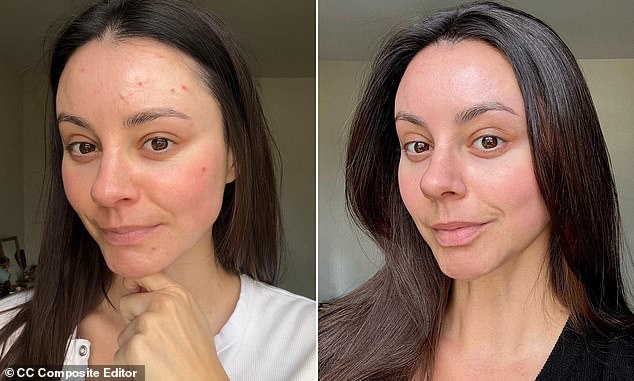

It starts with an intense urge to get to a mirror of 12x magnification. I give my skin the once-over, assessing each pore to find what needs to be ‘fixed’.
Then I can start squeezing, scratching and picking at any imperfection I find. A blocked pore, a small pustule or brown scab which is still healing, it doesn’t matter because I’ll attack it anyway.
I’m creating big, bloody craters in my skin, but in my trance-like state, despite the pain, I can feel my heart rate slowing and my anxiety easing. After ‘fixing’ every problem, I’m left with deep wounds all over my face that will take weeks to heal fully and a huge sense of relief that quickly turns to disappointment in myself.
I don’t know what triggered the compulsion to pick at my skin, but I remember it starting when I was 14.
Like most teens, I suffered from oily skin and spots I attempted to cure with harsh scrubs and astringent toners. Huge, painful lumps filled with pus would form under my skin and, with squeezing and prodding, they’d eventually explode.
But without a proper skincare routine or professional help, it’s no wonder my complexion never cleared. And so the squeezing continued.

Emma North’s skin is now a lot better than it was, but she says she still has the urge to scratch until it bleeds
Now, aged 34, my skin is a lot better, but the urge to scratch until it bleeds hasn’t left me. I recently learned that this compulsion is classed as a mental health condition, dermatillomania, also known as skin-picking disorder or excoriation disorder.
‘Psychologically, dermatillomania shares many of the same mechanisms seen in obsessive-compulsive disorder [OCD],’ says therapist Liam Pikett. ‘There is often a build-up of inner discomfort, which may be experienced as anxiety, restlessness or a sense that something abstract does not feel quite right. Picking then acts as a way of relieving that discomfort.
‘Many people occasionally pick or pop spots. But, with dermatillomania, the behaviour becomes much harder to control. It tends to happen repeatedly, often against a person’s intentions.

The main physical risks of dermatillomania are infection and scarring, says consultant dermatologist Dr Rishika Sinha
‘It can feel driven by an internal urge rather than a conscious choice. It may continue even when a person wants to stop and can begin to affect their wellbeing. The key difference is not the behaviour itself, but the loss of control and the emotional cycle of urge and relief that keeps it going.’
What I didn’t know was that the picking was probably part of the generalised anxiety disorder I’d been diagnosed with aged 18 – when I was prescribed 50mg of the antidepressant Sertraline after a bad break-up.
I’m still taking the medication now and, while it helps stabilise my mood and reduce the frequency of my picking, when life gets stressful, I just can’t help myself. Money worries, struggles with a difficult flatmate or an argument with my boyfriend and I revert to the mirror, squeezing my pores until I bleed.
As a beauty journalist, my picking has impacted the income I make via social media. I sometimes create Instagram and TikTok content for beauty brands, but there have been many times where I’ve declined opportunities to promote a serum I swear by owing to the state of my skin and rock-bottom confidence. The same goes for in-person events.
I’ve put certain barriers in place to limit my picking. Getting rid of my magnifying mirror, keeping my nails short, applying pimple patches and changing my environment whenever I feel the urge is a huge help.
Using prescription-strength skincare ingredients such as azelaic acid and tretinoin to reduce the likelihood of spots appearing and preventing scars also helps. Picking sessions happen but they’re few and far between.
But in more severe cases, professional help can be good. ‘Psychological therapies, particularly cognitive behavioural therapy approaches that include habit reversal training, have a strong evidence base,’ says Mr Pikett.
‘The main physical risks of dermatillomania are infection, delayed healing, and scarring,’ says consultant dermatologist Dr Rishika Sinha. ‘The picking can lead to post-inflammatory erythema [red marks], hyperpigmentation, or permanent scarring and this causes further psychological distress.
‘For active acne that isn’t being picked, prescription treatments such as topical retinoids or oral options can be appropriate. For marks and scarring, treatments like laser, chemical peels or microneedling can help.’
For me, a skincare routine involving a gentle cleanser, azelaic acid, retinoid and SPF50 has helped my skin to look more even and smooth, despite persistent scars.
And although I’ll never be cured of my urge to pick, it is something I can manage. As long as a magnifying mirror isn’t within reach.