

Rack ’em up before the Supreme Court cuts the legs out from under Donald Trump’s tariff leverage. One has to wonder whether the justices may be waiting for a few more trade agreements to come in line before publishing their ruling on Trump’s authority under the IEEPA. Or, perhaps, delaying it just in case Trump can use it to end the war in Ukraine.
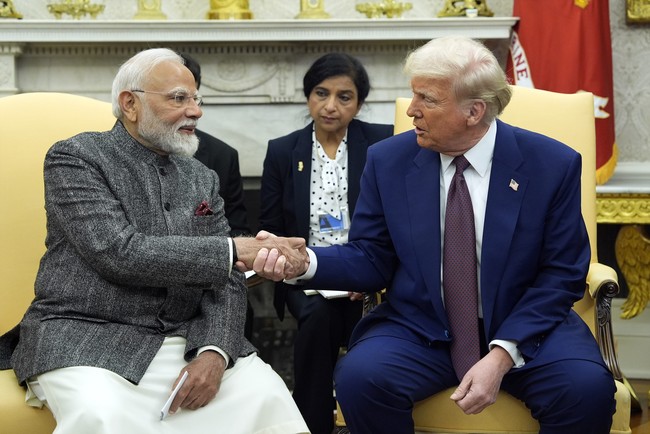
Trump offered that as a potential outcome from a new trade agreement reached with India today. The agreement will limit reciprocal tariffs to 18% and commits India to invest $500 billion in the US. Most importantly, Trump claims that India has agreed to cut off Russian oil imports while the war in Ukraine continues:
It was an Honor to speak with Prime Minister Modi, of India, this morning. He is one of my greatest friends and, a Powerful and Respected Leader of his Country. We spoke about many things, including Trade, and ending the War with Russia and Ukraine. He agreed to stop buying Russian Oil, and to buy much more from the United States and, potentially, Venezuela. This will help END THE WAR in Ukraine, which is taking place right now, with thousands of people dying each and every week! Out of friendship and respect for Prime Minister Modi and, as per his request, effective immediately, we agreed to a Trade Deal between the United States and India, whereby the United States will charge a reduced Reciprocal Tariff, lowering it from 25% to 18%. They will likewise move forward to reduce their Tariffs and Non Tariff Barriers against the United States, to ZERO. The Prime Minister also committed to “BUY AMERICAN,” at a much higher level, in addition to over $500 BILLION DOLLARS of U.S. Energy, Technology, Agricultural, Coal, and many other products. Our amazing relationship with India will be even stronger going forward. Prime Minister Modi and I are two people that GET THINGS DONE, something that cannot be said for most. Thank you for your attention to this matter!
PRESIDENT DONALD J. TRUMP
If India has indeed halted the importation of Russian oil, that would deal a body blow to Vladimir Putin’s war effort. Both India and China had reportedly begun to pull back from Russian energy when Trump announced his 25% excess tariffs on countries that traded with Russian customers, although that didn’t necessarily stop that trade. Trump began pushing Narendra Modi on Russian oil sales last summer, and threatened to escalate the penalty two weeks ago tp 500%.
Modi sent out a statement on X that celebrated the new agreement at the 18% reciprocal tariff level. Modi didn’t mention the part about finding new sources for energy:
Wonderful to speak with my dear friend President Trump today. Delighted that Made in India products will now have a reduced tariff of 18%. Big thanks to President Trump on behalf of the 1.4 billion people of India for this wonderful announcement.
When two large economies and the world’s largest democracies work together, it benefits our people and unlocks immense opportunities for mutually beneficial cooperation.
President Trump’s leadership is vital for global peace, stability, and prosperity. India fully supports his efforts for peace.
I look forward to working closely with him to take our partnership to unprecedented heights.
So Modi didn’t confirm it. He also didn’t deny it. Given that Trump has now removed the 25% excess tariff he started last August on India’s imports over their purchase of Russian oil, that at least provides some tacit evidence that Modi has cut Putin off from a big part of his oil income. He’s almost certainly still selling to China, albeit perhaps a bit more discreetly, but India provided a lot of income to Russia when it desperately needs it.
How much? India had been importing 2 million barrels a day before Trump’s tariffs, and 1.3 million barrels a day at late as last month. The India Times had expected that to continue in an analysis last week, but provided a major caveat. They reported that “the flow is very unlikely to drop to zero,” unless Modi and Trump signed a new trade pact. “Should a final agreement be signed,” the analysis noted, “that could prompt New Delhi to take a more conservative stance.” The same analysis points out that Modi has significantly diversified its oil imports from 27 sources to 41 over the last few years.
That loss would add up to more than a billion dollars a month, even at the steep discounts Russia has to apply to sell its sanctioned energy exports. And as Forbes noted in November, Russian oil sales have been plummeting during the war in Ukraine, but particularly last year:
According to recent estimates, Russia is expected to collect roughly 520 billion rubles—about $6.6 billion—from oil and gas in November. That represents a 35% decline from the same month a year ago and a meaningful drop even from October. For a government that relies on energy revenues for roughly a quarter of its federal budget, such a contraction creates immediate fiscal strain.
For the first eleven months of 2025, Russia’s cumulative oil and gas revenues are now estimated at $102 billion, down roughly 22% from the prior year. Those are still substantial sums, but Russia’s budget framework is built around steady and predictable energy cash flows. When that predictability erodes, the entire fiscal structure becomes more fragile.
Even at that time, Forbes saw a day of reckoning coming for an economy trapped in a quagmire war:
The revenue decline comes as government spending remains locked in at wartime levels. Defense and internal security expenditures continue to consume a growing share of the federal budget. Financing that spending becomes progressively more difficult as energy revenues weaken.
Russia still has short-term tools at its disposal. It can draw from reserves accumulated during earlier periods of high oil prices. It can also expand domestic borrowing. But both approaches carry costs. Reserves are finite, and increased borrowing can pressure domestic credit markets and slow broader economic activity.
If Modi has agreed to cut off Putin’s income stream, that may well force Putin into some concessions at the negotiating table. It might finally start affecting Putin’s domestic support as well, although that has remained relatively strong despite the military and diplomatic blunders over the last four years. With all sides finally negotiating over a potential peace in the war, or at least a cease-fire, Modi may end up competing with Trump on a Nobel Peace Prize … or partnering with him.
Editor’s Note: The Democrat Party has never been less popular as voters reject its globalist agenda.
Help us continue exposing Democrats’ plans to lead America down a dangerous path. Join Hot Air VIP and use promo code FIGHT to get 60% off your membership!