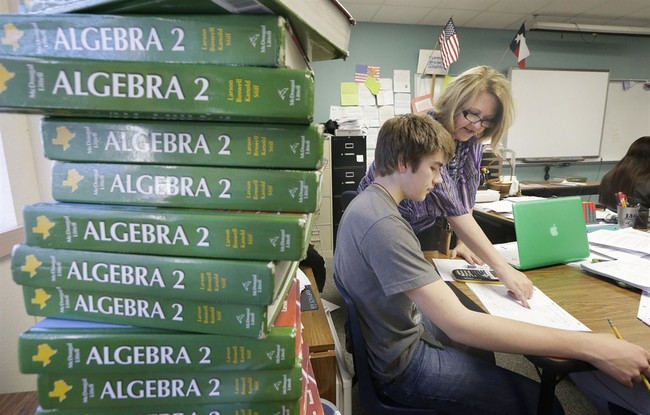
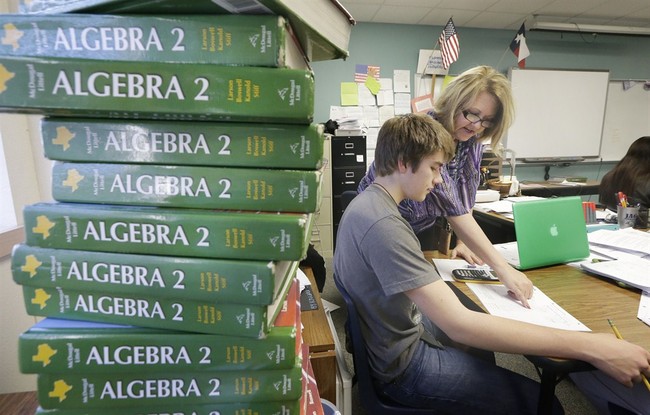
I’ve been writing about this for so many years that I feel obligated to write about it now that this long story is finally coming to an end. Twelve years after the city of San Francisco decided to end the teaching of Algebra in 8th grade, which it specifically did for equity, the city will finally be able to offer it again in most middle schools next year.
Since San Francisco’s school district removed Algebra 1 from all public middle and K-8 schools in 2014, families have pushed for its return.
Starting next school year, the math course is set to be an option for all 8th graders again for the first time in more than a decade. But after two years of piloting different options for the course’s implementation, there’s still internal and external debate on exactly how Algebra 1 should be offered. Think of it as solving for x after it took twelve years to solve for y.
At 19 of its 21 middle and K-8 schools, the district plans to offer Algebra 1 as an additional elective course. All students would be automatically enrolled in Math 8 — the final class in SFUSD’s current K-8 math sequence — while some could also choose to take Algebra 1 if deemed academically eligible.
Previously, the district suggested that students who wanted to take Algebra 1 had to be enrolled in both classes, which would mean giving up an elective like art or music. Now, eligible students would be able to opt out of Math 8 and solely take Algebra 1 after meeting with a counselor and receiving written consent from their parents.
As recently as last year, the district had decided to allow the teaching of algebra in 8th grade but couldn’t get its act together to actually offer the class in most middle schools. Some schools were offering a “self-directed” version of the class which basically amounted to a bunch of videos to watch.
What most painful about this whole thing is that it never should have been tried in the first place. But the people pushing this idea said that de-tracking studnets was going to create greater equity and help erase the achievement gap between white and minority students. That alone was enough to convince a lot of people it was worth a try. Here’s how the Washington Post reported on this back in 2021 when the state of California was considering following San Francisco’s lead: [emphasis added]
An emotional, racially charged debate over whether to sort students into higher and lower tracks that has unfolded in school districts across the country in recent years is now underway on its biggest stage yet, as the state of California considers a new math framework.
Advocates for the new California math guidelines say “de-tracking,” or mixing together students of varying academic performance, can help all students, particularly those who would have languished in lower-level classes. It can also unravel racial segregation inside schools. Almost everywhere, White and Asian American students are more likely to be placed in higher tracks, with Black and Latino students more likely to be placed in lower tracks.
But many parents — especially those of high-achieving students — are opposed.
At a public meeting in California, one parent said she was in tears thinking about the state’s proposal to de-track math. She saw it bringing children like hers down and said schools should try to bring low-achieving students up instead. “Don’t put down other kids who are really hard-working,” she said.
The battle over tracking is another chapter in an intense national debate over how schools can create a more equitable system for students of color and whether changes will threaten other students, many of them White, who are benefiting from existing advantages.
But by that point the de-tracking experiment in San Francisco had been running long enough that it was clear it had failed to create the equity results it promised. Education policy analyst Tom Loveless, formerly of the Brookings Institution, published his own look at it in 2022:
As displayed in Table 1, SFUSD’s scores for 11th grade mathematics remained flat from 2015 (scale score of 2611) to 2019 (scale score of 2610), moving only a single point. Table 1 shows the breakdown by racial and ethnic groups. Black students made a small gain (+2), Hispanic scores declined (-14), white students gained (+17), and Asian students registered the largest gains (+22).
As I wrote at the time, this meant there was still a large achievement gap that only seemed to have been made worse by de-tracking.
The raw numbers don’t really convey what the gap means but 2474 is the mean score for 4th grade math. So, on average, black students in 11th grade were performing just above that at 2479. Hispanic students, on average, were scoring 2498 in 11th grade which was the mean score for 5th graders. Meanwhile, white students and Asian students were both testing at a high school level. It’s a pretty dramatic gap and schools are right to want to address it. But if you re-read that excerpt above you’ll see that the achievement gap actually widened since de-tracking was implemented.
It failed and maybe even backfired. Word got out and by the next year there was talk about ending this experiment in San Francisco. A non-binding vote was taken and 81% of voters agreed that algebra should be restored to middle school. But as mentioned above, it still took years from that point to make it available. Now, finally, it will be available to most students starting next school year.
It was a 12 year experiment and its only positive outcome is telling other school districts what not to do in the name of equity. Between this nonsense and the people who spent years trying to take phonics out of elementary schools, it’s a wonder anyone in the US can read or do math.
Editor’s Note: Do you enjoy Hot Air’s conservative reporting that takes on the radical left and woke media? Support our work so that we can continue to bring you the truth.
Join Hot Air VIP and use promo code FIGHT to receive 60% off your membership.