
Welcome to Polished with Elise Wilson, where Daily Mail’s qualified makeup artist and hair stylist answers your questions, shares advice, and trials the up-and-coming beauty and skincare trends so you don’t have to.
I’ve spent close to two decades working in the beauty industry, testing products and treatments that promise everything from glass skin to a sculpted jawline in minutes.
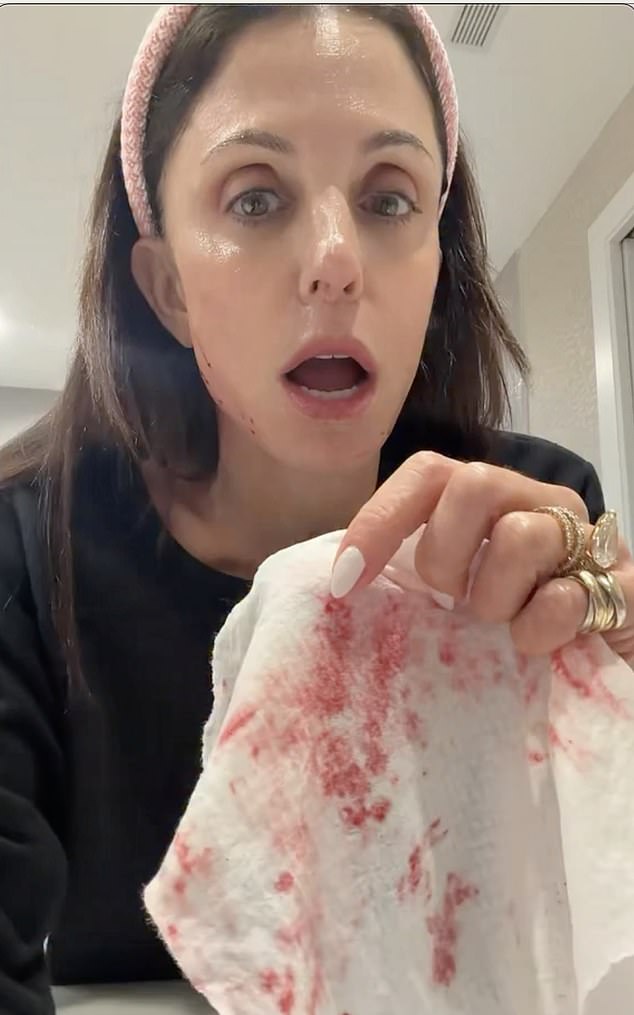
So, when I saw former Real Housewife, Bethenny Frankel, clutching a blood-soaked cloth after slicing her face open with an at-home cupping device, my first reaction wasn’t disbelief, it was a sinking sense of familiarity.
Because behind the glossy marketing and viral videos, I’ve seen, and unfortunately experienced, what can happen when beauty shortcuts go too far.
Bethenny’s ordeal, which unfolded on Instagram as she revealed how a glass-tipped suction tool left her bleeding and shaken, is pretty confronting viewing.
But it’s also a very real reflection of a much bigger issue quietly brewing in the beauty industry, and one that particularly irks me.
The rise of at-home devices that promise professional results without professional oversight, and the widening gap between those two things can be far more dangerous than people realise.
My own experience is something I still cringe thinking about.
It was September 2019, and I was attending a launch for what was being hailed as the next big thing in beauty – a compact lip-plumping device that promised fuller, more defined lips in under a minute, no needles required.

Recent news of former Real Housewife Bethenny Frankel (pictured) clutching a blood-soaked cloth after slicing her face open with a cupping device has sparked fresh concern over the risks of at-home beauty tools

The rise of at-home beauty devices promising professional results without expert oversight is more dangerous than many realise – and beauty expert Elise Wilson (pictured) knows this first-hand after badly bruising her lips with a ‘miracle’ plumping gadget years ago
On paper, it sounded like a dream. I was fully on board with the plumped pout trend and had treated myself to a few lip filler injections long before this ‘miracle’ device came along. In reality, of course, it was anything but.
The device worked by suction, drawing blood to the lips to create temporary volume. What it failed to provide, however, was clear, responsible instruction on how to use it safely – how long to hold it, how much pressure was too much, or what warning signs to look out for.
Within minutes, my lips had turned an alarming shade of blue. Embarrassed, annoyed and a little sore, I gapped it out of that event quicker than you can say ‘beauty fail’, clutching my bag and avoiding eye contact as I made a very swift and slightly humbling exit.
The bruising that followed lasted nearly a week. It wasn’t subtle either – it was the kind of deep, mottled discolouration that no amount of concealer could convincingly disguise.
I remember layering on dark lipstick just to feel somewhat normal, acutely aware that I, someone who is supposed to know better, had been caught out.
And that’s the part that stayed with me.
If I could get it wrong, with years of experience and industry knowledge behind me, what chance does someone with none of that have?


‘Within minutes, my lips had turned blue – raising the question: if an experienced beauty editor like me can get it wrong, what chance does anyone else have of avoiding injury, or permanent damage?’
The rise of DIY ‘skin treatments’
In the years following, I’ve noticed what’s changed is accessibility, with seemingly every beauty company launching some kind of sculpting, sucking, smoothing or massaging gadget.
Tools that were once confined to clinics – or at the very least used under professional guidance – are now being sold online as quick-fix, beginner-friendly solutions.
They’re packaged beautifully, priced to feel attainable, and marketed in a way that makes them seem almost foolproof.
But as skincare expert Noelle Diamond explained, that perception can be dangerously misleading.

Tools that were once confined to clinics – or at the very least used under professional guidance – are now being sold online as quick-fix, beginner-friendly solutions. Packaged beautifully, priced to feel attainable, and marketed in a way that makes them seem almost foolproof
‘I’ve spent over two decades working in clinical nutrition and wellness, and in recent years in medical aesthetics and longevity medicine,’ she told me.
‘What makes this space tricky is that skin isn’t just something you “treat” on the surface – it’s a reflection of what’s happening internally. When you interfere with it without understanding how it functions, that’s when problems arise.’
And those problems, she said, are far from rare. She quickly admitted that she sees complications from at-home devices regularly – and not just mild irritation.
‘I’m talking burns, infections, scarring and long-term pigment issues,’ she explained.
‘The difficulty is that many of these reactions aren’t immediate. They develop over time, which means people don’t always connect the damage back to the device.’
The social media effect
There’s no denying that social media has played a significant role in this shift. Just scroll for even a few minutes and you’ll find countless videos of people microneedling their skin, performing chemical peels, or using suction-based tools with seemingly flawless results.
It creates a very specific narrative: that these treatments are simple, safe, and universally effective. But, sadly, what’s missing is context.
‘You’re not always seeing the full picture,’ Noelle said.
‘You’re not seeing skin types, contraindications, underlying conditions or what happens when things go wrong. There’s also this belief now that if a product is available online, it must be safe, and that’s simply not the case.’
It’s this combination of accessibility paired with overconfidence that, experts like Noelle say, is driving a surge.

Skincare expert Noelle Diamond explained that she sees complications from at-home devices regularly – and not just mild irritation. ‘I’m talking burns, infections, scarring and long-term pigment issues,’ she told Daily Mail
When ‘harmless’ tools cause lasting damage
Some of the most concerning devices are the ones that look the least intimidating.
Take pore vacuums, for example. The small handheld tools designed to extract blackheads using suction.
They seem harmless enough, but used incorrectly, they can rupture capillaries beneath the skin. Trust me, I’ve seen it happen.
A former colleague of mine became so enthusiastic with one that he ended up with deep purple bruising across his nose and broken capillaries that, in some cases, do not resolve without laser treatment.

Just scroll for even a few minutes will reveal countless videos of people microneedling their skin, performing chemical peels, or using suction-based tools with seemingly flawless results. But Noelle says they’re missing context of any underlying skin issues which is misleading
According to Noelle, that kind of outcome is not uncommon.
‘Excessive suction can damage capillaries and increase inflammation, particularly in people with sensitive or rosacea-prone skin. And yes, in many cases, those broken capillaries are permanent.’
Then there’s dermaplaning – a treatment that has been completely rebranded online as a quick, easy way to achieve smooth, glowing skin at home.
‘At home, people often apply too much pressure, use dull blades or go over compromised skin which can lead to micro-cuts, irritation, barrier disruption and even trigger breakouts or pigmentation.’

Pore vacuums, dermaplaning and microneedling are all top contenders for misuse and can lead to unwanted micro-cuts, irritation, barrier disruption and even trigger breakouts or pigmentation if not used correctly or santised properly
The tools experts are genuinely worried about
While some devices carry moderate risk, others venture firmly into what Noelle described as ‘medical-adjacent territory.’
Microneedling devices and derma rollers are among them, as they work by creating controlled micro-injuries in the skin to stimulate collagen.
‘But in a clinical environment, that’s done with sterile equipment, precise depth control and proper aftercare. At home, those variables are completely uncontrolled.’
The result, she warned, can lead to infection, scarring and post-inflammatory hyperpigmentation – and once that kind of damage is triggered, it can be very difficult to reverse.
Even more concerning are mole and skin tag removal pens, which have surged in popularity online.
However, Noelle said these can be one of the biggest risk to a life-threatening misdiagnosis.
‘You might think you’re removing something benign, but without proper assessment, you could be dealing with skin cancer. That delay in diagnosis can have serious consequences.’

The rise of DIY beauty doesn’t stop at gadgets with medical-grade acids and peels now easily available online, despite the serious risk of burns, infection and lasting damage if used incorrectly
The chemical side of the problem
If devices weren’t enough, there’s also a growing trend of consumers experimenting with high-strength chemical treatments at home.
Medical-grade acids like TCA (Trichloroacetic Acid) are now widely available online, often, again, with little to no guidance.
‘These are not cosmetic products. They penetrate deeply into the skin and, if used incorrectly, can cause significant chemical burns,’ Noelle stressed.
And when a chemical peel goes wrong, the damage isn’t superficial.
‘You’re creating uncontrolled injury to the skin, and that can lead to excessive peeling, inflammation, infection risk and long-term scarring or pigmentation.’
Layering multiple strong actives, which is something heavily promoted in online skincare routines, only compounds the issue.
‘People think more is better, but what they’re actually doing is compromising their skin barrier. And once that barrier is damaged, everything else becomes harder to treat.’

Not all at-home beauty devices are off-limits, but experts say understanding your skin, knowing a device’s limits and recognising when to see a professional is key to glowing skin success
The cost of cutting corners
There’s a reason professional treatments come with a higher price tag. It’s not just about the device or the product, it’s about the training, the hygiene standards, the ability to assess skin properly and respond if something goes wrong.
At-home devices remove most, if not all, of those safeguards, and while they may seem like a cost-effective alternative upfront, the long-term reality can be very different.
‘We often see patients spend significantly more correcting damage than they would have investing in proper treatment from the start,’ Noelle added.
‘When it comes to your skin, shortcuts tend to be the most expensive path.’
This isn’t to say all at-home beauty devices should be avoided entirely, and I know there are plenty of tools that can be used safely – particularly those that don’t disrupt the skin barrier or create trauma.
But the key difference is understanding things like your skin type. Understanding the limits of what a device can realistically do. And most importantly, understanding when something should be left to a professional.
I know Bethenny’s experience is an extreme example, but it’s far from isolated. Mine was less dramatic, but no less instructive.
And if there’s one thing I’ve learnt – both personally and professionally – is that just because something promises quick results doesn’t mean it comes without risk.
Your skin is incredibly resilient, but we have to remember it’s not invincible. And in a world where beauty is increasingly being sold as something you can DIY in your bathroom mirror, it’s never been more important to approach it with a little more caution.
Disclaimer:
The views and opinions expressed in this article are solely my own and do not reflect those of any brands or companies mentioned. This content is not sponsored or endorsed.