
An animated movie gets labeled underrated all the time, but most of those picks are just popular films that people want to sound special about. This list is different. These are the ones that feel quietly perfect and still somehow slip through the cultural cracks, even though they play like total classics. They’re not that popular either. You might not have heard about most of these.
Each pick is a clean 10 out of 10 for me because the craft disappears, and you just feel the story working. Some are funny, some are heavy, and a couple are downright strange, but every one of them has real staying power once you finally press play. So if you’ve been hunting down an animated 10/10 watch, lock in.
10
‘April and the Extraordinary World’ (2015)

April and the Extraordinary World is a pulp adventure that hides a surprisingly sharp idea inside its fun. In this version of history, science keeps vanishing, so Paris feels stuck in a smoky, steampunk limbo while a teen, April Franklin (Marion Cotillard), chases the truth behind her parents’ disappearance. The movie earns your attention fast because every invention feels practical, and every chase has stakes.
As it escalates, it never forgets the emotional core, which is April choosing curiosity over fear. There is a clean sense of momentum to the mystery, and the villains stay unsettling without turning cartoonish. By the time the finale clicks, the story feels complete rather than overexplained, and you realize it pulled off a big, strange premise with real control. It’s a good watch for both children and adults.
9
‘The Red Turtle’ (2016)

The Red Turtle barely uses dialogue, yet it still tells a full life story with clarity. A castaway washes up on an island and keeps trying to escape, until a red turtle blocks him in a way that feels maddening, then meaningful. The film turns survival into a relationship with place, time, and consequence.
What makes it linger is how it keeps changing shape while staying simple. There is no wasted emotional noise, just images that do the work and transitions that feel earned. It’s a 10/10 because it proves animation can hold an entire human life in a handful of images, and somehow make it feel more real than dialogue ever could.
8
‘Tokyo Godfathers’ (2003)

Image via Sony Pictures Entertainment Japan
This film starts as a messy night out and turns into a chain of plot turns that never stops paying off. Tokyo Godfathers follows three homeless friends who find an abandoned baby, and instead of treating it like a cute gimmick, the movie forces them to follow the baby’s trail through Tokyo’s backstreets, debt, family secrets, and bad luck. Hana (Yoshiaki Umegaki) keeps the group moving with stubborn warmth.
The magic is that every “coincidence” hits like life, not writing (and that’s a major problem with most animated films). It is directed by Satoshi Kon, who seems to have kept that feeling checked. The film, therefore, keeps the pacing sharp like a thriller but never loses the bruised humanity underneath the jokes. It’s funny in that painful way where you laugh and immediately feel something catch in your throat. And by the time all the threads collide, you realize the movie wasn’t just about finding where the baby belongs, it was about watching these three people accidentally find their way back to themselves.
7
‘Persepolis’ (2007)

Image via Diaphana Distribution
Persepolis is so different. It looks simple on the surface, yet it carries enormous emotional weight without ever getting stiff. It follows Marjane (Chiara Mastroianni) growing up through the Iranian Revolution and its aftermath, and the story keeps focus on what that does to a kid’s identity, friendships, and sense of safety.
That whole premise makes it an excellent film, giving it that rewatchability factor for anyone who clicks with the themes, and how it refuses to flatten anyone into a symbol. You get clear personal stakes in every phase, from teenage rebellion to exile loneliness, and the film never pretends those phases are neat. Any child who feels the same things in their life ends up loving it.
6
‘Fantastic Planet’ (1973)

There are animated films that feel whimsical, comforting, even playful, and then there’s this strange, unnerving sci-fi fever dream from 1973 that seems designed to make your skin crawl in the best possible way. Fantastic Planet drops you onto a distant world where humans aren’t heroes or explorers, but tiny, disposable creatures treated like pets (or pests) by towering blue beings called Draags.
From the very first minutes, the movie radiates imbalance. Everything is off-kilter: the scale, the power, the cruelty baked into everyday life. Terr (Jean Valmont), the human who escapes captivity, isn’t framed as some shiny savior figure. He’s just surviving, learning, resisting, and the film refuses to turn his struggle into a simple fantasy of triumph. The ending doesn’t wrap things up with some satisfying overthrow or blood-soaked payback. Terr doesn’t defeat the Draags. Nobody wins, nobody is redeemed, and that’s why it sticks.
5
‘Millennium Actress’ (2001)

Millennium Actress makes memory move like cinema itself — fast, fluid, impossible to hold still. A filmmaker interviews retired legend Chiyoko Fujiwara (Miyoko Shōji), and her answers don’t arrive as neat recollections. They explode into scenes: her life collapsing into the roles she once played until the boundary between performance and reality stops mattering.
The film jumps across centuries, wars, and romances with dizzying speed, but it never loses its center. Everything is anchored to Chiyoko’s longing, that single emotional current pulling her forward. It qualifies as a 10/10 for me because it frames love not as something she ever has, but something she is always moving toward. The story becomes a chase stretched across an entire lifetime — not for a man exactly, but for the feeling of pursuit itself. By the end, it appears that the blurred timelines were the only honest way to show what she spent her life running after.
4
‘The Secret of Kells’ (2009)

The Secret of Kells feels like a story carved into illuminated manuscript pages and then brought to life. The plot follows Brendan (Evan McGuire), a young monk in a fortified abbey, and his world is ruled by fear of invasion and strict boundaries. And once he meets Aisling (Christen Mooney), the film shifts into a quest where art becomes the thing worth risking everything for.
The movie stands out because it commits fully to its visual style. Inside the abbey, everything looks stiff and controlled, straight lines, tight spaces, repeated shapes, which match how Brendan’s life is ruled by rules and fear. Once he goes into the forest with Aisling, the animation changes. The backgrounds get looser, filled with curves and swirling patterns, like the world is opening up. The design is taken directly from the real Book of Kells: flat perspective, heavy outlines, and decorative detail packed into every shot. That’s why the film doesn’t feel like a typical fantasy cartoon.
3
‘A Scanner Darkly’ (2006)

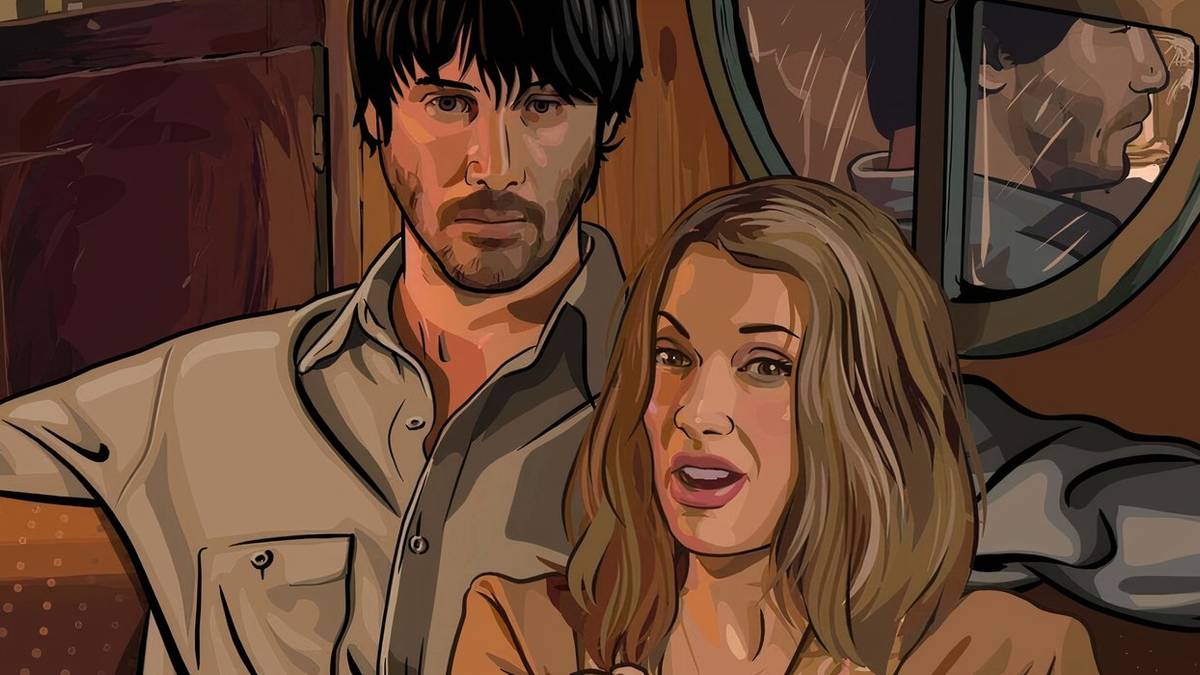
A Scanner Darkly uses rotoscope animation to make paranoia feel physical. Bob Arctor (Keanu Reeves) is an undercover cop sinking into addiction while spying on his own friends, and the film never gives you a safe viewpoint. Every conversation feels slightly off, like you are listening through a damaged wire. Donna (Winona Ryder) might be honest, or she might be another angle.
What makes it stick is how it turns comedy into discomfort. The group’s jokes have real nervous energy, and the story keeps tightening until Bob cannot tell what he knows anymore. When the final reveals land, they are brutal because they are quiet, and the movie makes you sit with the cost instead of dressing it up.
2
‘Ernest & Celestine’ (2012)

Ernest & Celestine is one of those rare kids’ films that feels genuinely kind. Celestine (Mackenzie Foy) is a young mouse raised on the idea that bears are basically monsters, and Ernest (Forest Whitaker) is a broke, hungry bear who looks scary on paper but is basically just exhausted and decent. Their friendship doesn’t just “challenge society” in some vague way, it pisses off an entire world built on fear and tradition.
What I love is how calm the movie is about its message. It doesn’t do big speeches or melodrama. The prejudice is baked into everything: the courtrooms, the rules, the way crowds immediately turn cruel. And the softness of the watercolor animation makes that harshness hit harder, because the world looks gentle even when it’s being unfair. The movie feels like watching two outsiders accidentally expose how ridiculous the whole system is, just by refusing to play along.
1
‘Song of the Sea’ (2014)

Song of the Sea is one of the most emotionally wrecking animated films that somehow still looks like a bedtime story. It follows Ben (David Rawle), an angry, shut-down kid who is carrying grief like it’s poison, and Saoirse (Lucy O’Connell), who is quieter, almost otherworldly.
What makes the film work so well is how tightly the fantasy connects to the family’s emotions. The folklore animation is the movie’s way of showing sadness, memory, and healing without spelling everything out. The story itself, setting off on a quest to liberate the fairies and protect the spirit world from the forces of evil, is just beautiful and makes it an ideal watch for children. It’s like Spirited Away, but at a low heat.