
Only the best kind of terror leaves audiences stunned by the very end. And truly, horror history is known for creating that feeling through its many fine examples. We’ve been pleased to see horror evolve over the years, growing to become one of the most successful forms of filmmaking ever, and still going strong. We’ve had countless horror films scare the absolute wits out of us from start to finish, filling us with so much dread that we simply couldn’t forget them. Half the reason some have become so memorable is because of their finales.
Though it’s a genre that has seen plenty of mediocre endings, most of the best horror films conclude with one hell of a satisfying payoff. The last one hundred years have been nothing but successful for horror, and there are plenty of iconic endings to choose from. Whether they’ve given a deserved resolve or left things terrifyingly ambiguous, these ten horror endings have become legendary in cinema; some are still widely talked about today.
10
‘The Mist’ (2007)

The Mist follows a group of small-town residents struggling to survive as a mysterious fog created through a military dimensional portal experiment unleashes a horde of Lovecraftian monsters. With such a terrifying concept, it might seem the ending would see the remaining survivors escaping the mist or being consumed by it, but, in a cruel twist, it concludes with the protagonist, David (Thomas Jane), breaking down after being rescued just moments after mercy-killing his son and friends after they all thought the creatures were surrounding them.
Some who criticize this see it as frustrating, unnecessary; others find it hard to watch, but no one can deny it’s one of the most heartbreaking endings in cinema. The fact that David and his group were just moments away from safety is one last rug puller to this bleak, hard-hitting film. It concludes on the right note and perfectly sums up how depressing and brutal Frank Darabont‘s The Mist truly is.
9
‘Invasion of the Body Snatchers’ (1978)

A remake of Don Siegel‘s 1956 science fiction Cold War classic, Philip Kaufman‘s version of Invasion of the Body Snatchers takes the eerie concept of alien doppelgängers slowly replacing humanity to a horrifying new level with better effects and unrelenting suspense. Donald Sutherland stars as San Francisco resident Matthew Bennell, who becomes the city’s last hope as he takes the fight to the aliens. But, the end sees him finally succumbing to their power, as he’s taken over, and the creature replacing him alerts others around him as he’s located another survivor, Nancy (Veronica Cartwright).
The step-up to the reveal that Bennell has been taken over is truly haunting, as in the moments leading up to this, we’re never actually shown him being killed. It’s only once Nancy reveals herself to be human to him that he sheds his human facade and delivers one of the scariest facial expressions and screeches in horror movie history. This finale demonstrated the bleak hopelessness surrounding the film, showing humanity’s destruction and inability to stop the aliens.
8
‘The Sixth Sense’ (1999)

A unique filmmaker widely known for his gut-punching twists, M. Night Shyamalan became a household name thanks to his thrilling 1999 horror drama The Sixth Sense. Capping off the ’90s with one last banger for horror, this mix of compelling character drama and thrilling terror saw Bruce Willis as a struggling child psychologist, Dr. Crowe, trying to help young Cole Sear (Haley Joel Osment), a boy with an ability to communicate with the dead. It’s deep, emotional, but elevated by one incredible finale.
In perhaps one of the most famous twists in horror, the ending reveals that Crowe was actually a ghost his entire time helping Cole, having been killed by a disgruntled former patient at the start of the film. It’s a shocker that felt greatly warranted as it was perfectly set up throughout the story through Shyamalan’s brilliant direction and clever visual cues. Even when experiencing the twist through rewatches, it still has an emotional impact that hasn’t dwindled in the years since, and it still remains a satisfying way to end such a unique story.
7
‘Night of the Living Dead’ (1968)

Changing the horror genre forever, George A. Romero‘s legendary zombie masterpiece Night of the Living Dead became a benchmark for countless other horror films to reach. Featuring revolutionary ideas and boundary-pushing violence, it’s become timeless thanks to its compelling story of a group of survivors attempting to hold out until rescue in a farmhouse as the dead have risen from their graves to eat the living. As it progressed, the survivors dwindled in size as the dead continued to push their way inside until one man, Ben (Duane Jones), was the only one to make it through the night.
Tragedy befell him in the morning. Just when it seemed Ben had finally survived his horrifying ordeal, he was mistaken for a zombie and shot in the head by an armed posse who ironically came to rescue any survivors. It feels like a punch in the gut to see Ben survive so much death and close calls only to be abruptly killed off in the most swift and anticlimactic way possible. Night of the Living Dead‘s conclusion is not only shocking, but it sends this story off on a depressing note, and further shows the harsh, brutal reality of living in Romero’s version of a zombie apocalypse.
6
‘Hereditary’ (2018)

One of the scariest horror films of the 21st century so far, Ari Aster‘s horror masterpiece Hereditary blends the psychological and supernatural into one tense, slow-burning thriller that easily gets under your skin. Toni Collette delivers a powerhouse performance as a grieving mother, Annie, who slowly comes to the realization that her family is being targeted by a sinister cult, and believes they want her teenage son, Peter (Alex Wolff).
There’s a lingering sense of dread throughout the film, and it makes it all the more likely that something truly horrible will happen to the characters. Sure enough, it ends with both Annie and Peter succumbing to the evil presence, with Peter being possessed by the cult’s worshiper, the demon King Paimon. It’s a spine-chilling and deeply unsettling way to go out on. Not only is it a perfect send-off to all the suspense, but it creates an unimaginably frightening feeling that perplexes the mind and makes the viewer question just what they have seen.
5
‘Psycho’ (1960)
The great Sir Alfred Hitchcock stunned the world in 1960 with Psycho, a tense psychological slasher thriller that has become a landmark of the genre. Anthony Perkins and Janet Leigh deliver career-best performances in a story about a young woman being murdered at an isolated motel in the desert. But was it really the motel owner’s reclusive, unstable mother, or was something far more sinister going on? The ending certainly answers this question in one unexpected, brilliant way.
Turns out the woman, Marion Crane, was actually killed by the owner, Norman Bates, who suffered from an identity disorder, believing himself to be his mother after the guilt of killing her years prior, and even dressing and acting like her at points. The ending shot of Norman’s “mother” personality completely taking over his mind in his jail cell is one of the most disturbing finales ever brought to screen. It’s made even more iconic as Anthony Perkins gives a terrifying grin that perfectly encapsulates the character’s evil.
4
‘Saw’ (2004)

The most game-changing horror classic of the 2000s, James Wan defined the genre in this decade with the dark and brutal mystery thriller Saw. Providing intense suspense and unpredictable scares, it follows two morally complex strangers as they awaken in a locked bathroom and play a life-or-death game with the elusive vigilante serial killer Jigsaw (Tobin Bell). In the end, it seemed the two outwit the killer, and one of them, Dr. Gordon (Cary Elwis), managed to escape the room to look for help, but, in a shocker, the last man, Adam (Leigh Whannell), came face to face with the real killer who revealed himself as the supposed dead body laying in the room.
As Jigsaw coldly locked Adam in the bathroom as he begged for his life, audiences were left just as stunned and hopeless as this poor character. From the sudden shock of seeing Jigsaw for the first time to hearing Adam’s blood-curdling screams for help as the credits roll, it is an utterly horrifying finale that’s become edged in horror history with its lingering feeling of intense dread.
3
‘The Shining’ (1980)

The most analyzed horror classic ever, Stanley Kubrick‘s nail-bitingly suspenseful interpretation of Stephen King‘s The Shining has become legendary in the genre’s history. A horror must-watch for those looking for a good spine-tingling experience, it’s a powerful mix of supernatural and psychological horror, following Jack Nicholson‘s Jack Torrance as he falls under the influence of the evil spirits of an isolated mountain hotel, The Overlook, and tries to murder his wife and son. But when they escape, and he succumbs to the cold elements outside, his face appears in a photograph in the hotel lobby, further showing his eerie connection to his disturbing place.
Audiences have debated this ending long since its release. Does it mean Jack is a reincarnation, or does it mean his spirit has been absorbed by the hotel along with the other ghosts who died there? Whether one or the other is true, or if there’s something more to interpret, it is still a horrifying and mind-boggling finale. It shows the power of using ambiguity to spice up a finale, showing that it’s best to leave something up to interpretation so that the audience can come up with all kinds of terrifying conclusions in their heads.
2
‘The Thing’ (1982)

Providing the ultimate terror for sci-fi horror lovers, John Carpenter‘s The Thing is a masterclass in dread that, even years later, has an effect on new audiences. Set in the isolated and frigid Antarctic, a team of American researchers battles a fearsome shapeshifting alien that wants to infect the rest of the world if it escapes them. By the end, two survivors, MacReady (Kurt Russell) and Childs (Keith David), remain after they’ve blown up their base and the creature along with it. Or did they?
Truly one of the most intense cliffhanger endings in movie history, The Thing ends with no clear answer whether MacReady or Childs is secretly one last alien imitation. There have been countless theories and several ways this ending could be answered. But wisely, Carpenter used the greatest tool any horror filmmaker could use and decided to leave this question open to the viewer’s interpretation, much like how The Shining ends. Whatever answer is true, there’s no doubt about one thing: it is one horror ending no one will ever forget.
1
‘Rosemary’s Baby’ (1968)

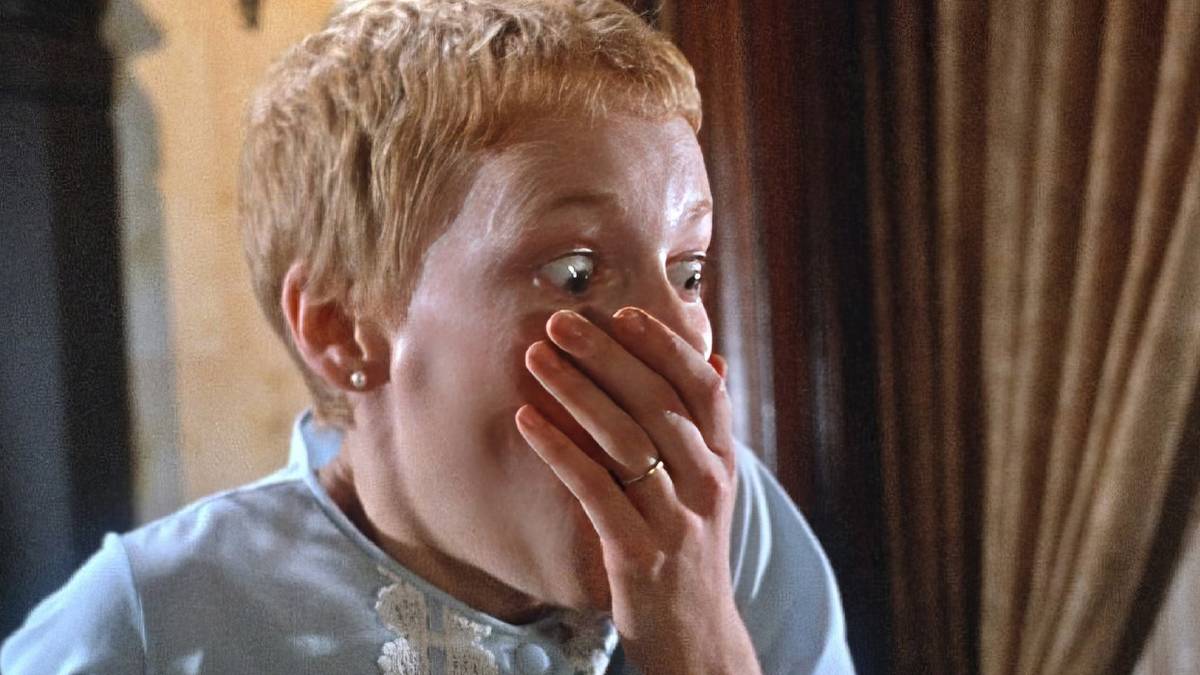
Taking the top spot goes to the legendary twist finale of Roman Polanski‘s 1968 horror classic Rosemary’s Baby. Truly one of the most well-executed and shocking endings ever happens in this nail-biting slow burner about a to-be mother, Rosemary Woodhouse (Mia Farrow), who becomes paranoid that her husband and her strange-acting apartment neighbors want to take or kill her unborn child.
The whole follows this intensely suspenseful mystery as Rosemary slowly pieces together what’s happening. But, when she has the child and goes to save it from her neighbors, she horrifyingly discovers her son is the offspring of Satan, and she has been manipulated to raise it. It ends terrifyingly open whether Rosemary will nurture the child because she loves it or if she’ll be trapped in it. Not only was this ending perfectly set up, but it was the most satisfying way to end it for all the suspense and build-up leading to it. Overall, with its terrifying execution and the way it’s maintained its place in horror pop culture, Rosemary’s Baby has the best horror movie ending from the last one hundred years.