It’s easy to talk about masterful epics, and doing so usually involves going over some of the best movies of all time. You probably don’t need another person telling you to watch (or rewatch) Lawrence of Arabia, you know? It might be more interesting (though arguably less helpful) to go over some epics that fall a little short of perfection; the near-masterpieces, in other words.
That’s what the movies below debatably are. You might love some of them, and sure, some are considered classics, or near-classics… it’s just that each one has at least one or two things that could hold them back from genuine 10/10 territory. Hopefully, what follows doesn’t read as too negative, since something being “nearly perfect” is still very much cause for celebration.
10
‘Heaven’s Gate’ (1980)

After The Deer Hunter, Michael Cimino infamously went bigger and more ambitious with his follow-up, Heaven’s Gate, which had a difficult and lengthy production that generated so much bad press, the movie never really stood a chance. It seemed the frenzy around it generated an idea that it was one of the worst epic movies ever made, but if you actually watch it now, removed from all that noise about its production, it’s pretty great.
Watching this, you feel some messiness, but not the amount you might fear, based on Heaven’s Gate’s reputation.
Obviously, not perfect, since it’s in this ranking and all. You feel some messiness, but not the amount you might fear, based on Heaven’s Gate’s reputation. It’s underrated overall, as well as impressive, as one of the biggest and longest Westerns ever made (it’s more than just a Western, of course, but that’s the easiest way to describe something that is ultimately pretty hard to describe and/or summarize).
9
‘Intolerance: Love’s Struggle Throughout the Ages’ (1916)

To get the obvious out of the way, Intolerance: Love’s Struggle Throughout the Ages is incredibly old. It was made at a time when the first feature-length talkie was still more than a decade away, and those are pretty ancient in the overall scheme of things, seeing as 1927 is now almost a century ago. Anyway, Intolerance: Love’s Struggle Throughout the Ages is impressive, once you take its age into account.
It could well even be one of the best epics of all time, if you’re looking at historically significant and properly groundbreaking ones, because this goes all out as a historical epic that takes place across a vast amount of time; throughout the ages, and all that (the title’s not messing around). It also holds up a good deal better than the film D.W. Griffith is probably more well-known for, for better or worse: 1915’s The Birth of a Nation.
8
‘Gangs of New York’ (2002)
There are a few Martin Scorsese films that could go here, since his longer, newer movies are a bit more contentious than some of his comparatively snappier classics. See the way people talk about The Irishman vs. Goodfellas, for example. But Gangs of New York? That one might well get the most criticism out of all his films that exceed the 2.5-hour mark, and it doesn’t deserve all of that criticism.
It’s a sprawling movie, and almost bursting at the seams, since it wants to tell a personal story of revenge against the backdrop of a much larger gang conflict in the titular city at a tumultuous time in said city’s history. Certain actors here fit into the world of the film, and what it’s going for tonally, more than others, but there’s still so much to be impressed by in Gangs of New York, and it’s also probably worth watching for Daniel Day-Lewis alone.
7
‘A Touch of Zen’ (1970)

There is a good deal of A Touch of Zen that feels pretty much perfect, and it’s the kind of gargantuan and endlessly ambitious film that any downtime, comparatively speaking, feels largely excusable. It’s long and slow-paced at times, but at least the slower parts give you great visuals while serving to conjure up a beyond-unique atmosphere, and then when it starts getting a bit more action-focused, things inevitably get better and more striking.
It’s a film about a young woman on the run, and the people she encounters who ultimately help her take a stand against her pursuers. You could technically tell the story in A Touch of Zen within a shorter runtime, though this one does feel like it wants to be more than just a well-told story, and on that front, it succeeds. It might not do it all perfectly for you, but it’s still worth experiencing, even with the enigmatic and perhaps more confusing parts.
6
‘The Ten Commandments’ (1956)

The Ten Commandments is, as the title suggests, a biblical epic, and certainly one of the biggest and best of its time. The story here concerns the Book of Exodus, with the narrative mostly centering on Moses and what he eventually did as a leader and liberator, thanks to being given the titular ten commandments. It’s probably the most significant of the Old Testament stories, you know… or neck-and-neck with Noah’s Ark, in any event.
The whole thing is done justice here, with this film, because The Ten Commandments is genuinely impressive on a technical front (outside some shots with dated effects that don’t look great, even for the standards of the time). Much of it still looks and feels striking, at least, even if you do feel the length here, with the movie being just 20 minutes short of four hours.
5
‘Doctor Zhivago’ (1965)

You can’t talk about legendary epic movie directors without mentioning David Lean, who’s perhaps best known for helming the previously mentioned Lawrence of Arabia. His follow-up, Doctor Zhivago, might not have felt perfect the same way that one did, but it’s not far off quality-wise, succeeding as an epic romance and a war movie the same way Lawrence of Arabia shone as a simultaneous epic war film and a character study.
The other way to tie these movies together is the fact that World War I plays a role in both narratives, but isn’t exactly the focus of either. Doctor Zhivago is more about a tumultuous time in history, and a love affair that happened throughout it all, with World War I being just one of the events that prove relevant to said time in history.
4
‘Greed’ (1924)

It’s not entirely Greed’s fault it’s imperfect, since it is a partially lost film, but what can be said is that what remains is still pretty great, at the very least. It’s hardly a subtle movie, either, given the title and the fact that it’s about things spiraling out of control for a married couple after they win a fair amount of money, but it handles that premise well for a film of its era.
Also, Greed is quite disturbing for a film of its era, and what it has to say about money and the way it can change someone still feels relevant, in a weird and possibly upsetting manner. It’s got that timeless quality you do sometimes find in silent films, and there is something bleak about a movie from about a century ago still feeling relevant, when it deals with difficult subject matter, but that’s life or whatever (see also Metropolis).
3
‘Ben-Hur’ (1959)

Of all the movies here, it might be most alarming to suggest that Ben-Hur isn’t perfect, but it is still largely masterful. You can’t really overstate how significant it was as an epic, too, delivering spectacle that might have been matched or exceeded by epics in the 1960s and beyond, yet of those made before the year 1960, Ben-Hur was probably the grandest.
It takes place around the era of Jesus, but it’s not exactly about him, even if he sort of appears throughout, and religion is a relevant topic to the movie at hand, of course. But Ben-Hur is more concerned with telling a story about a betrayal, and the betrayed person’s endeavor to get revenge after being made a slave by someone he once trusted. It’s long, and perhaps a tiny bit slow at times (you do feel the length in the last half-hour), but the spectacle is indeed spectacular, and there aren’t enough good things one can say about that justifiably iconic chariot race sequence.
2
‘Kagemusha’ (1980)

When talking about Akira Kurosawa’s epics, you’ve got two that are genuinely perfect: 1954’s Seven Samurai and 1985’s Ran. Between them (albeit much closer to Ran) was Kagemusha, which has some similarities to that 1985 epic, particularly on a visual front. Oh, and both star Tatsuya Nakadai, who was technically in Seven Samurai, but only for a second or two in an uncredited (pretty much background) role.
Kagemusha has him playing two roles: one a warlord, and the other a thief who just so happens to look identical to the warlord, so when the warlord dies, the thief takes his place and has to pretend to be this much more powerful and influential figure. Things don’t exactly go well from there, but things do look beautiful from there. Kagemusha isn’t perfect as far as things like pacing and the narrative are concerned, but it is a perfect-looking movie, and it’s easy to admire it as a feature-length warm-up for Ran, on Kurosawa’s part.
1
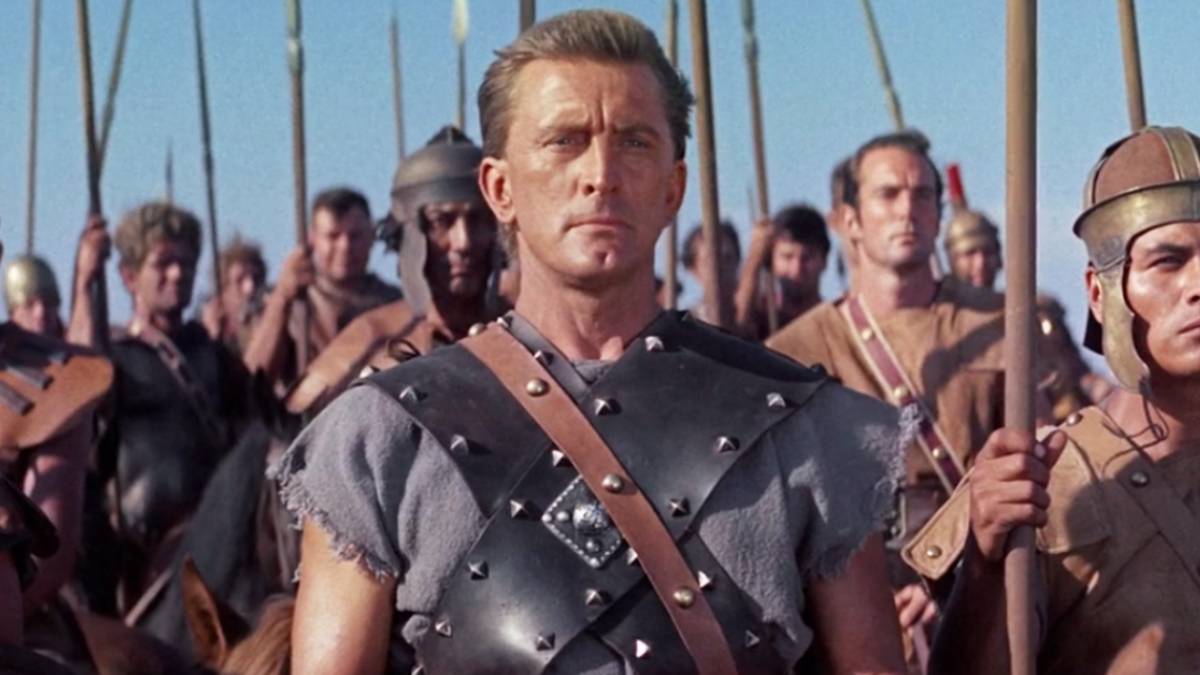
‘Spartacus’ (1960)

An epic about revenge and rebellion, Spartacus is hard to fault as a film from this time, but maybe flawed if you want to judge it as a Stanley Kubrick movie, or compare it to some of his other ones. Kubrick’s influence was not felt as strongly here, since Spartacus had a troubled production early on and Kubrick was brought in as a replacement director, after the original one, Anthony Mann, was removed from the project after a few weeks of shooting.
There are other Stanley Kubrick war movies that feel more distinctly like Stanley Kubrick movies, but none that scratch the same itch epic-wise (even Barry Lyndon is a bit more restrained/grounded, albeit about as long). But as a rousing and exciting film made on a grand scale, Spartacus does have quite a bit to offer, to the point where you might not even mind too much that it doesn’t feel particularly Kubrick-esque.

Spartacus
- Release Date
-
November 17, 1960
- Runtime
-
197 Minutes