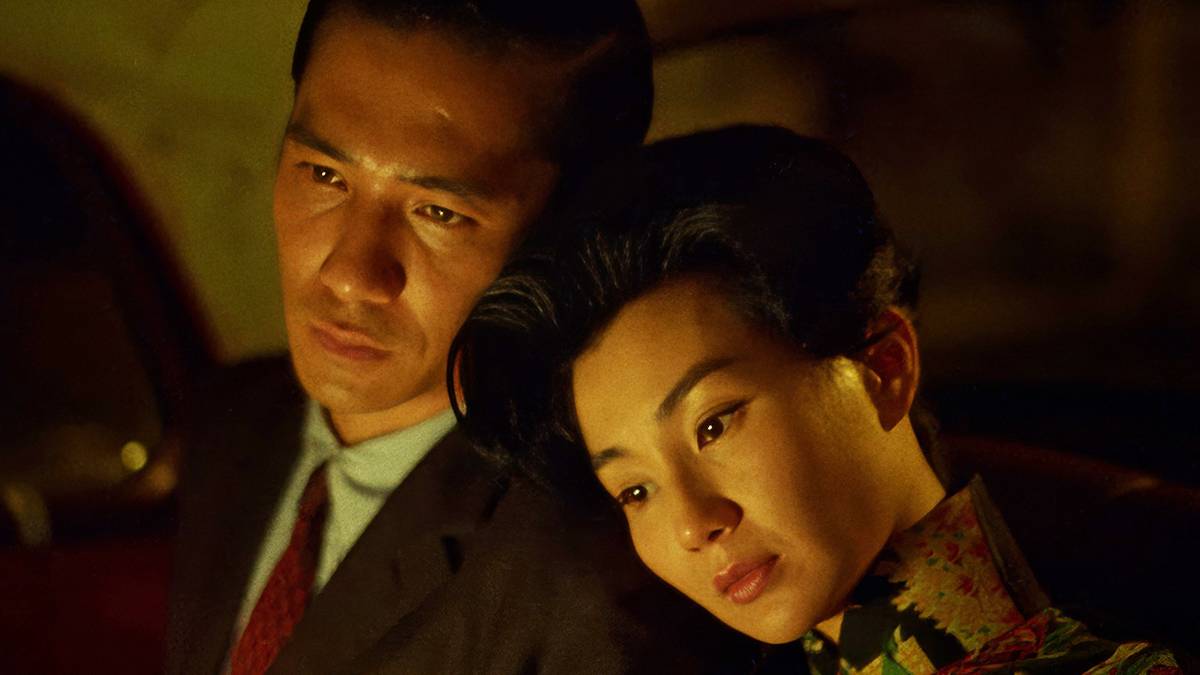

Though there is plenty to be grateful for, Hollywood isn’t the backbone of cinema. Film brings together and speaks to people all across the world, encouraging them to share their own stories, capture moments in their lives, and speak from the heart. Cinema can be a lifeline for some and a muse for others, but for both, it often becomes a sense of purpose.
The 20 greatest international movie masterpieces of all time are influenced by history, context, imagination, and the artists’ personal lives. They aren’t just very important moments in film, but they’re also windows into diverse cultures and perspectives on the world. They go beyond mere storytelling, reminding us why cinema, at its best, easily moves across borders.
20
‘The Holy Mountain’ (1973)

The Holy Mountain by Alejandro Jodorowsky is one of the greatest international films ever made because of its audacity. It’s one of the few movies that uses film as a means to express the spiritual and the intellectual, abandoning narrative structure in favor of symbolism and a meditative pace. The film questions organized religion, capitalism, and the idea of enlightenment by combining psychedelic imagery, political satire, religious iconography, and surrealism. Its impact is obvious in experimental and arthouse cinema, and even music videos and album art, creating frequent homages to this film.
The Holy Mountain follows a Christ-like wanderer who joins an alchemist and a group of powerful elites on a quest to overthrow the gods and attain immortality. Jodorowsky is a Chilean-French filmmaker, but The Holy Mountain is considered a Mexican film because it was entirely filmed there. It was financed in part by John Lennon and Yoko Ono; the production was famously extreme, with Jodorowsky subjecting the cast and crew to intense spiritual practices, living together in a commune for a while, and he himself, together with his wife, decided to forego sleeping for a week to achieve a psychedelic state. Few pieces have advanced the medium in a similar way, and few still have an almost similar cultural significance decades later.
19
‘Infernal Affairs’ (2002)
.jpg?q=49&fit=crop&w=500&dpr=2)
One of the most important contemporary crime thrillers, Infernal Affairs, is a masterclass in suspense, intricate narrative weaving, and moral ambiguity. It transcends traditional genre storytelling with its twisty plot and perspectives, turning into a psychological chess match that keeps viewers on edge. The film’s influence is global; it impacted a generation of filmmakers in both Asia and Hollywood, most notably serving as an inspiration for Martin Scorsese‘s The Departed, proving the massive impact that foreign cinema can have on mainstream cinema. A fun fact is that Infernal Affairs was inspired by John Woo‘s Face/Off.
Infernal Affairs is set in Hong Kong and follows an undercover cop, Chan Wing-yan (Tony Leung), infiltrated within the triads and a mole planted by the same criminal organization, Lau Kin-ming (Andy Lau), within the police force. Both men struggle with their own deception, loyalty, and identity, racing to uncover each other before their secrets, and those of their employees, are exposed. Directors Andrew Lau and Alan Mak meticulously choreographed suspense through tight editing, overlapping timelines, and dual narratives. The film’s success brought Hong Kong cinema back to life and into the limelight, and it’s still praised for its great pace, suspense, and moral complexity.
18
‘The Act of Killing’ (2012)

The Act of Killing by Joshua Oppenheimer is among the most morally ambiguous and controversial films ever made. It’s a documentary, but steers away from its conventions in unique ways. It shows how violence is internalized and rationalized by letting participants of a genocide replay their acts. Oppenheimer allows their performances to turn into acts of self-incrimination, but his movie never comments or passes judgment. The outcome is a documentary that pushes the boundaries of the genre, feeling more like psychological horror than conventional nonfiction.
The Act of Killing follows former Indonesian death squad leaders who participated in the Indonesian mass killings in 1965–66, as they eagerly recreate the mass murders they were a part of in the style of their favorite Hollywood films. The production, which took place over almost ten years, demanded a great deal of secrecy, and many staff members chose to stay unidentified for safety. The nonchalant pride of the offenders gradually reveals obvious psychological decay, with focus on the squad’s scarred leader, Anwar Congo. The Act of Killing is one of the most talked-about documentaries of the 21st century, and a difficult war documentary that will leave you breathless.
17
‘Le Samouraï’ (1967)

Le Samouraï, written and directed by Jean-Pierre Melville, depicts a professional killer as a character made up of existential dread. Filmmakers worldwide have been influenced by Melville’s French New Wave feature, and if you remember David Fincher‘s most recent film, The Killer, you can see the influence is still alive and well. Le Samouraï reduces the usual flair of a classic neo-noir to simple mechanics, feeling devoid of emotion and extravagance. Through his almost silent performance, Alain Delon redefined cool as something hollow, desolate, and fatalistic, turning detachment into a form of cinema that echoes throughout.
Le Samouraï follows Jef Costello (Delon), a meticulous loner hitman whose carefully constructed alibis begin to unravel after one of his jobs goes wrong. Melville famously wrote the film for Delon, but he opted to minimize dialogue and emphasize repetition, stillness, and rhythmical precision. Even Delon’s wardrobe and movements were carefully choreographed to reflect the character’s disciplined isolation, showing a life of order spiral into chaos with one false move. Though Le Samouraï was modestly received by critics and audiences upon release, its reputation grew over time, shaping modern crime films and noir-inspired stories, from Taxi Driver to Drive.
16
‘All About My Mother’ (1999)
Pedro Almodóvar‘s All About My Mother is a celebration of empathy, femininity, and chosen family, and it’s one of his most recognizable and talked about films, even today. It’s one of the most emotionally sincere films ever made, combining melodrama and real life in a beautiful story that feels magical and surreal yet very grounded throughout. This movie helped Almodóvar become a widely talked-about director, mostly because it strikes such a delicate balance between generosity and grief.
All About My Mother follows an Argentinian nurse in Madrid, Manuela (Cecilia Roth). After the sudden death of her son, she travels to Barcelona in search of the boy’s transgender father, reconnecting with figures from her past along the way. The film draws openly from classic cinema, particularly All About Eve and A Streetcar Named Desire. Almodóvar wrote the script shortly after the death of his own mother, writing an interesting dedication: “To all actresses who have played actresses. To all women who act. To men who act and become women. To all the people who want to be mothers. To my mother.” All About My Mother won the Oscar for Best International Feature and remains a cornerstone of modern Spanish cinema.
15
‘Beau Travail’ (1999)

Claire Denis’ Beau Travail is an interesting and very hypnotic study of masculinity and repression, conveyed almost entirely through physical movement and visual rhythm. Loosely inspired by Herman Melville’s Billy Budd, the film foregoes a conventional narrative structure in favor of mood and body language. Denis transforms routine military rituals into expressions of obsession and control, crafting a movie that feels as direct as it is abstract. Over time, Beau Travail became one of the most influential art films of the modern era, with many showing respect for its daring structure and storytelling style.
Beau Travail follows members of the French Foreign Legion in Djibouti, in particular centering on a sergeant whose jealousy toward a young recruit leads him into obsession, revenge, and anger. The stunning cinematography gives the desert an oppressive beauty, while the bodies in repetitive motions begin to feel threatening and vicious with every cycle. Beau Travail is known for providing catharsis without speaking a word or delivering an emotional monologue; Denis’ eye for detail and movement feels like a precise, gorgeous science that can be studied for years to come.
14
‘Hiroshima Mon Amour’ (1959)

Hiroshima Mon Amour is one of the most influential feature films of all time. Director Alain Resnais used a still unconventional approach at the time of non-linear storytelling, and, interestingly, this was his directorial debut, inspired by Agnes Varda‘s La Pointe Courte. After his debut, it seems Resnais’ influence on the French New Wave and modernist cinema grew further, with Hiroshima Mon Amour in particular being a representative of broken storytelling that amplifies the emotions it tries to represent. It’s one of the greatest movies that depicts personal love and loss in a historical context.
Hiroshima Mon Amour follows 24 hours of conversations and encounters between an unnamed French actress (Emmanuelle Riva) and an unnamed Japanese architect (Eiji Okada) in postwar Hiroshima. She is there to make a movie, and he is from Hiroshima, and they have conversations about their pasts and trauma connected to their hometowns. Hiroshima Mon Amour was written by Marguerite Duras, and the dialogue floats between past and present, blending with poetic monologue. Resnais incorporated documentary footage of Hiroshima’s aftermath, but it’s the emotional exchange between Riva and Okada that really drives the movie forward.
13
‘The Lives of Others’ (2006)

The Lives of Others is one of the most popular German films of the 21st century, and all because it won the Oscar for the Best International Feature Film. Many had intense words of praise for this movie, and it really is a rare example of a political drama that just touches on the political, focusing more on the emotional and moral repercussions of those politics. The movie has a restrained structure that allows small gestures to carry weight, and it could be compared to The Conversation starring Gene Hackman.
The Lives of Others centers on Stasi agent Gerd Wiesler (Ulrich Mühe), who is assigned to spy on a playwright and his actress lover in East Berlin during the last years of the German Democratic Republic. Florian Henckel von Donnersmarck made his directorial debut with this film, and he conducted a great deal of research. He explored the Stasi archives to ensure authenticity, and many former East German citizens praised the film’s accuracy. Mühe’s performance guides the movie’s emotional and moral changes, garnering it continuous critical acclaim and a spot among the best films of all time.
12
‘La Haine’ (1995)
La Haine remains one of the greatest, most powerful portraits of urban decay, alienation, and survival ever put onto screen. Directed, written, and edited by Mathieu Kassovitz, La Haine was shot in stark black-and-white, capturing the cyclical nature of violence, poverty, and systemic failure. La Haine‘s sociopolitical aspects are still painfully relevant decades after its release, influencing people across the globe. The movie’s famous line: “So far, so good” became synonymous with the film, and it perfectly summarizes the film’s bleak but ultimately realistic worldview.
La Haine translates as Hate and follows three friends in Paris— Vinz (Vincent Cassel), Hubert (Hubert Koundé) and Saïd (Saïd Taghmaoui)—coping together, and individually, with the aftermath of a Parisian riot in which their friend Abdel was severely injured by the police. Kassovitz wrote the script in response to real cases of police brutality in France, in particular the murder of Makomé M’Bowolé in 1993. La Haine‘s structure feels like a ticking clock, building relentless tension and culminating in an unforgettable finale; if you grew up in a place at least somewhat similar to those depicted in the film, La Haine will be painful, but it’ll feel like it understands you.
11
‘Close-Up’ (1990)

Close-Up by Abbas Kiarostami is one of cinema’s most beautiful arthouse movies, blurring the lines between documentary and fiction with confidence and skill. After all, Kiarostami is the master of his art and he was one of the most important directors of the Iranian New Wave, becoming a representative of filmmakers that show deeply felt emotions through political and social topics. Close-Up is just one of his movies about identity, but also about the power of cinema itself, remaining a crucial feature that blends documentary-style visuals with emotional storytelling.
Close-Up was based on a true story about Hossein Sabzian, a cinephile and fan of the famous Iranian director, Mohsen Makhmalbaf. Upon meeting a woman on the bus who tells him she is a fan of Makhmalbaf, Sabzian tells her he is the very director and befriends her, soon infiltrating her family home and planning to make a movie with them as leads. Kiarostami cast the actual people involved, and even reenacted the trial to Sabzian, as he was found out fairly quickly. Close-Up is an interesting depiction of a search for belonging, importance, and identity, with Kiarostami’s beautiful signature style.