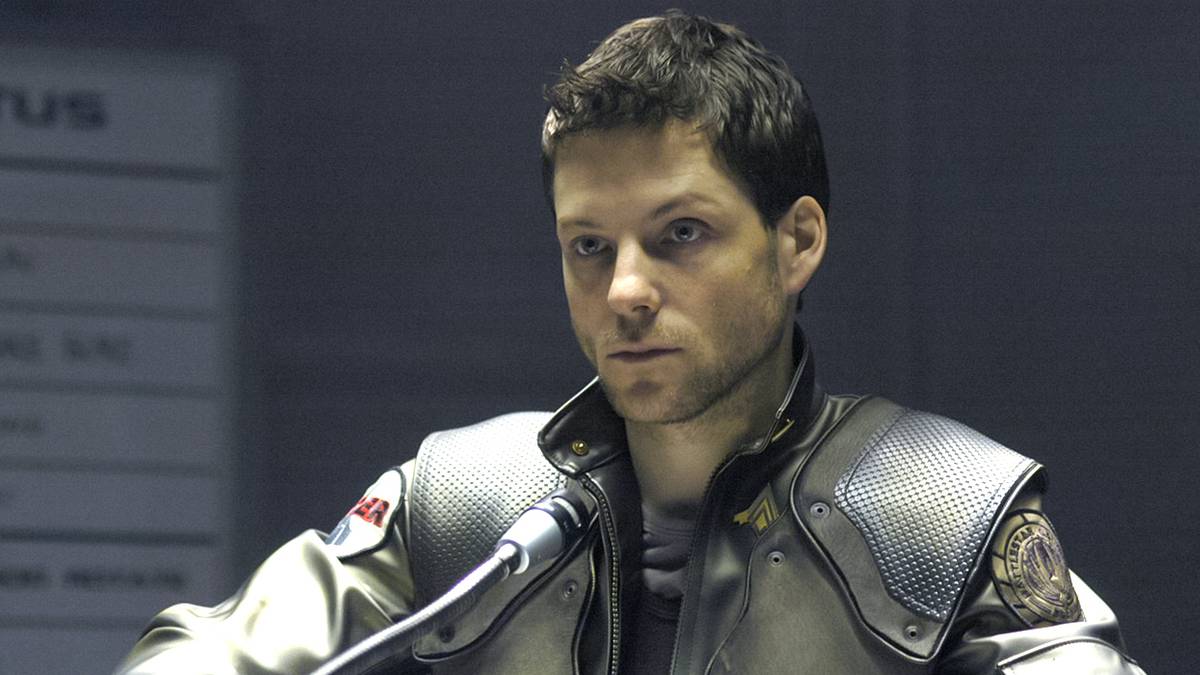

When Battlestar Galactica hit television in 2004, audiences had no idea that they were in for a space opera of the ages. Ronald D. Moore took a science fiction property that hadn’t been touched for decades and breathed new life into it with a deeply complex human drama set in the stars. After an exceptional two-part miniseries that set the stage, the first season of the SyFy drama kicked off with one of the most impressive episodes of sci-fi television ever made, and it’s the highest-rated episode of the series on IMDb. “33” is a masterclass in how to begin a sci-fi epic with style, pushing the human survivors of Caprica to their absolute limits.

What makes “33” such a great episode to begin Battlestar Galactica is that it effortlessly sets the tone for what is to come next. The story, at it’s core, is about what it means to be human and the desperation that comes with human survival. At the start of “33,” many of the remaining 50,000-something human survivors have barely slept a wink in five days, and with the Cylons closing in every half-hour (33 minutes to be exact), they are forced to flee again and again until the threat subsides.
Michael Rymer directs a tight script penned by Moore himself, which emphasizes the exhaustion of its main cast as they fight to stay both awake and alive. Because the miniseries had already introduced us to the world (in fact, the pilot begins with a “previously on” to clue in newcomers), “33” wastes no time retreading the same ground. Instead, it throws us right into this intergalactic battle, and we’re better for it.
As Commander, William Adama (Edward James Olmos) holds everything together from the Galactica, bearing the weight of his entire race on his shoulders. Of course, he doesn’t carry it alone. President Laura Roslin (Mary McDonnell) carries it too, dealing with all the civilian needs while Adama leads the fleet in each new FLT (faster-than-light) jump. Adama and Roslin are both stretched terribly thin, forced to keep up appearances for those under their command. As long as they can maintain their composure and stay upright, others around them will do the same. In stark contrast to these self-sacrificial leaders, James Callis‘ morally depraved Gaius Baltar is so ridden with exhaustion-fueled anxiety that he continues to drift into a dreamlike state where he is haunted by the source of his troubles, Head Six (Tricia Helfer), who represents the human-disguised Cylon he fell in love with, thus betraying his own race.
As Adama, Roslin, and their underlings fight to save as many lives as possible, Baltar is out only to save himself. He’s a classic case of what happens when human selfishness and total desperation find themselves trapped within the same worried mind. “33” expertly overlaps these motivations in its climactic ending, where Baltar (hoping to avoid being exposed as a traitor) convinces Roslin and Adama to destroy the recently returned Olympic Carrier. Baltar’s motives here are purely self-serving, while the commander and president realize that the only way to ensure the survival of the entire fleet is to destroy the one ship that may just be housing Cylons after all. The irony that there is a secret Cylon in their own midst is not lost on the audience.
‘Battlestar Galactica’s First Episode Instantly Proves Its Uniqueness Compared to Other Sci-Fi Productions

Everything about “33” stands out as a genuine triumph in science fiction television. Bear McCreary‘s unforgettable score runs deep throughout, and the sporadic shot composition and quick documentary-like cuts lull audiences into this strange sense of familiarity and full-immersion. While the 2003 miniseries was still finding its space legs, “33” hits the stars soaring with full knowledge of what it aims to be. It juggles various characters and plotlines, including Helo’s (Tahmoh Penikett) battle against the Cylons back on Caprica, Apollo (Jamie Bamber) and Starbuck’s (Katee Sackhoff) sleep-deprived flirtatious back-and-forth that turns into a moral conundrum on the battlefield, and Chief’s (Aaron Douglas) attempts to keep up. It’s masterful use of tension elevated the material far beyond any campy sci-fi project, turning it into must-see television on the same level as a program you might see on HBO or Showtime.

10 Sci-Fi TV Shows That Deserve a Remake
These shows are just begging to be remade!
While most science fiction programs set on a starship are an ensemble, few are as adult in nature as Battlestar Galactica. From the off-set, “33” deals with real-world problems and moral complications that could easily have taken place in our modern world. In every instance it can, the show avoids technobabble and overly complicated sci-fi conventions, sticking instead to the human drama that pulls audiences in. Still, the added science fiction elements — the Cylons, the battlestars, the voyage through the stars — offers the series greater stakes than anything we could achieve on Earth, enhancing the drama by pushing the boundaries of what we believe is possible. As humanity wrestles with its future, Adama and Roslin only see death, but in a stroke of genius, the episode ends with the (albeit small) hope of new life, as a child is born on one of the surviving ships. This is what Battlestar Galactica manages to achieve throughout its entire run, and it all starts in its very first episode.
‘Battlestar Galactica’ Maintained This Level of Quality Throughout Its Momentous Run
It’s no wonder that Jamie Bamber once told Aced Magazine that “33” was his favorite episode, a sentiment shared by series creator Moore as well. “It was kind of a nutshell of what the whole of our story is, which is a nightmare, waking up constantly to find that the monster is on you again, and that’s basically the modus operandi of the show,” Bamber explained. “And [Moore] captured it in one episode.” “33” distills everything that made Battlestar Galactica great from the very beginning.
The moral dilemmas, the complicated interests, the spiritual implications of every decision, and the weight of mankind’s survival all on Adama and Roslin’s shoulders are all captured marvelously here. The chemistry between the characters — including Michael Hogan‘s Saul Tigh, who is always a delight — and the exceptional visual quality are likewise established from the start. If there’s one episode of the show that is truly a “must-watch,” it’s this one. While admittedly quite different from the original Glen A. Larson-created space adventure, the 2004 reimagining of Battlestar Galactica remains a profound take on the genre for a reason, one that many still attempt to live up to today, even if its spin-offs never could.

- Release Date
-
2004 – 2009-00-00
- Directors
-
Wayne Rose, Michael Nankin, Rod Hardy, Sergio Mimica-Gezzan, Edward James Olmos, Robert M. Young, Jeff Woolnough, Félix Enríquez Alcalá, Jonas Pate, Allan Kroeker, Anthony Hemingway, Jean de Segonzac, Marita Grabiak, James Head, Paul A. Edwards, Gwyneth Horder-Payton, Brad Turner, Ronald D. Moore, Bill Eagles
- Writers
-
Carla Robinson, Michael Taylor, Bradley Thompson, David Weddle, Jane Espenson, Mark Verheiden, Michael Angeli, Anne Cofell Saunders, Jeff Vlaming, Michael Rymer, Dawn Prestwich, Nicole Yorkin, Seamus Kevin Fahey
- Franchise(s)
-
Battlestar Galactica