Summary
- Collider’s Perri Nemiroff chats with Rian Johnson and Josh O’Connor for Wake Up Dead Man: A Knives Out Mystery.
- In this interview, Johnson explains why this was his hardest script to write, and which scene was the breakstory moment for him.
- O’Connor discusses Johnson’s writing, relating to his character, and the phone call scene with Bridget Everett, which Johnson calls the heart of the film.
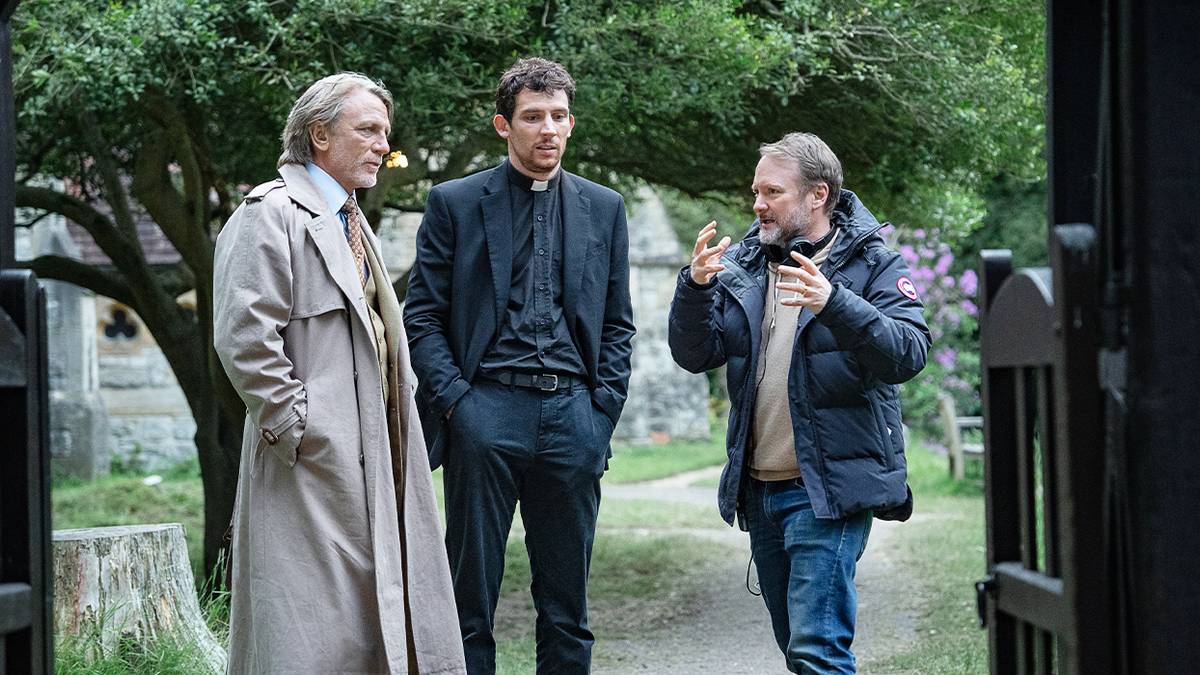
Rian Johnson is dealing in a rare commodity these days among the Hollywood crowd. As a writer-director, Johnson not only has seven original feature films under his belt, but his original and adapted screenplays for his beloved Knives Out whodunit series have earned him two Academy Award nominations. Now, once again, Wake Up Dead Man: A Knives Out Mystery, the third in the Netflix franchise, is buzzing with awards talk. But despite having two solid, chart-topping films in Benoit Blanc’s (Daniel Craig) ongoing saga, Wake Up Dead Man posed a unique challenge for Johnson. “This was the hardest thing I’ve ever written,” the filmmaker tells Collider’s Perri Nemiroff during an interview with Johnson and one of the threequel’s leads, rising star Josh O’Connor.
In this return to the world of Detective Blanc, local police chief Geraldine Scott (Mila Kunis) calls in the Southern gentleman gumshoe when an impossible murder rocks an upstate New York hamlet. A young priest, Jud Duplenticy (O’Connor), maintains his innocence in the face of the brutal slaying of Monsignor Jefferson Wicks (Josh Brolin), where all signs seem to point to his guilt. As in typical Knives Out fashion, Wake Up Dead Man enlists the stacked talent of Glenn Close, Jeremy Renner, Kerry Washington, Andrew Scott, and Cailee Spaeny as Blanc’s list of suspects.
During their conversation, Johnson opens up about the personal reasons why the third Knives Out mystery was his most challenging script to tackle to date and shares the heartfelt scene that became the “heart of the movie,” and a sort of breakstory moment for the writer-director. O’Connor shares why Jud’s complicated nature was easy for him to navigate, how Johnson’s direction made the set feel “otherworldly and spiritual,” and discusses tackling the phone call with Bridget Everett‘s Louise.
This Scene Is the “Heart of the Movie”
“This was the hardest thing I’ve ever written.”

PERRI NEMIROFF: Rian, you’re getting my first question. I love hearing about how these films evolve. What is the biggest difference between draft one of the screenplay and the finished film that everybody is seeing and loving now?
RIAN JOHNSON: I mean, the biggest difference is the finished film, hopefully, is good. As anyone who is a writer will tell you, a draft one is… This was the hardest thing I’ve ever written, and this was a really tough writing process. It took a long time to dial in, and that was both because the mystery is a little more intricate, but also the themes in there, the fact that it’s about faith. I wanted to get that right. It’s something that’s really personal to me. I used to be a Christian, and I’m not anymore, and it’s still something that’s very personal. So, I wanted to not just be tiptoeing around things and trying not to offend, but I also wanted it to have a generous spirit. Dialing all that stuff in, it was a long trek from draft one to what we ended up with, but I’m even more proud because of that, of where we ended up.
Is there anything you would call a break-story moment, something you came up with along the way that made you think, “I got it now?”
JOHNSON: I’ll say there’s a scene in the middle, and I’ll try to avoid spoilers, but there’s a scene with Josh, and he is on the phone with Bridget Everett.
That is a brilliantly written and performed scene.
JOHNSON: I appreciate it. That was a moment where I was like, “Okay, I think we found the heart of the movie.”
Rian Johnson Captured Sun in a Bottle
“I wanted those big, dramatic, theatrical lighting changes…”

Josh, I love asking actors about having “aha” moments with characters, but in particular when they’re playing characters that carry themselves in a very specific way that is necessary to the success of the film. So, whether it was in prep or on set, do you remember the very first thing you did that made you say to yourself, “I really get who Jud is now?”
JOSH O’CONNOR: It’s a really good question because I think there is often, in fact, there’s always a moment of that. I often think the best performance is, in my opinion, where there is an inevitable merger of the actor and the character, and it’s often the moment where they align, those things come together, that that happens, when you have this moment of clarity with it.
I have to say, the first time I read the script, it was there, and I think that’s obviously a testament to Rian’s writing. I think I was also primed and ready to discuss the things that Rian’s just talked about, about faith, and about our understanding of God and religion. And in this premise, being a big fan of these films, to sort of have this character that I really understood and really kind of shared thoughts with and feelings, that was a pleasure. So, it really came very early on, really.
Perfect casting across the board, but I really appreciated how much you soar as an anchor in this film.
There’s a particular scene that I wanted to focus on, particularly because of the lighting. It’s the scene with you and Daniel in the church, and we see the lighting evolve. I’d love to hear from both of you about that. Rian, what was it like working with Steve [Yedlin] to design that particular lighting scheme, and Josh, how does that either pose a challenge for you to maybe hit certain marks, or does it help your performance?
JOHNSON: That was the first conversation I had with Steve Yedlin, my cinematographer. The inside of the church is a set on a stage, and I wanted it to feel like the outside world was constantly informing it. I wanted those big, dramatic, theatrical lighting changes that happen in real life when the sun goes behind a cloud. It’s sunny in a room, and suddenly everything gets not just dark, but kind of cool in tone, and the emotional tenor changes. So, Steve did a lot of work to pre-rig it so that we could basically play the light changes on his laptop like we were playing music, and just play them to the scene. The thing that makes me happiest is when friends see the movie, and they think we just got lucky with the sun coming through the windows. I’m like, “That would have been very, very lucky. I’m so happy you feel that way.”
The first time I thought that, but then I was like, “Oh, no. They’re wizards with that kind of stuff.”
JOHNSON: That makes me very happy.

O’CONNOR: Again, this is the genius of Rian and Steve. Really, truly, all this other stuff is going on in the background, which is why Rian is Rian and what makes him such a great filmmaker. But the truth is, from an actor’s perspective, it feels like everything is catered for the actor to allow them to give the best performance they can give. So, to take your example, no, Rian and Steve didn’t sit me down and say, “By the way, at that line, the sun’s going to come out,” but it is extraordinary, and it impacts all the feelings that come out in that moment, which you’re trying to conjure as an actor.
But having these lighting shifts, which were extraordinary, and as Rian said, the set was extraordinary, and these stained-glass windows, there’s something very eerie when the light changes in any church, but through the stained-glass, and how light comes through those windows, it does feel otherworldly and spiritual. And when it doesn’t, it’s so cold and overpowering. It felt like these lighting shifts were the cinematic way of telling the Father Jud/Brolin side of things. I keep calling him “Brolin,” but from Wicks, to have these different sides of the same coin.

Will ‘Wake Up Dead Man’ Be the Last Knives Out Movie? Rian Johnson Reveals the Franchise’s Future
Daniel Craig’s Benoit Blanc is back on the case for a star-studded murder-mystery.
On the Road (to Damascus) Again
Johnson and O’Connor discuss the impact of Louise’s phone call.
I’ll raise the spoiler warning to briefly touch on that particular moment in the movie, the Louise moment. I’d love to hear about that from both of your perspectives. Rian, what was it like figuring out that that was key to cracking the script, and also that Father Jud’s arc needed that moment? And Josh, what was it like doing a scene like that, where I imagine you don’t have a traditional scene partner?
JOHNSON: Writing-wise, it was an interesting moment because the whole movie is about the relationship between Jud and Blanc, and Blanc is very much not a believer, and Jud very much is. But Jud is in this horrible situation. He finds himself kind of caught up in the gamified thing of Blanc’s trying to find the guilty person and solve the crime, which is what the detective does in these movies. So at this point in the movie, Jud and the audience, hopefully, have been swept along with that: Here’s our mission. We’re going to find the bad guy. We’re going to get him. We’re going to solve this case and put everything right.
At some point, Jud has this road to Damascus moment where he remembers that he’s a priest, and he remembers that is actually antithetical to what he’s set on this earth to do. And so it was having a moment where everything would stop, and we would reset and remind Jud, and also the audience, of what his moral compass is supposed to be at, and it doesn’t line up with Blanc or the movie or the genre that we’re in, and intentionally so. Then you get on set, and you have Josh and Bridget Everett performing it, and I love watching that scene.
Did you have Bridget there for it?
O’CONNOR: Yeah, and on that, she was extraordinary, wasn’t she? She gives everything. Scenes like that are so, not easy, but so straightforward in the sense that you feel, as a character, you need that. When you’re prepping a character, there is this sort of idea of direction of what their vocational, their intentions are, and how that shifts. And as Rian said, he gets swept up in the game of Blanc. But a call like that rips your heart out, so it’s very straightforward to play when you’ve got Rian leading it, and Bridget, who’s brilliant.
Move Over, Cruella – Drusilla’s Ready for Her Close-Up
Glenn Close teases her looks for The Hunger Games: Sunrise on the Reaping.
Joining the ranks of Johnson’s star-filled Knives Out cast list is eight-time Academy Award nominee and award-winning actress Glenn Close as Martha Delacroix, the devout companion of Brolin’s Monsignor Jefferson Wicks. In this interview with Nemiroff, Close discusses sharing an emotional scene with O’Connor and how it brought out more than she expected on set, and tapping into Martha’s character through the costume design.
Of course, on the subject of unique costume design, we’d be remiss not to bring up Capitol couture. Close also teases her looks for The Hunger Games: Sunrise on the Reaping as the dreadful District 12 mentor, Drusilla Sickle, crafted this time by Tár costume designer Bina Daigeler. She promises plenty more iconic looks to join the ranks of her past characters she’s embodied, including Cruella de Vil. “She’ll definitely be in the pantheon of characters I’ve played who, hopefully, will end up in gay Halloween parades.”
Wake Up Dead Man: A Knives Out Mystery is available to stream on Netflix now.

- Release Date
-
November 26, 2025
- Runtime
-
140 minutes
- Director
-
Rian Johnson
- Writers
-
Rian Johnson
- Producers
-
Ram Bergman, Rian Johnson