
Editor’s Note: The following contains spoilers for Minions & Monsters.
Summary
- Collider’s Steve Weintraub talks with Minions & Monsters writer-director Pierre Coffin and Illumination CEO Chris Meledandri.
- At the Annecy International Animation Film Festival, the duo discuss how they cracked the story on the newest Minions adventure, deleted gags, and edgy jokes.
- They also break down some of the movie’s Hollywood Easter eggs, the two jokes that might be divisive, homages, and how they landed on the end-credits scene.
We’re now less than a week away from a Hollywood takeover with Illumination Studios’ Minions & Monsters. It’s the Megaverse’s seventh feature, and the third standalone for the beloved yellow fiends, and this time, they’re taking on Tinseltown and a whole batch of monsters. After the world premiere at the Annecy International Animation Film Festival, Collider’s Steve Weintraub sat down with returning writer-director and voice of the Minions, the Academy Award-nominated Pierre Coffin, and Illumination CEO Chris Meledandri to find out all the behind-the-scenes goodies and on-screen details you might miss on a first watch.
Co-directed by Patrick Delage (Despicable Me 4) and co-written by Brian Lynch (Minions), Minions & Monsters takes audiences on a cinematic adventure through the Golden Age of Hollywood when one of them gets the itch to make a monster movie. Naturally, to do so, they’ll need to summon real-life monsters, but the Minions don’t anticipate those monsters turning against their makers to wreak havoc on the world. Now, our lovably misguided henchmen must put an end to the chaos they’ve unleashed. The movie features another star-studded vocal cast, including Trey Parker, Allison Janney, Jeff Bridges, Zoey Deutch, Christoph Waltz, Jesse Eisenberg, and even George Lucas.
Read the full conversation below, where Coffin and Meledandri discuss some of the many Hollywood Easter eggs and references and reveal the movie moments they couldn’t include, or that were trimmed for time. Coffin talks about the mega responsibilities of returning to the Megaverse and why Minions & Monsters brought him right back into the fold, plus the pair addresses the movie’s deleted gags, the most scandalizing jokes (“I think it’ll be a polarizing moment.”), and how they schemed up that little “treat” of an end credits scene.
Making a Minions Movie Is a “Really Hard” Process
“It’s really a lot of work directing, doing all the voices for all the Minions, and having the iteration of going in this direction.”

COLLIDER: How many voicemails have you left as the Minions?
PIERRE COFFIN: None.
That doesn’t make sense.
COFFIN: I know, but none. No, I do drawings for people, and sometimes I do those animated cards for people. Also, birthdays and stuff where I do voices for those characters. That’s a good idea, though.
You’re selective with what you direct. When do you know you want to direct one of these?
COFFIN: There was something in Despicable Me that I really liked. The fact that there are two brothers. There’s a pattern. You’ll see. Because having Steve Carell play the two characters of Gru and his brother Dru, I thought, opened up a world of possibilities for me and for Steve Carell, because I knew that he would do something that would be very, very interesting, and it proved to be so.
But I also felt that I came out of a Minion movie, which was really hard because we were trying to discover it, and we really struggled. I remember the first time, our first screening where it was 45 minutes of just Minions, and I didn’t know how to do that. Those suddenly became main characters, so we had 45 minutes of gibberish, which was even to me, like, “Oh, man, this is never going to work. It’s too much.” I didn’t know how to write them. Brian [Lynch] didn’t know how to handle them either. We didn’t know how to write a script that way. Now, we have a way of writing it. We discovered that. Now, we write everything in English. We settle on the story, and I start being creative about the language after I know what the scene is about, after I know what the meanings are supposed to convey in terms of story point or character. So, we know all that now.
So, all of that to say that it’s really a lot of work directing, doing all the voices for all the Minions, and having the iteration of going in this direction, and I know that’s never going to work because we need a human character to convey that, so changing the script to go there, and having me voice everything, etc. It was taking a toll on me a little bit, and so I said to Chris, “If there are any other projects than Minions, it’d be fun.”
Except one day, he calls me and says, “Putting aside the fact that maybe you don’t want to do a Minion movie, I have this idea that might motivate you,” and he pitched me the idea of a Minion wanting to do a monster movie, so he needs a monster. He summons a monster? Creates a monster? Builds a monster? Didn’t know. But then that monster turns against the Minions, turns against humanity, and they have to correct the mess that they just made. And out of all of that, it became like evidence for me. I had ideas just because of the context that was given. Hollywood in the ‘20s popped in my head, all sorts of monsters. I had the background to put the Minions in, like an aquarium, to see, “Will they survive?”
‘Minions & Monsters’ Is a Giant Tribute to Hollywood
There are so many references that one nod to Harry Potter had to be cut.
I love that the film is a love letter to Hollywood, especially in the 1920s and the early Silent Era into Talkies. There’s that scene where Allison Janney is doing the tour of the museum, and there are so many references. I wrote some of them down, like Universal Monsters, Matrix, Orson Welles, Hitchcock, Metropolis, E.T., Trip to the Moon, Buster Keaton, Charlie Chaplin, and Casablanca. Obviously, there’s Citizen Kane. There’s so much in that one.
COFFIN: You’re missing the most important one! Because when we think of classic, we’re thinking of movies in the ‘20s and stuff like that. One of my best movies ever is Airplane!. It’s there!
Keep in mind, I’ve only seen the movie once. But talk about which things you wanted to put in that museum, and when you’re doing stuff like that, do you need to get permission from Warner Bros. when you’re putting The Matrix in?
CHRISTOPHER MELEDANDRI: That whole process of constructing, for example, a sequence like that, is obviously Pierre, and then Pierre and Brian come into the scene with lots of ideas, but then it also becomes almost about set design, because where are all these ideas going to reside? Then, once Pierre starts setting the camera in the sequence, what is the camera going to see? So, Pierre talks a lot about his process and the process of animation being an iterative process, and so even that collection of references is changing. One of the things that affects the change is when we do need permission, whether we get it or not. So, there are things that we had talked about where getting permission just wasn’t feasible.
Is there one that you really wanted?
MELEDANDRI: I’m trying to think. There was something we were turned down on.
COFFIN: I can’t really remember. Also, when we start making these movies, we’re slow, so we have this big chunk. The opening was twice as long, I think, at some point, so we needed a lot of stuff to be shrunk. Then all of a sudden, after screenings, we thought, “We’ve got to get to the Minions faster.” And so we were shrunken down to what we thought was the best timing for that little moment, and thus also reducing the amount of references that we needed to make. So, we used to shoot a lot of stuff, like Harry Potter stuff, and a lot of things, but then all those moments sort of went away when the scene became shorter, also.
There are so many references that people who love movies will get, like, for example, Citizen Kane, and instead of saying Rosebud, it’s poop. When you’re doing a joke like that, how much are you debating, because it’s going to be such a small percentage of the audience that understands this joke, and the ones who do are going to laugh hard, and everyone else, it’s going to go right over their heads.
COFFIN: It’s a great question.
MELEDANDRI: Given the nature of this whole process of Easter eggs, it’s an invitation to look inside a frame harder than you might normally look, that there are things that you realize that somebody else might be seeing that you’re not. To me, it’s this invitation. I think that as long as there’s sort of a cadence, for example, with the Citizen Kane piece, I think that for the majority of the audience who doesn’t understand that, they see a very serious, solemn scene with a situation that they do understand. They understand the Minion’s struggle being put into that scene with a very unexpected vocal expression. So, I actually think that it’s working, even if you don’t understand the specific reference.
I agree, because of the dialogue. What they say makes it work. Most people are not going to know that’s Citizen Kane.
COFFIN: And that’s okay. Also, we used to have it at the very, very beginning, where the Minion was just saying, “Bikini,” and that was it. But we struggled, we added details, and then we thought let’s do the reference, like, “Oh, poop?” instead of Rosebud, and add those visual moments after. That’s why we have all the Minions coming in frame at the very end and doing raspberries. It is one of those moments where you have this first degree of lecture, like, okay, it’s a guy dying, saying his last word, but his last words are, “Oh, poop,” just because he let that thing go. Then, on the multiple tries, you have all these funny little characters just going, “Yeah!” at the very end, when the guy was in pain, obviously at the beginning of that moment. So, that’s the first degree.
The second degree is obviously the reference to Citizen Kane and saying, “Oh, poop,” instead of Rosebud, or saying “bikini,” or doing raspberries. And if people don’t know, or if kids don’t know, then they’ll ask their parents, who maybe know that reference, and then they learn something.
There are some really good shots that are long shots. When you’re doing a oner in animation that is so loaded with information, how much does that add to the cost of making that scene?
COFFIN: That’s a good question.
That is not simple stuff, and it’s so loaded with background.
COFFIN: It’s planning, and it’s also magic because we have this facility, Illumination Studios, in Paris. That last shot, we’re revealing a lot of things. I couldn’t believe it, I think they did it in three weeks. But it’s just the know-how of knowing how to cut a scene just to give it to different people and then reassembling it after. So, as long as you have that tool or that knowledge, “You, animator, animate those three guys there. You, animator, animate those three guys who are next to those three guys.” As long as we have those tools, we put them together. Obviously, if stuff isn’t working right away, we need to tweak, but the tweak is just a couple of days, and multiply that by the number of animators.
And also, in that particular last shot, I told our lighting supervisor, “Keep the lights as if they were realistic,” meaning that it’s lit there, it’s lit there, it’s lit there, and the rest is sort of in shadow, which, with all the bouncing lights, you can actually see. So there’s an aesthetic choice, also, which is protection over that. But the main thing is to separate everything.
One of the things about technology is that each year things are getting more powerful, and I’m curious how it’s changed at Illumination in terms of rendering time and what they’re able to accomplish now in a few days, which used to take a few weeks.
MELEDANDRI: What I’ve noticed is that as technology enables us to do more, faster, our ambition for the visual expression rises. So, the overall time, it’s essentially man-hours that go into making one of these films, is not coming down, even though there have been technological advances that enable us to be more efficient. But if you look at, for example, Despicable Me side by side with Minions & Monsters, you see that just on a pure level of cinema, there’s so much more dynamics in Minions & Monsters than Despicable Me by comparison.
COFFIN: Also, from one movie to another, we try to surf. I have technical knowledge that has me say, for instance, like Irene, I know we need to do her procedural, so from that idea I discuss with Nico, one of our CG supervisors, and he says, “Okay, but we need to have her being animated first with an intention,” and then the procedural aspect of it, like adding the eyes, adding a rolling movement to her, adding a tentacle, adding face, all that comes as a second step, which comes out of a discussion, and it also comes out of me saying we need to do her procedurally. Otherwise, I don’t know how it’ll look realistic enough.
Pierre Coffin and Chris Meledandri on That Lego Joke and Those End-Credits Cameos
“The bar for us, when we’re looking at these ideas that might populate the credits and come interstitially, is very high.”
What’s the strangest Minions idea that almost made the movie but was cut?
COFFIN: Well, it wasn’t the strangest. It was a Minion idea that I wanted in the movie, that we tried in the movie, that I sent you, saying, “Maybe there’s room?” It’s two Minions eating an ice cream, and one guy shows up with his, and then the two guys on the side with their own ice creams are thinking maybe his ice cream is better than theirs, so they start licking it. It’s this whole thing, physical comedy again, where the guy is just trying to save his ice cream from those two guys. I think my first edit of it was one minute, and it didn’t make the cut, obviously, because it was not one minute, so we left it aside. It’s one of those ideas where I’m thinking, “Maybe if we have some free time.”
What I realized, which is really dumb, in this movie, was that Minions were kids. Really kids. When we started doing all those tests with Henry and James, we wanted to show that they’re friends. How do you show that they’re friends? There’s nothing physical here that’s happening, and I hope we’re friends, but how do you show that two creatures/people are friends? So, we usually take six months to test admission ideas, and so six months we spent trying to find ideas of how to show friendship, and how does that embed itself in the narrative of the movie? We found a couple of things, but we found mostly that those guys are kids. The moment that you say those guys are kids, you can do anything with them. Like when they start fighting, but then two minutes later, they get on just fine, that sort of thing. But once you see how kids behave and interact, then you’ve got the Minions.
MELEDANDRI: Also, I think that the most unexpected moments that were ever in play through making the movie have ended up in the movie. It’s not as if there were things that we would go, “Oh my gosh, that’s just too weird or too strange.” For example, when the Minions are searching for a villain to serve in the opening of the film, and the idea that a Minion falls asleep while he’s supposed to be holding his spear in front of a boss.
COFFIN: Royalty.
There are two jokes that I was very surprised you did, which were exactly what you’re saying, when you cut off someone’s head, and also one where the monster sits on the Lego. Those two are great gags, and they’re pushing boundaries, if you will. So how much debate is there at the studio, or is it like, “That’s funny. We’re doing it?”
COFFIN: Exactly. And it’s also seeing the public’s reaction to it. It’s the biggest laughter.
MELEDANDRI: For me, the cutting off of the head, I never paused, never questioned.
COFFIN: It’s so soft in the way it’s happening.
MELEDANDRI: In the Lego scene, which I think is so funny, there is no question that I think that will be one of those moments that people love the most, and then also where people are like, “Oh my God, I just don’t like that they did that.” So, I think it’ll be a polarizing moment.
I think most people are going to laugh pretty hard.
COFFIN: It’s also about what we dare do, maybe, in those sorts of movies as opposed to others.
During the ending credits, there are a bunch of little bits. How did you decide on those? Was it ever anything else?
COFFIN: It was many things before it became that, and then when we found the idea, it was evident. It was like, “Why didn’t we think of that?”
MELEDANDRI: Those are interesting challenges because it’s unquestionable that once you start making movies where you start to entertain people during the credits, they really enjoy it, but you’re still asking audiences to give you their attention after the end of the movie. So, there’s an automatic, habitual kind of idea that’s embedded in us that when something ends, it’s over. So, the bar for us, when we’re looking at these ideas that might populate the credits and come interstitially, is very high. The thing that would be, you know, would be you make this incredible movie that Pierre’s made, the movie ends, and then you continue to create scenes, but the audience is like, “I wish I had left at the end.” So there’s a lot of iteration there and a lot of exploration to find something that really works, and I think, as Pierre said, when you had this idea of bringing back the book…
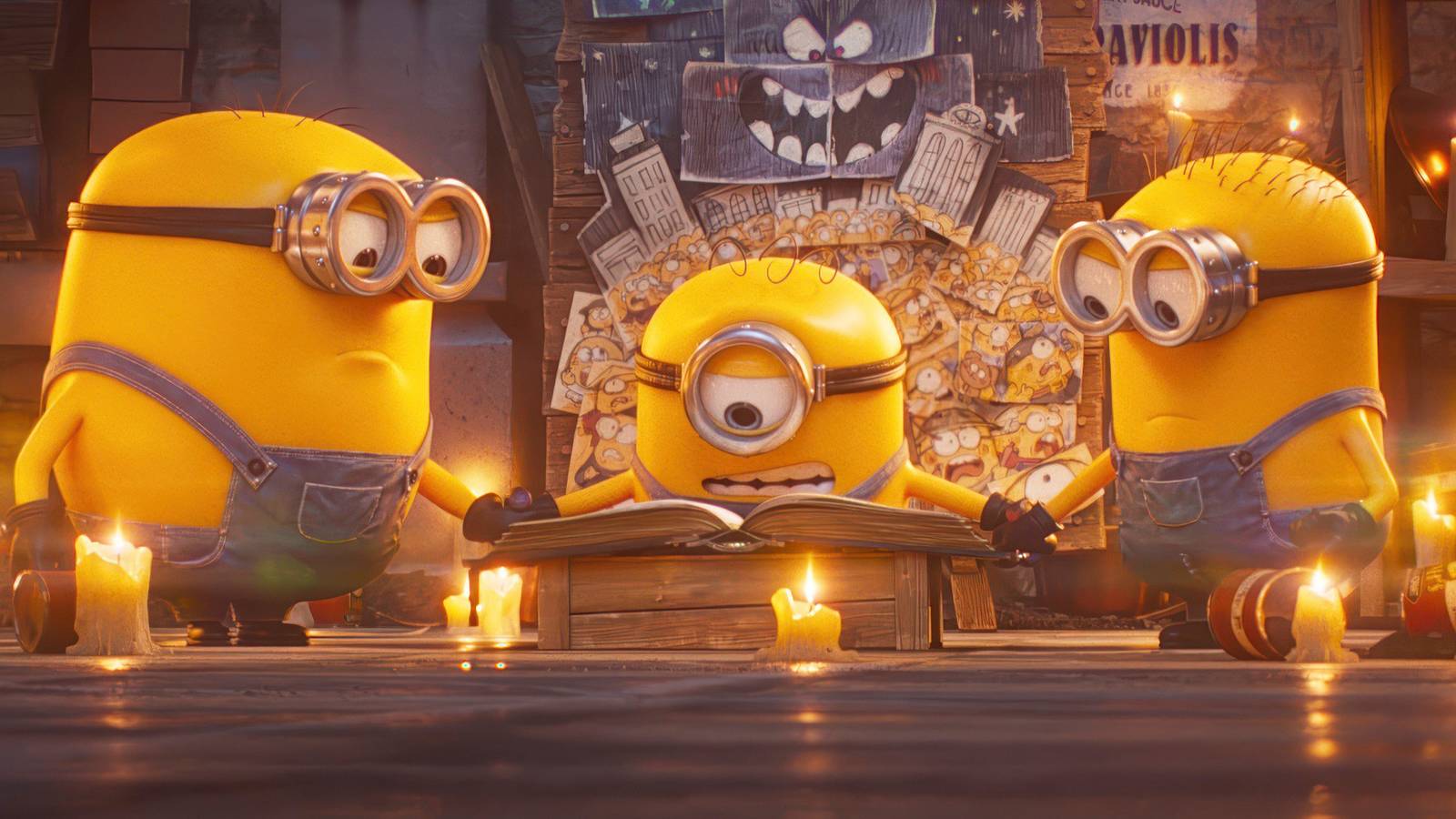
COFFIN: And also, the book is found by Kevin, Stuart, and Bob, the guys from the two previous movies, it felt like, “Obviously!”
MELEDANDRI: Like a treat, too.
Minions & Monsters take over theaters on July 1.

- Release Date
-
June 24, 2026
- Runtime
-
90 minutes