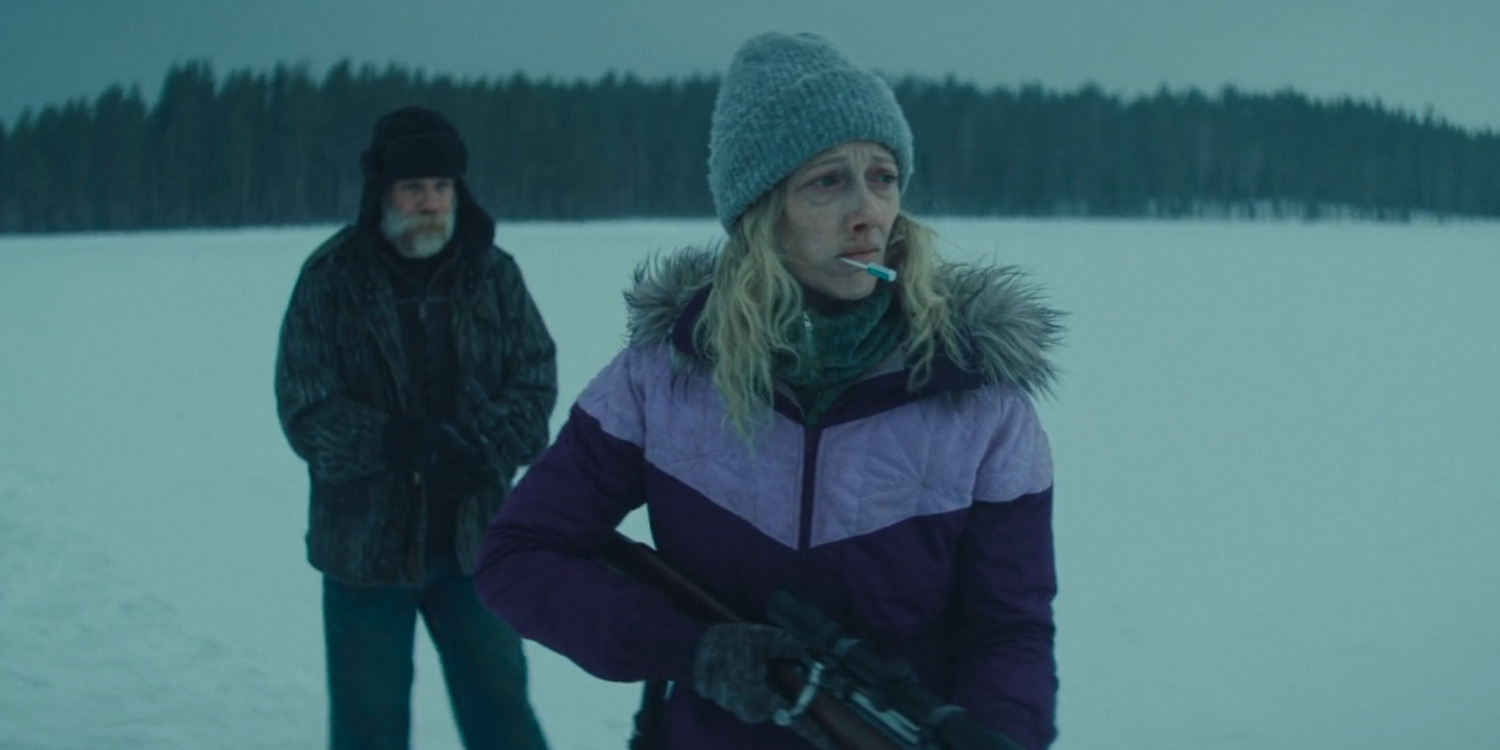

In ‘Dead of Winter,’ the harsh environmental setting of northern Minnesota becomes a character of its own, impacting the flow of the narrative in good and bad ways. The story’s protagonist, Barb, is an older woman who finds herself embarking on an adventure through the elements with Lake Hilda, a meaningful location for her and her late husband, as her destination. Along the way, she ends up encountering something unexpected when she runs into an ongoing abduction of a teenage girl. Miles away from any towns and stranded without cellular service, Barb has no choice but to carry out a rescue on her own as the young woman’s last hope of survival. As the tale unravels, Lake Hilda becomes a crucial location both narratively and in terms of the thematic elements. For the same reason, the on-screen location is bound to attract the audience’s intrigue.
Lake Hilda is a Fictional Lake in Northern Minnesota
For the most part, ‘Dead of Winter’ charts a fictitious story penned by screenwriters Nicholas Jacobson-Larson and Dalton Leeb, with Brian Kirk as the director at the project’s helm. The character of Barb, as well as the hellish experiences that she undergoes, are all works of fiction with no direct counterparts in reality. The same is true for Lake Hilda, the central location where the story takes place. In real life, Northern Minnesota is home to numerous lakes, including Bowstring Lake, Kitchi Lake, Big Rice Lake, and more. Nonetheless, there is no direct off-screen counterpart identical to the on-screen Lake Hilda. In fact, the frozen lake depicted in the film isn’t actually connected to a Minnesota-based location at all.
In real life, the filming for ‘Dead of Winter’ took place in European countries, such as Finland and Germany. Among the many location that became home to the film’s production were Finland’s Koli, Joensuu, Pielisjärvi, and Lieksa, as well as Germany’s North Rhine-Westphalia. Even though these filming locations remain disconnected from the on-screen setting of the story, the similarities in climate conditions allow for realism in storytelling as well as the performance of the actors. In a conversation with Forbes, the lead actress, Emma Thompson, spoke about her experience.
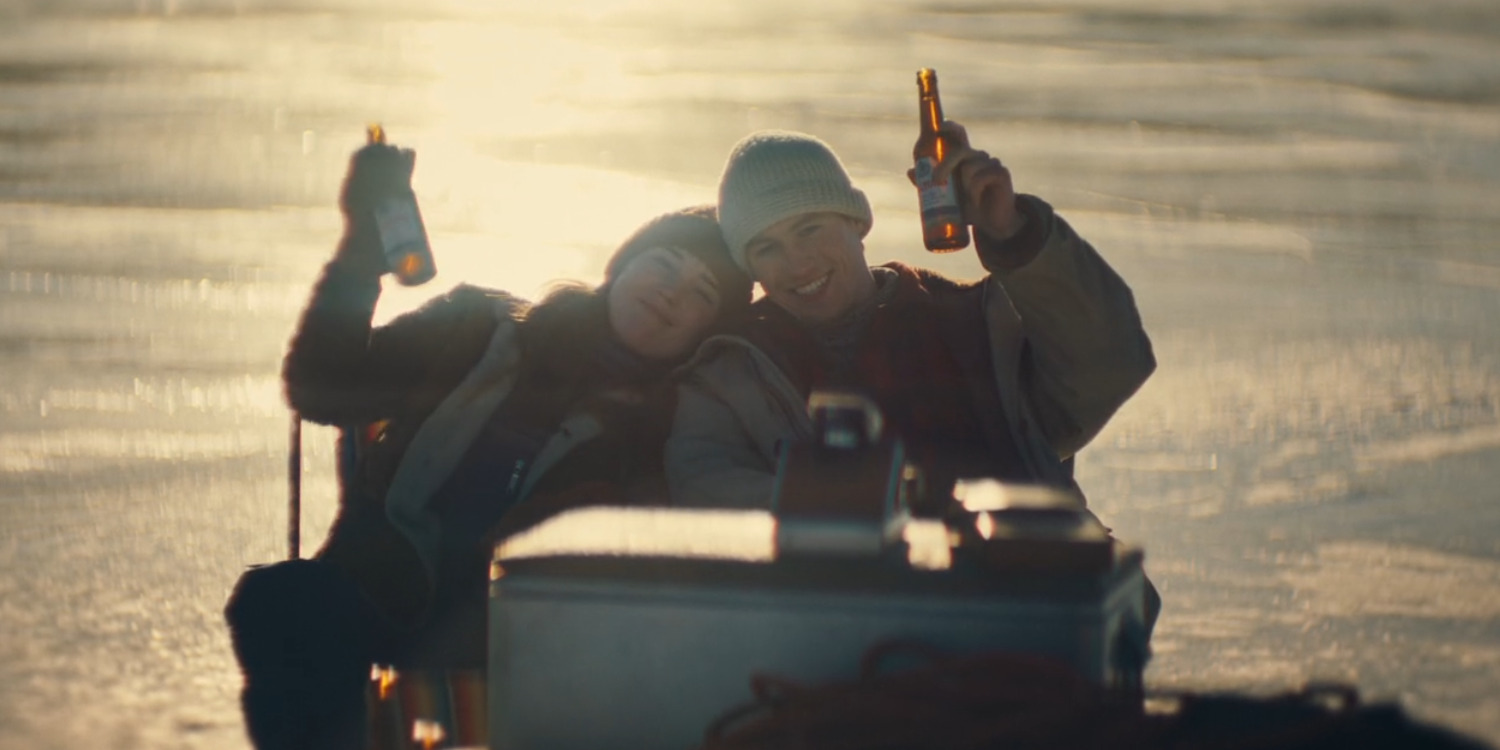
She shared, “(So) I went out, for instance, a month in advance to Finland, where we all had to get used to the temperatures. So, it was very nice to be with the crew, watching the cabin being built, working with the costume designer to create a costume that would survive (the cold) and would also survive being pulled underwater. It was great to spend time there with the crew, gearing up for what we were all going (to) have to kind of endure, you know? It was not an easy shoot, but it was a very close-knit one.” Thus, ultimately, Lake Hilda is confined within the premise of the fictionalized story, retaining no tangible counterparts in reality. While the production’s authentic filming locations allowed for a realistic depiction of the icy lake, Lake Hilda itself remains a work of fiction.
Read More: Dead of Winter Ending Explained: Why Did the Kidnapper Abduct Leah?