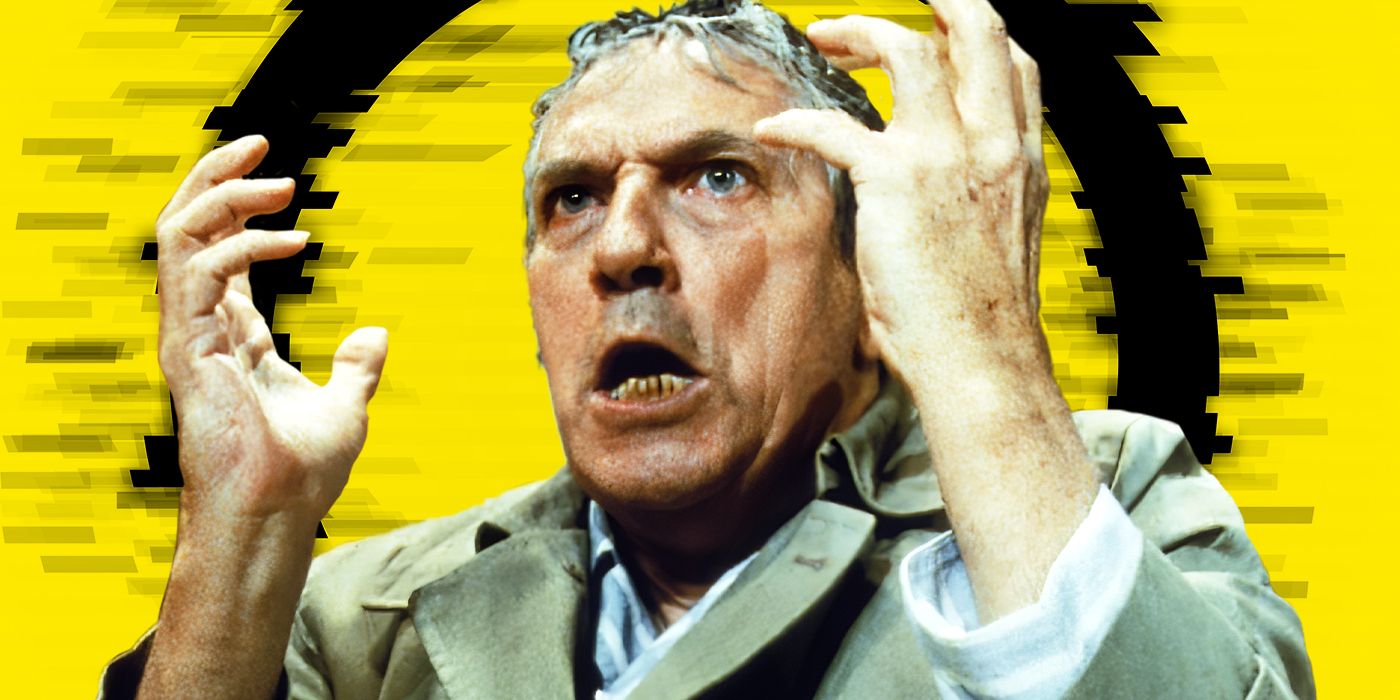

Although he’s known primarily for his goofy comedies, Jim Carrey‘s tastes in cinema are wide-ranging, as witnessed by the many left turns he’s taken in his own movie career. It shouldn’t be surprising that his favorite movie takes similar wild swings from comedy to drama to tragedy and back to comedy again. “My favorite movie of all time is Network,” Carrey wrote in his book, Memoirs and Misinformation: A Novel. “It’s like a prophecy of what happened in the last fifty years. Every actor scores immensely. It’s phenomenal.” Indeed, the 1976 media satire feels more prophetic with each passing year, making one wonder if screenwriter Paddy Chayefsky and director Sidney Lumet were looking at a crystal ball when they were making it.
Even if you haven’t seen Network, you’ve likely seen the iconic scene in which news anchor Howard Beale (Peter Finch), clad in a soaking-wet raincoat, implores his viewers to stick their heads out of their windows and yell, “I’m as mad as hell, and I’m not going to take this anymore!” Beale has suffered a nervous breakdown after getting fired and believes he’s hearing the voice of God. Rather than take him off the air, ratings-hungry programming chief Diana Christensen (Faye Dunaway) decides to turn the nightly news into entertainment programming, much to the chagrin of veteran news producer Max Schumacher (William Holden). Night after night, Beale, now rebranded “the mad prophet of the airwaves,” rants and raves to a captive in-studio audience about the degradation of the American dream. Yet when his truth-telling threatens the network’s sale to a major Saudi conglomerate, the decision is made to take him off the air in a way that’s sure to generate ratings.
It might be hard to believe in an age of 24-hour news, but there was a time when the nightly news was viewed as a loss leader, not a means for the networks to make extra ad dollars. That changed throughout the 1960s and 1970s, when earth-shattering events like the Kennedy assassination, Watergate, and the Vietnam War encouraged viewers to tune in every night. The founding of CNN in 1980 created a need for constant coverage, i.e. a way to keep eyeballs on screens. The news slowly morphed from an anchorman dryly delivering the daily headlines into a chorus of talking heads debating them, with figures on the right and left clashing over the Iraq War, the financial crisis, and the election of Donald Trump. They might not be quite the cartoon characters that eventually populate The Howard Beale Show, but they’re pretty close, and their purpose is the same: entertain an audience rather than inform them.

Related
Jim Carrey Has Tried (and Failed) To Work With Steven Spielberg Three Times
‘Jurassic Park’ could have looked a lot different if Carrey landed a certain role.
The trajectory of Beale’s show from straightforward news broadcast to three-ring circus mirrors the same degradation of our current media, and it’s not just the news. As Roger Ebert pointed out in his Great Movies review, “When Chayefsky created Howard Beale, could he have imagined Jerry Springer, Howard Stern, and the World Wrestling Federation?” Could he have also predicted our thirst for on-air bloodshed, dramatized in Diana’s insistence on creating a docu-series about a terrorist group (called The Mao Tse-Tung Hour) and in Beale’s ultimate fate? Could he have also foreseen the corporatization of our media, as the messages we receive are increasingly filtered through what’s best for corporate mergers and acquisitions? In 1976, this felt exaggerated; today, it feels frighteningly accurate.
If Network were merely the story of Howard Beale, it would forever hold a place in cinema history for its prophetic media critique. Yet its brilliance comes from the fact that it’s so much more than that. At its core, it’s the story of the values of the old (Max) getting pushed out for the immorality of the new (Diana). Max, whose career began with Edward R. Murrow, still believes in the integrity of the news and is shocked and outraged at the direction it takes under Diana’s leadership. Yet he is not above corruption and temporarily leaves his wife (Beatrice Straight) to become Diana’s lover before once again becoming her victim. Their relationship culminates in a raw breakup scene, in which Max expresses his fears of getting older and his desire for a connection Diana is unable to give him.
When talking about Network on an episode of Norm MacDonald Live, Carrey said, “Now that I’m a little older too, you can look back on that movie and see William Holden and Faye Dunaway in the kitchen scene, and he’s saying, ‘I’m closer to the end than the beginning,’ and ‘Death has become a real thing with definable features’; I mean, f**k who writes that? That is incredible.” There aren’t many movies that can balance as many tones, themes, and nuances as successfully as Network does, and it’s that touch of humanity that takes it from being a sideshow and turns it into a classic.

Network
- Release Date
-
November 27, 1976
- Runtime
-
121 Minutes