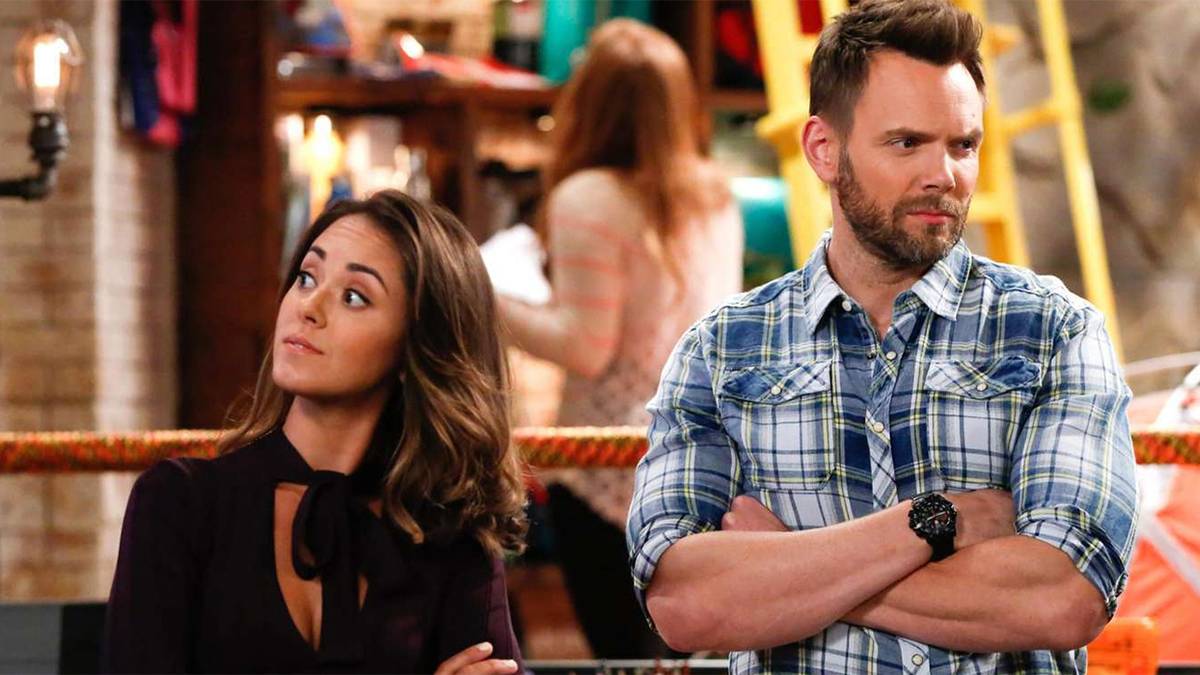

Television is an unforgiving business. Most shows never make it past the pitch stage, and even the ones that do live and die by ratings. Network TV may be viewed as a primitive medium now, but it’s still cutthroat, which is exactly the lesson Joel McHale’s character tries to teach the “coddled” millennials in The Great Indoors. And while we’re still waiting on the long-promised Community movie, it’s worth revisiting the McHale series that briefly looked like a hit before the numbers turned.
The CBS show experienced surprising success during the onset stages of the first season in 2016. During the second half of the season, The Great Indoors‘ ratings plummeted, and the show was cancelled upon the season’s conclusion in 2017. Some would claim the show was not so much taken off the schedule, but rather, a victim of “cancel culture,” due to offending millennials. But in reality, it cancelled itself due to an egregious misread on the part of executives to move away from the perfect lead-in.
McHale Is an Older Journalist Teaching Millennials How To Work in the Real World in ‘The Great Indoors’
Created by Mike Gibbons, co-creator of Tosh.0 and prolific late-night writer, The Great Indoors follows an outdoors magazine journalist, Jack (McHale), who becomes the boss of a group of millennials after the magazine pivots to exclusively digital. Jack, an old-school guy with traditional ways, clashes with the new generation and their tech-obsessed behavior. The magazine is produced by an outdoors adventurer and staunch baby boomer, Roland (Stephen Fry). The series also features Christopher Mintz-Plasse and Christine Ko as the naive millennial employees, and Chris Williams as Jack’s friend and bar owner, who guides him on how to manage this group of young hipsters. Susannah Fielding stars as Brooke, who once had a romantic fling with Jack, and is not only Roland’s daughter but Jack’s boss as well. Throughout the show, Jack embarks on a series of romantic endeavors.

This Is What Happens When You Let Joel McHale Do Everything
Turns out ‘The 1% Club’ host Joel McHale didn’t choose a lane — he built the whole road.
Because modern-day seemingly exists in a cultural vacuum, any year of the decade blends in with each other with few distinct characteristics, but derisively looking down upon millennials as a curse on society is very much 2016-coded. It was a time when “triggering” people deemed “snowflakes” was in vogue and used unironically. The Great Indoors premiered on October 27, 2016, less than two weeks before the hotly contested Presidential election, which was a platform for that hostile dialogue surrounding toughness and fortitude. While the CBS show is not explicitly political or socially active to any degree, it imagines a fantasy where the traditionally masculine, world-traveling reporter teaches inexperienced twentysomethings how to operate in the world beyond the purview of their computer. In the same breath, it gleefully pokes fun at the vanity and arrogance of McHale’s character.
‘The Great Indoors’ Sparked Controversy Among Some Millennials
Life mirroring art, The Great Indoors, a show that provokes its millennial characters, was mired in controversy among millennials upon release. At a press conference for the show’s pilot, a fiery discussion broke out between Gibbons and the cast with members of Millennial Media. The showrunner shared that when they focus-grouped the pilot, the millennial viewer took umbrage with the jokes about the respective generation being coddled. A millennial audience member interrupted Gibbons and asked, “How are we so coddled, and what about our overly politically correct workplace bothers you?” in an incendiary tone. Stephen Fry defended his showrunner, bringing up familiar talking points such as his generation growing up in tougher times, which ignited more contentious back-and-forths between Gibbons and the disgruntled audience member. Gibbons clarified that he respects millennials and their intelligence, but added that they have an “inability to resist taking four photos of themselves a day. They will come back if it’s about them.”
Defending himself against the wrath of the combative millennial audience member, Gibbons insisted that The Great Indoors is an equal-opportunity offender, claiming it targets younger generations and the older generations of McHale and Fry. When a different conference attendee asked Gibbons if the show would be dismissed for its simplistic premise, the writer jokingly responded, “Our show is going to make America great again.” In 2016, those latter four words were destined to ignite any crowd, positively or negatively. The millennial audience member returned to ask if Gibbons wanted millennials to watch the show, since he was striving to alienate them. If the show is offending millennials, it is “the best strategy ever,” McHale responded.
‘The Great Indoors’ Struggled Once It Lost Its ‘Big Bang Theory’ Lead-in

It appeared The Great Indoors struck a chord with a certain demographic in America, as it opened to a solid rating of 8.8 million viewers. Most importantly, the show received a 1.9 rating in the key 18-49 age demographic. The show attracted enough attention to earn a full season extension through 2017. However, The Great Indoors proved to be a front-runner, as the ratings plummeted in the second half of the season. The May 1 airing of Episode 21 dropped to 4.1 million viewers and a 0.8 demo rating.
What happened? Did the “woke mob” ostracize The Great Indoors from the airwaves? Some would tie the show’s initial outrage from select millennials to the show’s eventual cancellation, but the explanation is actually simpler than that. The series initially aired right after CBS’s crown jewel, The Big Bang Theory. Having an advantageous lead-in of that caliber is vital for a brand-new show, and Gibbons’ sitcom capitalized on that opportunity with high ratings. All but the last two episodes of its lone season aired on Thursday nights, then, for whatever reason, executives moved it to Monday to conclude the season. The week before moving to Mondays, the show received 6.4 million viewers and a 1.2 demo. The following week, without the aid of The Big Bang Theory, ratings dropped to 0.9. The series failed to obtain a second season.
Even in an era where network television, especially multi-camera sitcoms, is marginalized in pop culture, the fundamental principles remain intact. An ideal lead-in like The Big Bang Theory can set a show up for decades-long success. When Seinfeld premiered, it aired behind Cheers, and by the time the latter show ended, the former carried the mantle as NBC’s prized show. However, The Great Indoors is no Seinfeld, but merely a forgotten, poorly reviewed sitcom with redundant jokes about every clichéd stereotype of millennials. The show ridiculed people left and right, but they didn’t get the last laugh once the show lost The Big Bang Theory lead-in. If anything, sticking with this lead-in would appear to be common sense, something that Joel McHale’s character would likely mock millennials for lacking.
The Great Indoors is available to rent on Prime Video in the U.S.