
It’s hard to imagine a gritty crime drama, much less a biker drama, as having anything to do with the Western genre, but in this case, there’s one that completely subverts it, without question. The genre has always been popular, and while Taylor Sheridan’s Yellowstone helped revive mainstream obsession with the modern-day Western, it certainly didn’t invent the trend. Hit predecessors like Deadwood and neo-Western Justified did that. When 2008’s Sons of Anarchy arrived, the genre experienced a subversion of epic proportions.
As an outlaw biker drama about a blended family within a blended family within a blended family, all fighting for survival, FX’s Sons of Anarchy saw massive success with audiences and critics, with Season 4 peaking on Rotten Tomatoes with a perfect score. It even went a step further and drew in not just gritty crime fans but also gritty Western fans, making a huge cultural impact. And why wouldn’t it? Creator Kurt Sutter crafted a gorgeously intense combination of gritty neo-Western elements with an addictively riveting Shakespearean tragedy. Its gritty narrative was so influential, in fact, it updated traditional Western tropes not just for a modern-day context, but also for an anxiety-ridden, post-9/11 one, giving us an inverted structure, setting and character exchanges, and unforgettable social critiques and evolution.
‘Sons of Anarchy’ Inverts the Traditional Western Narrative
In addition to their late-19th-century American Frontier setting, traditional Western narratives boast crystal-clear, plot-driven structures, rugged landscapes, stark dichotomies between good and evil, and a stoic, gun-slinging antagonist. There’s also that climactic, moral showdown topping it all off. Sons of Anarchy honors those tropes well but goes a step further and transforms them into a gritty neo-Western focused on urban outlaw culture. It modernizes the frontier setting and replaces the lone cowboy and typical homestead way-of-life with a defensive, extremely tight-knit, completely self-governed structure of a club where brotherhood and loyalty are the only forms of currency. Sutter knew exactly what he was doing in his decision to trade horses for Harleys, cowboys for outlaw bikers, and desolate landscapes for inner-city territory, which eventually led to his creation of a more heightened Western in 2025.
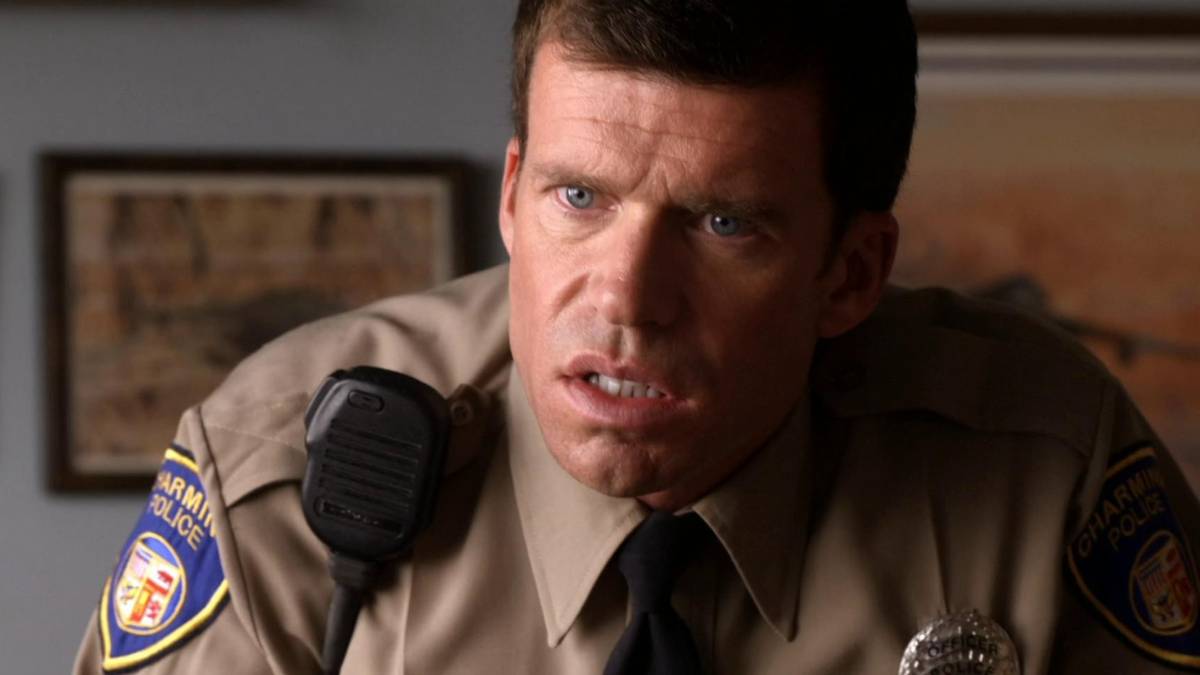
Instead of the vast, open landscape, the gritty crime drama moves its narrative to the claustrophobic, urban landscape of Charming, a quaint little town in the Central Valley of Northern California, between Stockton and Lodi. In doing so, it updates traditional themes of westward expansion to reflect modern anxieties, economic struggles, and community decay. Furthermore, in place of the traditional idea and expectation of civilization expanding into a wild frontier, Sons of Anarchy reverses that and inverts its borders, placing lawless bikers at the top of the law in a small, sheltered town fighting with all its might against encroaching threats. There is a police force in Charming, but they know it’s in their best interest to work with the Sons, not against them. There are law enforcement officers who try, though, and it’s fascinating that one of the first is portrayed by Taylor Sheridan.
In using SAMCRO (Sons of Anarchy Motorcycle Club Redwood Original) as the antagonistic archetype, the show further subverts the Western genre by placing the anti-hero as the community protector. SAMCRO is a morally bankrupt yet protective entity echoing traditional Western notions of lawmen, but in inverting them, the club enforces its own violent, illegal, and often selfish justice, all in the name of protection and preservation. They’re adamant about keeping their town drug-free, and they enforce that with threats backed up by violence. They’re shields against threats, and when local law enforcement fails, SAMCRO intervenes to protect themselves and Charming’s citizens.
Sons of Anarchy’s use of a self-contained world where the rule of law always yields to the rules of nature allows the club to operate like a governance and justice system, much like the whole sheriffs-versus-outlaws aspect of the classic Western. It also redefines the idea of violence with consequence by grounding its narrative in realism so brutal, it deeply alters plots and characters. Nearly every one of our main and supporting characters and plots are intensely altered in ways that force audiences to bear witness to such acts from a place of compassion, as is the case in Season 1, for example, when club officer Tig (Kim Coates) accidentally kills another brother’s wife, or in Season 5, when club president Jax Teller (Charlie Hunnam) takes revenge on the prison guard who killed club brother and best friend, Opie (Ryan Hurst). It goes without saying that fans could use — and deserve, as much as Sutter’s magnum opus does — a Sons of Anarchy revival.

The 55 Best Westerns of All Time, Ranked
Reach for the sky!

Sons of Anarchy also uses the Western framework to critique and redefine social tensions, which are examined through the club’s functioning as, in addition to violent criminals, a parallel government. Through the lens of Western themes, the show explores how a closed, loyalist, and violent group works to maintain its autonomy against approaching modernization, corporate corruption, and law enforcement. Sutter also spotlights post-9/11 societal anxieties through gripping, gritty explorations of how different characters cope with trauma and rebellion, like, for example, how the club matriarch silently deals with her gang rape in Season 2 or how Tig deals with trauma rooted in guilt, loss, and extreme fear. Paranoia, self-defense, cynicism, and retaliation reign supreme.
While classic Westerns feature clear divisions between the good guys and the bad guys, Sons of Anarchy does the opposite. The show intentionally blurs the lines between good and evil, right and wrong, to allow for more moral ambiguity than audiences can stand. Here, the protagonists are the outlaws, and everyone engages in violence and illegal activities. This forces viewers to question the nature of belief and perspective, of justice and survival, and it pushes their moral boundaries. Moreover, the show effortlessly works to deconstruct gender norms. It portrays women in a much more significant role — one with opportunity-wielding power, as is seen in key characters Gemma Teller Morrow (Katey Sagal), club matriarch, mother to Jax, and center of one of the show’s darkest storylines, and Tara Knowles Teller (Maggie Siff), Jax’s old lady. Unlike in traditional Westerns, the women in this gritty crime drama often control the narrative and the men, which turns out to be crucial in a crumbling patriarchal organization.
By using a modern-day outlaw motorcycle club in small-town America to explore themes that, before the 21st century, were predominantly reserved for depictions of the Old American West, Sutter allowed for an updated type of neo-Western to emerge, and it has, by far, been the grittiest, most riveting to date. Sons of Anarchy ultimately updated so much about traditional and neo-Western classic tropes, it became the impetus for future hits like Justified, Yellowstone, and the highly anticipated, upcoming Marshals, and it remains one of television’s most bingeable shows and the best, grittiest modern-day Westerns to date.
Sons of Anarchy is available to stream in its entirety on Hulu in the U.S.

- Release Date
-
2008 – 2014
- Directors
-
Paris Barclay, Guy Ferland, Gwyneth Horder-Payton, Peter Weller, Billy Gierhart, Kurt Sutter, Stephen Kay, Adam Arkin, Paul Maibaum, Phil Abraham, Terrence O’Hara, Allen Coulter, Charles Haid, Charles Murray, Karen Gaviola, Mario Van Peebles, Michael Dinner, Seith Mann, Tim Hunter
- Writers
-
Dave Erickson, Misha Green, Liz Sagal, Regina Corrado, Mike Daniels, Kem Nunn, Roberto Patino, Gladys Rodríguez, Peter Elkoff, Marco Ramirez, James D. Parriott, Julie Busher, Pat Charles, Stevie Long, David Labrava, Vaun Wilmott
- Franchise(s)
-
Sons Of Anarchy