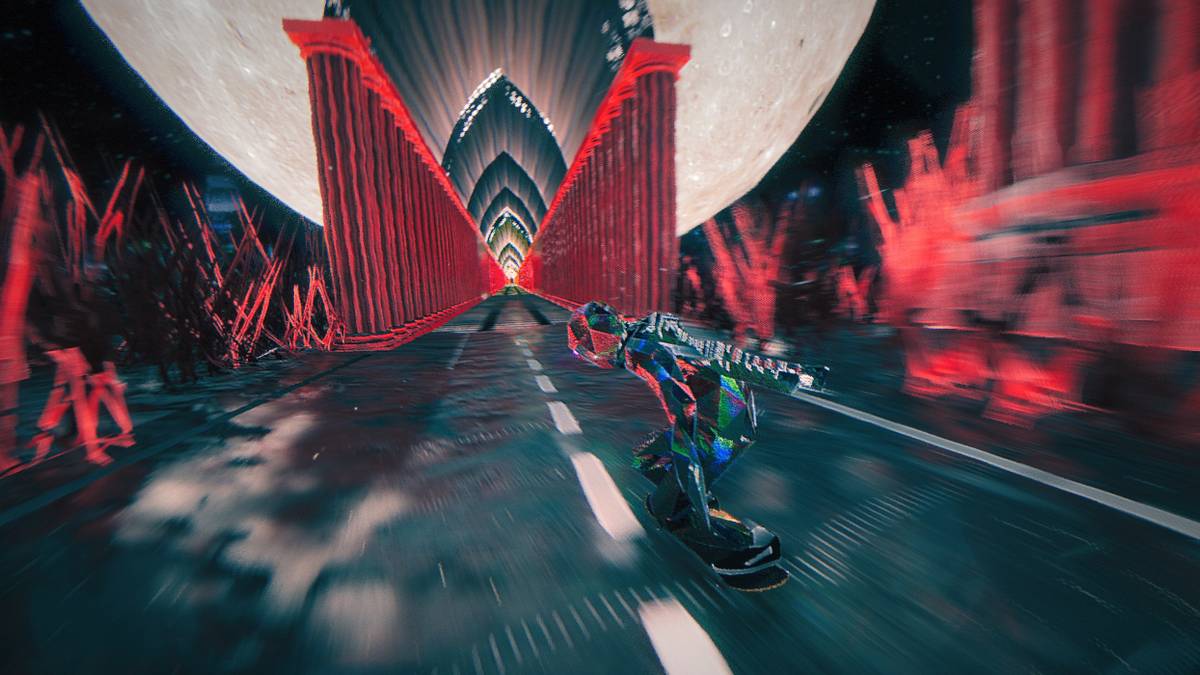

Skate Story might be a surreal skate sim, but its engine is solid as a board. After years of development delays, Sam Eng’s sublime paean to the pastime was worth the wait, blending a vaporwave VHS aesthetic and dreamlike dialogue with satisfying skateboarding fundamentals.
The bulk of the challenge here is self-directed, but the tactile feel and function of your glass avatar rolling over countless spectacles of delirious neon geometry is a winning combo, manifesting a transportive Zen-state skate experience in its finest hours.
Devolver Digital officially announced Skate Story three years ago, though the game has evolved leaps and bounds from Eng’s prior video reveals. With a massive visual upgrade from those early sneak peeks and a sensational soundscape by Blood Cultures et al. to accompany your ollies and nollies and heel-shoving whatsits, Skate Story will connect most strongly with those who prefer to eke out their own fun at their own pace, which is both its blessing and its curse.
A Demon Skater Born of Glass and Pane
Shoot for the Moon… Then Literally Eat It
This skater wants to eat the moon, a seven-word plot that summarizes the game’s marvelously meandering storytelling. As a hell-bound demon’s soul encased in multifaceted glass, you’ll glide through each chapter, splitting your time between segmented downhill sessions, free-skate open-world hubs, unusual boss sequences, and strange run-ins with maudlin underworld oddballs, including a rabbit with a secret, a plucky blue-collar frog, and even an insectile subway car.
Narrative proves vital to Skate Story’s design, with all of it crafted entirely from dream logic, often wonderfully strange and eerily heavy-handed. There aren’t any outright puzzles, but the Skater will routinely serve the interests of chatty creatures, like a pigeon in need of words to complete their café-born laptop masterpiece. Each chapter ends with a wrap-up poem that would be unintelligible had you not undertaken its preceding journey.
The overall vibes are distinct and potentially divisive, but I personally adored Skate Story’s worldbuilding fables, and they play out over such an unusual landscape and soundscape. Music and skating are both inexorably linked, and the game reliably connects its visual and aural elements in such an evocative way, the action onscreen riskily grinding on the edge of overstimulation.
Excellent Skateboard Fundamentals
Skate Story’s Wild Setting Never Overwhelms the Gameplay

If the game’s core skating gameplay wasn’t so finely tuned and felt, this experimental narrative and funky eye candy could have come off as too precious or pretentious. Luckily, the skateboarding gameplay here is nuanced, responsive, and outright exciting at certain junctures, even if there’s often no direct scoring task at hand.
I’m unsure if I’d directly hold this skating up against vérité-styled options like Session: Skate Sim, but the sound of wheels on asphalt, the shockwave ending a trick sequence with a stomp, the wiggly twist of your glass skater’s body in a revert, all these elements convincingly resonate throughout. It helps to ground Skate Story‘s otherworldly environments and themes, and it’s a pleasure to skate forward and simply go to a destination, even when you’re not restlessly chaining tricks.
There are also numerous techniques to learn, perform, and master. Tutorial explainer sessions crop up at certain junctures to help establish basic maneuvers like reverts as well as the slightly more complicated trick activations, which trigger a unique timed minigame that soon feels second-nature.
The Challenge is What You Make Of It
Skate Story is Nominally Easy, But Doing it With Style Takes Practice

When scoring requirements do appear, it’s usually in the guise of the game’s Moon bosses, which require you to chain tricks and build up a score combo, then stomp a finisher onto a target zone. Alternatively, downhill portal-hopping sessions feature objectives that unlock the way out, such as collecting symbols or catching air. Some of these sections and bosses are time-limited, presenting the game’s only occasional friction, but you’re free to spill and retry to your heart’s content endlessly.
The open-world areas often require that you complete a simple task or head to an interactive hotspot to progress. You can track down scoring objectives to accumulate more “soul” – a currency used to buy a small assortment of fun board cosmetics – but most of these options refresh endlessly, so there’s never any impetus to clear out a level.
Shops feature a few different boards, trucks, wheels, and stickers. It’s entirely possible that some of these add-ons affect the skating mechanics, but I never noticed a significant difference after swapping trucks and wheels.
Free of such requirements, I soon settled into Skate Story’s rhythms and vibe, and progress concerns fell to the wayside. I sought out NPCs for fun conversation, scoped out the best skate targets, and just explored each chapter at a leisurely pace. Note, however, that the game sorely lacks half-pipes and bowls, neither of which appears in a single quest, a gigantic missed opportunity in my estimation.
A Skateably Solid Hellish Dreamworld
Skate Story Features A Few Rough Edges, But There’s Barely Any Penalty for Failure

Skate Story’s gleaming hallucinatory aesthetic is almost always pleasing to the eye and highly readable, even with its vaporwave-coded kaleidoscopic scenery (with just the smallest sensory-assault-styled tang a la Cruelty Squad). Its soundtrack is one of the year’s best, a mix of nu-soul, synthwave, and other genre blends that magnetize to skateboarding and synergistically connect the entire package, especially during select encounters.
I did note a few minor issues and bugs. Sometimes a portion of the floor wouldn’t register correctly as a safe landing, other times the sound of my wheels on coarse asphalt would repeat ad infinitum ever after, even when I wasn’t moving. Two whole sections of my game cycled and reset, which I first thought was some brazen artistic choice, but a complete restart snapped them back to normal.
While not a bug per se, Skate Story’s autosave is outright relentless. Landing tricks accumulates more soul currency, so it’s nice that the game is always noting this down as you go, but it was a little unnerving to have a save alert in the top-right corner, machine-gunning through the whole experience.
Zen and the Art of Hell-Skating
Skate Story Is A Singular Skate Sim, Though It’s Missing Some Bells and Whistles

It would be wrong to call Skate Story a pure “art game,” but I do wonder if players will find its abstract narrative and occasional lack of urgency too wayward. There’s a clear quest and set of goals laid out, but the open-world chapters can feel as brief as you want them to be, and it could be an easy game to speed-run (while missing a lot of good content).
I see this as intentional, though. To put it succinctly: behind its galaxy-warping visuals, Skate Story is a game about play. Some attach to skateboarding for its competitive potential, but it’s also about enjoying the environment, testing abilities, and teasing adrenaline. It’s about loitering as much as it is about achievement, and Skate Story celebrates this paradox.
This does make the absence of a pure skate park/sandbox mode an issue, let alone the lack of a stage-select. Some of the game’s scenarios are good enough to warrant a second attempt, and it’s surprising that, at launch, we basically get a straight-up story mode with no extra goodies. The demo is a perfect commitment-free vibe-check if you’re on the fence, but I think Skate Story successfully claims a critical corner of the modern skate gaming niche.

Skate Story
Systems


8/10
- Released
-
December 8, 2025
- Developer(s)
-
Sam Eng
- PC Release Date
-
December 8, 2025
- Xbox Series X|S Release Date
-
December 8, 2025
- PS5 Release Date
-
December 8, 2025
Pros & Cons
- A beautifully surreal aesthetic that somehow never overwhelms the experience
- Rock-solid skateboarding fundamentals, more of an outright skate sim than the arcade experience screenshots may imply
- Outstanding soundtrack that renders every part of the game moreish
- A zen-state skate experience with little that compares
- Notable lack of stage-select, post-game content, and other missing skate-game essentials
- Generally easy to a fault, even though the game feels deliberately designed for you to find your own fun
- A few bugs and rough edges, which can be hard to parse amidst the haze of the aesthetic