When Stefan Merrill Block’s two daughters were born, they had, he says, ‘beautiful, blonde, fluffy hair’. It was the same sort of hair that Block had had when he was young. Now, the 44-year-old novelist’s children are five and eight and their hair has turned brown as they’ve aged. Block remembers watching this shift. ‘I felt a sadness over the loss of those sweet first years, but also a lot of joy. I thought, you know, be yourself.’
It doesn’t sound hugely consequential, a child’s hair getting darker – but it was for Block. When he was nine years old, and his own hair had changed from blond to brown, his mother decided to colour it. She started with a lightening spray and, when that only turned things orange, she covered his head with hydrogen peroxide. Block remembers the feeling of the bleach: ‘painful’, ‘itchy’, ‘excruciating’. Afterwards, his hair was bright yellow – a garish imitation of what it had been when he was born.
Block, who is speaking over Zoom from his home in New York, details this event in his book, Homeschooled. The memoir recalls the five-year period when his mother removed him, aged nine, from primary school in Texas to educate him herself.
It is a relevant story: since Covid, home-schooling has increased both in the US (by 48 per cent) and in the UK (by 136 per cent). The reasons are varied – 23 per cent of families in England say home-schooling is a lifestyle choice; 14 per cent say it’s due to their child’s mental health; 13 per cent say it’s because of dissatisfaction with school.
And it is a tangled story, too. While he was home-schooled, Block’s mother subjected him to behaviour that was plainly abusive. But, until she died of lung cancer in 2020, their relationship stayed a close one: she was tricky but she was also totally and obsessively loving.
Block’s family – his homemaker mother, therapist father and elder brother – moved from Indianapolis to Plano, Texas, when he was eight. He liked his new school but his mother became convinced it was stifling his creativity. So she pulled him out. Block’s brother Aaron was allowed to remain in formal education – the family line was that he and his father were structured people who did well in institutions. Block and his mother, meanwhile, were creative types who needed freedom.

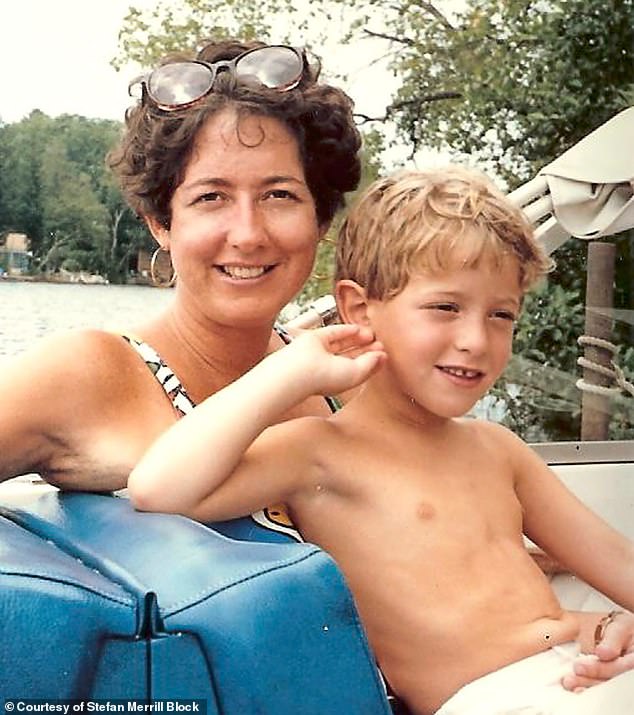
Stefan with his mother in 1987, age five. His hair started to turn from blond to brown at nine… at which point she decided to colour it using lightening spray and then bleach
Texas in the 1990s had precisely zero rules or systems to moderate home-schooling, and Block’s days with his mother were often spent doing very little. Sometimes they went to libraries to read and write stories, but sometimes they spent entire afternoons shopping in TK Maxx. A lot of the time Block sat in his room, alone – watching sitcoms, visiting internet chatrooms, pressing the needle of a compass into his hip until he drew blood.
He rarely saw other children besides his brother, meaning his mother became both his educator and entire social life. She could be confusing company. When Block was 12, his mother became convinced by a study that said crawling improved fine motor skills. His handwriting was bad, so, in an effort to improve it, he was made to crawl. For months Block moved around his house like an infant; his palms and knees became scored with carpet burns.
It seems obvious that someone should have seen what was happening to Block and stopped it. But reality was thornier. At home, his mother was characterised as eccentric but adoring. No one, including Block, thought that what she was doing was abuse.
Today he thinks his mother’s rationale was unclear. By being made to crawl, Block was, ‘literally being infantalised’ but says: ‘I don’t think that my mother would ever have, on any conscious level, been like, “I was so much happier when Stefan was crawling [as a baby].”’
When he was 14, Block asked to rejoin school. His parents agreed but his mother made him wheel around a filing cabinet instead of using a backpack and, because his handwriting was still poor, she got him a 1980s typewriter rather than a notebook and pen.
He wonders, again, about her motivations. ‘I think she was worried about my handwriting being a liability.’ Block pauses. ‘But, you know, there’s another way of looking at it, which is that it’s so obviously going to be social poison, that it almost feels deliberate – like it was a trap she was sending me into.’ She wanted him to fail at school. ‘She wanted me to stay at home.’

Stefan today. Realising his childhood had been strange happened slowly, ‘by degrees’, he says

Mother and son in 2006, when he was 24… despite everything, Block says he is not entirely against home-schooling
Block left Texas for New York when he was 19 and remained close, in a complicated sort of way, to his parents. Realising that his childhood had been strange happened slowly, ‘by degrees’.
When I ask if he forgives his mother, he says yes. ‘She had been suffering, too.’ She was misdiagnosed with polio as a child and had a deep mistrust of institutions; she was sexually assaulted at university; her father drank too much; in her later life she drank heavily herself. ‘Forgiveness is automatic. What’s harder for me is to not be forgiving. What’s harder for me is to hold on to anger. To hold on to the truth that this was wrong.’
After his mother died, Block, his father and brother could be more honest with each other. ‘We had this code of silence around the topic of my mother for her whole life. And it was only as she was dying that the first cracks in that started to appear.’
Still, he was worried to show them the first draft of his book. Especially his dad. ‘The idea of it was so upending to our family structure.’ Block’s father called him after finishing every chapter. ‘He was shaken. He was surprised, but he was also deeply empathetic.’
He adds: ‘I don’t want to speak for my dad, but he told me, after reading it, he wished he had done more to help [me] in that situation. But he trusted [my mother], her decisions and her opinions and just thought that she knew what was best.’
How does he think his mother would have reacted to the book? ‘I don’t think it’s an exaggeration to say that she probably would not have survived this book. I was so central to the story that she told herself of her own life. And those [home-schooling] years were so happy and so critically important for her. The thought that what I was experiencing I was receiving as isolation and abuse, that would have been so painful to her.’
Today Block is not entirely against home-schooling. For some children – those with special needs who aren’t getting support at school, those who are bullied – ‘home-schooling can be a wonderful refuge or a temporary measure’. But, ‘there have to be checks on socialisation, on academic competency, on physical and psychological wellbeing’. (In Block’s native Texas, home-schooling rules have barely changed from the 1980s: ‘there’s essentially no oversight whatsoever’.)
Still, children need to be around other children. ‘When I think about what happened in my childhood, I think there were moments that appear abusive in a physical way. But the most painful thing that happened to me was the isolation,’ he says. ‘I remember the loneliness of those years so acutely.’
Block and his wife have sent their own daughters to school: the younger to a small nursery and the elder to a big state primary. With the latter he was, like all parents, nervous for her first day – ‘but she loved it, she fitted right in’.
He attends every school event and, recently, he found himself ‘brought to tears’ watching a Halloween parade, his child dressed up in a costume, waddling along with her classmates. ‘I am reliving what I didn’t get through watching her,’ he says. ‘And I am so happy for her.’
Homeschooled by Stefan Merrill Block is published by Wilton Square Books, £18.99. To order a copy for £16.14 until 8 February, go to mailshop.co.uk/books or call 020 3176 2937. Free UK delivery on orders over £25.